


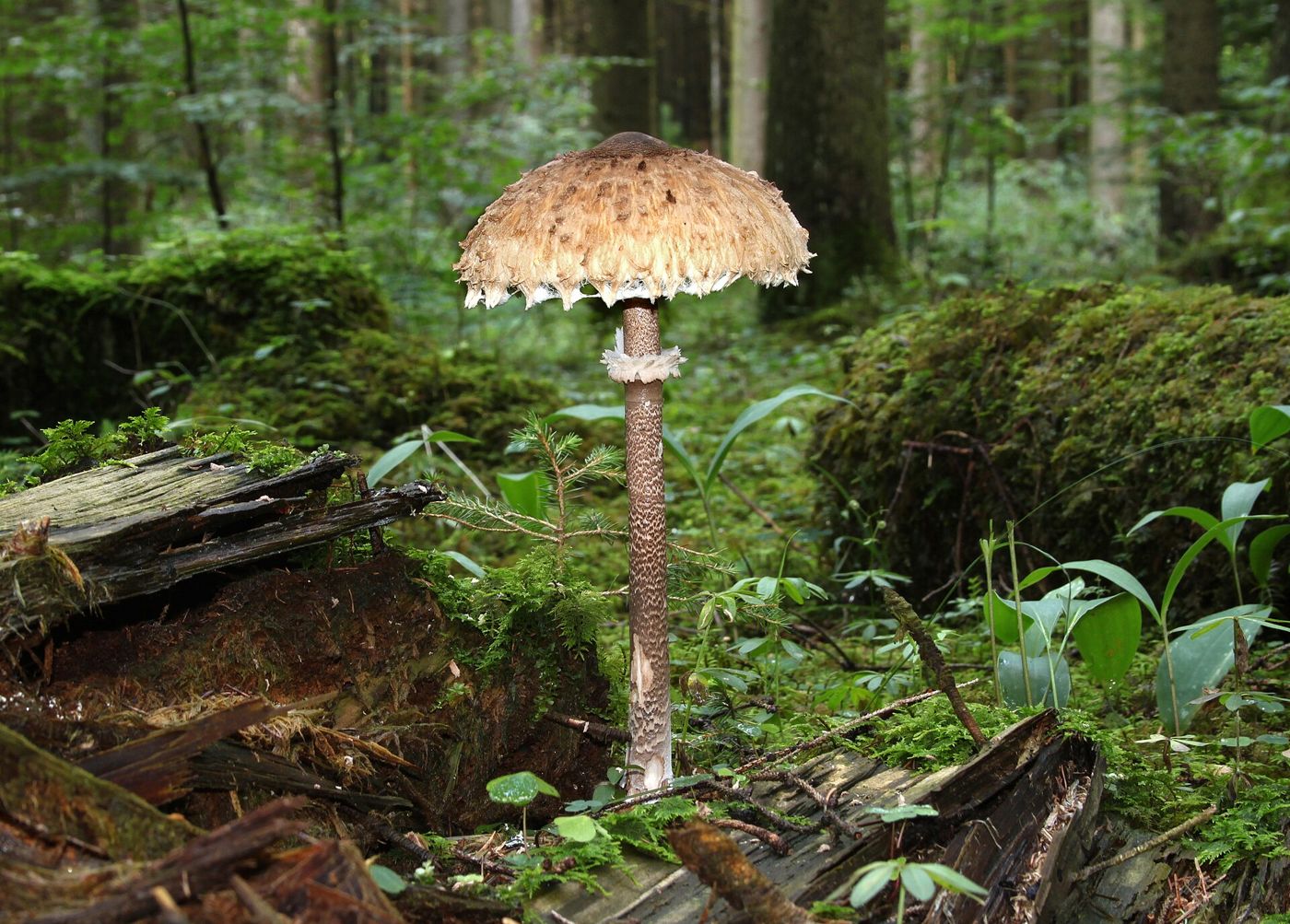
The true parasol mushroom, known scientifically as Macrolepiota procera, is one of the most striking fungi found in temperate landscapes across Europe, North America, and parts of Australasia. In mature specimens, the cap expands into a wide, slightly domed circle that can reach over ten inches across, perched atop a tall, fibrous stem that resembles an opened umbrella. Fresh caps feature a pale buff or cream background covered in coarse, brownish scales that break apart as the mushroom expands, leaving a smooth, darker central bump known as an umbo. Beneath the cap, the gills are white to creamy buff, crowded, and completely free from the stem, which means they do not touch the stalk directly. The stem itself is hollow, tough, and marked by a distinctive brown zigzag or snakeskin pattern beneath a thick, double-edged ring that can often be slid up and down like a bracelet.
Parasols are saprotrophic fungi that break down decaying plant matter in the soil, making them common inhabitants of open, sun-warmed grassy habitats. Foragers frequently encounter them in pastures, meadows, unfertilized lawns, golf courses, open glades, and along woodland edges and grassy verges. They tend to emerge from late summer through the middle of autumn, usually flushing several days after substantial soaking rains when the ground remains warm. While young specimens emerge as compact, drumstick-shaped buttons, they expand rapidly over a day or two into their classic wide-brimmed form. Understanding their growth habit is vital because immature specimens are far easier to confuse with completely different, hazardous species.
The greatest danger when seeking parasol mushrooms comes from confusing them with toxic look-alikes, foremost among them the green-spored parasol (Chlorophyllum molybdites). Also known as the false parasol or vomiter, this species is the single most frequent cause of mushroom poisoning in North America and causes severe gastrointestinal distress lasting for days. While young specimens of Chlorophyllum molybdites look nearly identical to true parasols with their scaly caps and large rings, their gills gradually turn a pale olive or greyish-green as their spores mature, and their stems lack the dark snakeskin pattern of Macrolepiota procera. Taking a spore print on white paper is a critical field technique, as Chlorophyllum molybdites produces a unmistakable dull green spore deposit, whereas true parasols produce a pure white or cream print.
An even more dangerous risk involves tiny relatives in the Lepiota genus, commonly called dapperlings, such as Lepiota subincarnata and Lepiota brunneoincarnata. Several dapperling species contain deadly amatoxins, the exact same cellular toxins found in the notorious death cap (Amanita phalloides), which cause catastrophic liver and kidney failure. While mature parasol mushrooms are very large, young parasol buttons can be small, and inexperienced observers sometimes assume any scaly-capped mushroom with a ring must be a parasol. Foragers must also be aware of the shaggy parasol group, including Chlorophyllum rhacodes and Chlorophyllum brunneum, which feature abruptly bulbous bases and flesh that quickly turns reddish-orange when bruised or cut, a reaction that causes unpleasant stomach upset in sensitive individuals.
Persistent folk rules often lead foragers astray, and relying on them can be fatal. Old myths suggest that poisonous mushrooms always tarnish silver cutlery, smell foul, peel cleanly, or are avoided by insects, slugs, and wild animals. In reality, toxins like amatoxins have no bitter taste, silver spoons remain unchanged regardless of fungal chemistry, and wildlife routinely feast on fungi that are lethal to humans. Furthermore, cooking or boiling will not neutralize amatoxins or the gastrointestinal toxins found in false parasols. If anyone suspects that someone or a pet has ingested an unidentified wild mushroom, do not wait for symptoms to develop; call poison control or emergency medical services immediately and preserve the remainder of the specimen in a paper bag for identification.
Because popular wild mushrooms share so many traits with poisonous relatives, accurate identification requires evaluating every anatomical detail in person. Only a qualified mycologist who can examine the physical specimen directly can reliably confirm its identity. When documenting a find in the field, photograph the surface of the cap, the gill attachment beneath, the presence and mobility of the stem ring, and the intact base of the stem unearthed from the soil. The Shroomly app can analyze these clear images to suggest probable species, highlight key diagnostic traits, and alert you to dangerous look-alikes in your region, giving you the detailed information you need to consult local experts safely.