


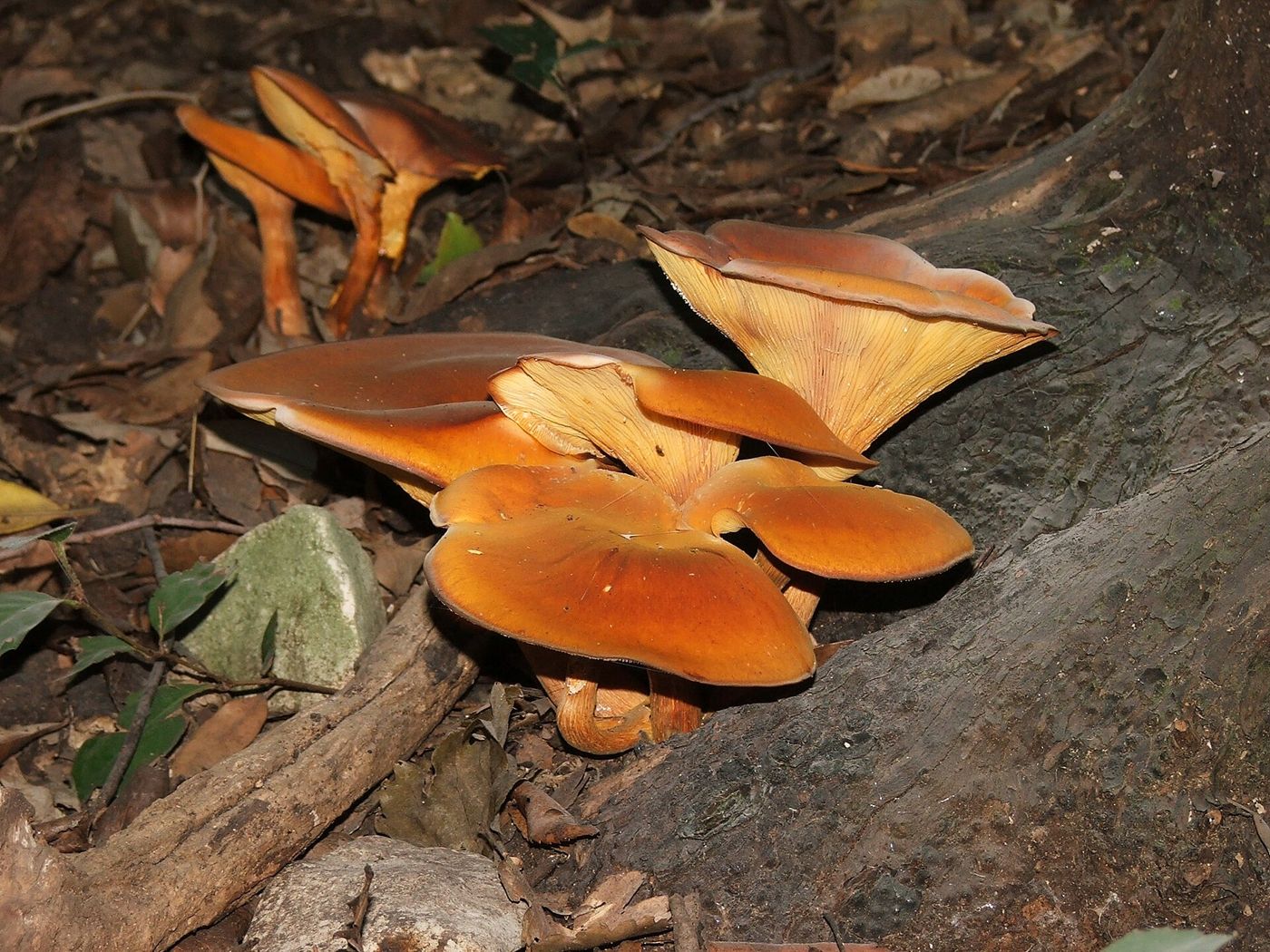
Orange is one of the most eye-catching colors in the woods, and it brings in a steady stream of questions: what is this orange mushroom, and is it dangerous? The honest answer is that orange is not a useful group on its own. Many unrelated fungi share warm yellow, apricot, rust or pumpkin tones, from chanterelles and jack-o'-lanterns to bracket fungi on tree trunks and small cup fungi on bare soil. Color shifts with age, rain, sunlight and even the camera's white balance, so treat it as a starting clue at most. Matching a few structural features is what separates one orange mushroom from another.
Start underneath the cap, because this one observation removes many candidates. True gills are thin, blade-like plates that break cleanly when touched. Chanterelles (Cantharellus species) have false gills instead: blunt, shallow, forked ridges that run down the stem and look more like wrinkles melted into the flesh. Boletes have a spongy layer of pores. Chicken of the woods (Laetiporus species) has tiny pores on the underside of shelf-like brackets. Orange peel fungus (Aleuria aurantia) has no cap at all, just a bright orange cup sitting on bare soil or gravel. Our guides to true versus false gills and to pores versus gills cover these structures in more detail.
Next, look at how and where it grows. Jack-o'-lantern mushrooms (Omphalotus olearius in Europe and Omphalotus illudens in eastern North America) usually grow in dense clusters from wood, though the wood may be buried roots that make them seem to rise from soil. They have true, sharp-edged gills that run down the stem. Chanterelles more often grow singly or scattered from soil near trees they partner with. The false chanterelle (Hygrophoropsis aurantiaca) has crowded, repeatedly forked, true gills that are often a deeper orange than the cap, and it commonly appears on conifer litter or rotting wood. Spectacular rustgill (Gymnopilus junonius) forms large golden-orange clumps on stumps and roots and drops a rusty brown spore print, which a chanterelle never does.
The orange mushroom with the most serious consequences is not a showy one. The deadly webcap (Cortinarius rubellus) and the fool's webcap (Cortinarius orellanus) are tawny to rusty orange-brown, often in moss under conifers, with a faint cobweb-like veil (cortina) when young and rusty brown spores. They contain orellanine, which can cause kidney failure, and symptoms may not appear for days or even weeks after the meal, so the link to the mushroom is easily missed. Jack-o'-lanterns are not usually deadly but cause severe vomiting and diarrhea, and false chanterelles are known to upset some people. Because several of these grow in the same woods and seasons as chanterelles, mistakes are common.
A spore print is one of the most reliable ways to split orange species into groups. Leave the cap gill-side down on white and dark paper for several hours. Rusty or orange-brown deposits point toward Gymnopilus or Cortinarius, while pale cream to whitish prints fit chanterelles, jack-o'-lanterns, false chanterelles and many others, so a pale print narrows things down without proving anything. Also note the flesh when cut, any smell, whether it bruises, and whether milky latex appears: the saffron milk cap (Lactarius deliciosus) is orange with a zoned cap and orange milk that slowly turns green.
Be wary of shortcuts. Bright colors do not mean poisonous, and dull colors do not mean safe. Folk tests like peeling the cap, tarnishing a silver spoon, a pleasant smell, or seeing slugs or squirrels eat a mushroom tell you nothing about human toxicity, and orellanine is not destroyed by cooking. Even a perfect match on five features is not proof of edibility. Only an experienced expert who has examined the actual specimen can confirm what it is, and some toxic orange species closely resemble popular edible ones. If anyone may have eaten a wild orange mushroom, call poison control or emergency services immediately and keep a sample of the mushroom; do not wait for symptoms.
If you have found an orange mushroom and want to know what it is, good photos make all the difference. Photograph the top of the cap, the underside clearly enough to show gills, ridges or pores, the full stem, and the very base where it meets the soil or wood, plus a shot of the surroundings and a cut cross-section if you can. Shroomly can use these images to suggest likely species and flag toxic look-alikes such as jack-o'-lanterns and webcaps, giving you a strong starting point. Treat that result as a lead rather than a verdict, and confirm any identification with a local mycological society or an experienced expert who can examine the mushroom in person.