


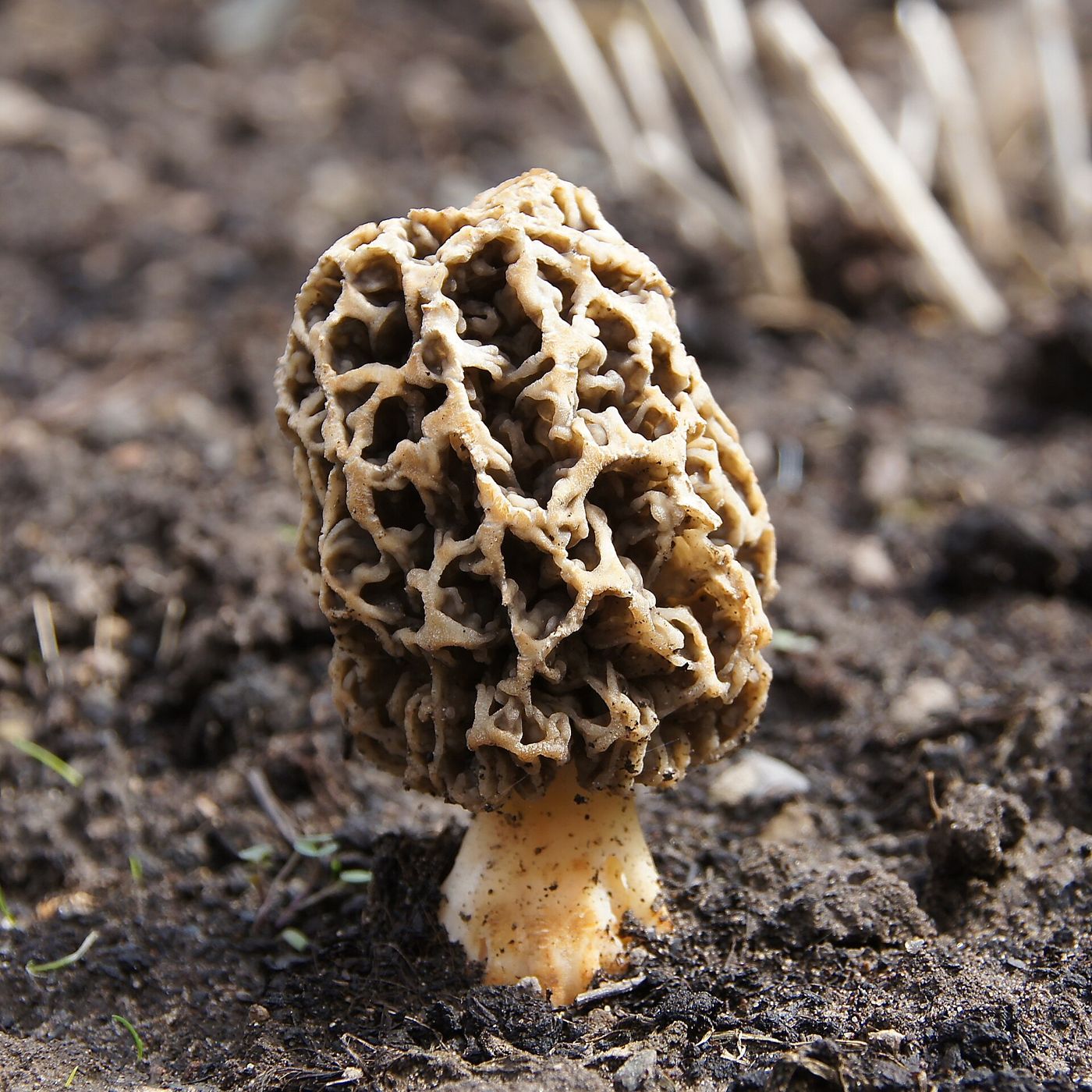
Morel mushrooms, belonging to the genus Morchella, are among the most celebrated wild fungi in the temperate world. Their arrival each spring signals the start of the foraging season across North America, Europe, and parts of Australia and Asia. Because morels do not have traditional gills, pores, or teeth underneath their caps, beginners often assume they are unmistakable. However, successfully identifying true morels requires understanding their specific anatomy, their exact seasonal windows, and how to separate them from toxic species that fruit in the exact same habitats.
The defining physical characteristic of a true morel is its cap, which resembles an intricate honeycomb or a sponge composed of intersecting ridges and hollow depressions. Depending on the species and stage of development, morels can vary in shade from pale blonde and yellow (such as Morchella esculenta and Morchella americana) to tan, grey, or charcoal black (such as Morchella elata and Morchella angusticeps). Unlike cap-and-stem mushrooms whose caps rest like umbrellas on top of their stalks, the cap of a true morel is continuously fused to the stem along its lower margin, creating a single integrated structure rather than a loose skirt.
The most critical structural test for any morel is examining its interior. When sliced cleanly in half from the tip of the cap down to the base of the stem, a true morel reveals a completely hollow central chamber. There should be no cottony pith, fibers, separate compartments, or solid flesh inside the hollow column. The interior wall is typically pale, smooth, or slightly granular. This single, open cavity is one of the most reliable diagnostic markers distinguishing true morels from deceptive impostors, and slicing every specimen lengthwise is an essential habit for anyone studying these fungi.
Morels are strictly seasonal, appearing for only a few brief weeks in the spring when soil temperatures reach roughly fifty degrees Fahrenheit or ten degrees Celsius. They form mycorrhizal or saprotrophic relationships with particular trees, often emerging near dead or dying American elms, mature ash, tulip poplars, and untended apple orchards. In western North America, specific black morel species produce prolific flushes across coniferous forests that were burned by wildfires during the preceding summer. Moisture is equally vital, meaning the heaviest fruitings typically occur several days after gentle spring rains follow unseasonably warm afternoons.
Several unrelated fungi can be mistaken for morels, some of which contain severe toxins. False morels in the genus Gyromitra, such as Gyromitra esculenta, have convoluted, wrinkled, or brain-like lobes rather than distinct honeycomb pits, and slicing them reveals chambered or solid interiors rather than a single hollow void. Gyromitra species contain gyromitrin, a compound that metabolizes into monomethylhydrazine, a potent toxin that damages the liver and nervous system and can prove fatal. Another common look-alike group is the genus Verpa, often called early morels or thimble morels; their wrinkled caps attach only at the very top of the stalk, leaving the bottom edge hanging completely free like a thimble on a finger, with stems stuffed with soft fungal fibers. Folk tests, such as relying on an earthy smell, checking whether wildlife has nibbled on the mushroom, or assuming that thorough boiling renders every wild mushroom safe, are dangerously unreliable and must never replace precise anatomical study.
Because potentially dangerous look-alikes fruit alongside true morels in the spring, accuracy is paramount before reaching any conclusions about a wild specimen. If you discover a pitted fungus in the woods, document the mushroom in its natural habitat, take sharp photos of the cap pits, slice the mushroom in half lengthwise to record the internal cavity, and photograph the base where the stem meets the ground. Running these clear images through Shroomly can help you compare your find against likely Morchella species and warn you of hazardous look-alikes like Gyromitra or Verpa. Always take your physical specimens to a local mycological society or professional mycologist for in-person verification, as only an expert holding the mushroom can definitively confirm its identity, and if you ever suspect someone has ingested a toxic fungus, contact poison control or emergency medical services immediately.