


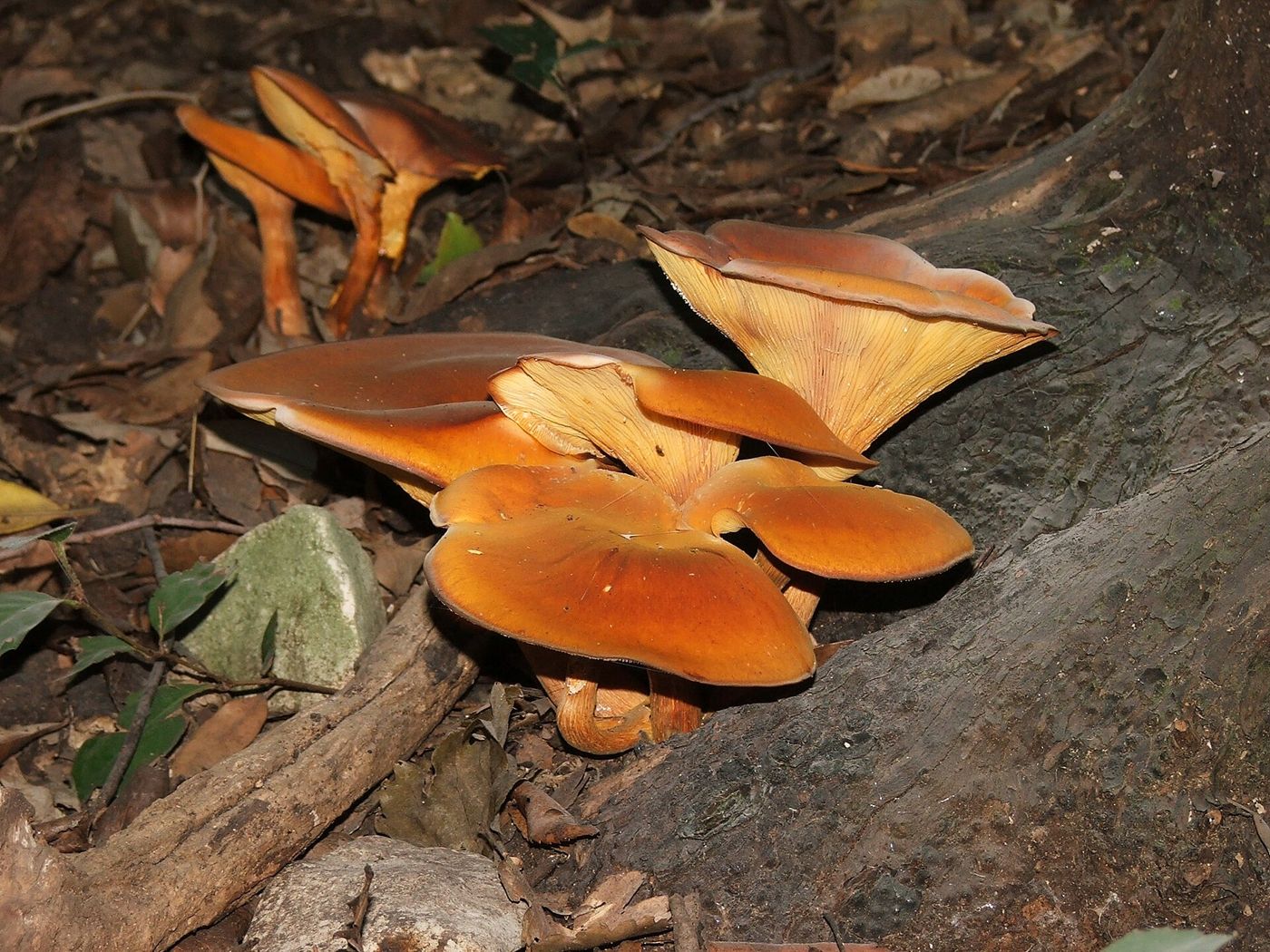
Jack-o'-lantern mushrooms belong to the genus Omphalotus, with prominent species including Omphalotus illudens across eastern North America, Omphalotus olivascens in the western United States, and Omphalotus olearius throughout southern Europe. Easily recognized by their striking, vivid pumpkin-orange or yellow-orange coloration, these fungi are famous for producing dense, overlapping clusters on or near decaying hardwood trees. They are also celebrated in popular folklore for bioluminescence, as fresh gills can sometimes emit a faint greenish glow in total darkness due to an enzyme called luciferase. While captivating to encounter in the woods, these mushrooms are seriously toxic and represent one of the most frequently reported causes of mushroom poisoning.
Recognizing a jack-o'-lantern mushroom requires examining several specific physical characteristics across the cap, gills, and stem. The caps range from deep orange to golden-yellow, starting convex with inrolled margins when young before flattening out or becoming distinctly funnel-shaped as they mature, often reaching across several inches with wavy edges. Underneath the cap, jack-o'-lanterns possess true, sharp, blade-like gills that run significantly down the length of the stem, a feature known in mycology as decurrent attachment. The stems are smooth, firm, and fibrous, usually matching the orange hue of the cap and tapering toward the base, where multiple stems typically fuse together into a tight, shared clump. When collected on paper or glass, their spore print is creamy white to pale cream-yellow.
Jack-o'-lantern mushrooms are saprotrophic, meaning their underground network feeds exclusively on dead and decaying wood. They most frequently emerge in late summer and throughout the autumn months following substantial rainfall. While they commonly fruit directly on visible hardwood tree stumps or rotting trunks, especially oaks, they frequently cause confusion by appearing to sprout directly out of forest leaf litter or suburban lawns. In these instances, the fungal mycelium is actively feeding on buried tree roots or forgotten timber just beneath the soil surface. This deceptive terrestrial appearance often leads casual observers to overlook their fundamental nature as wood-rotting fungi.
Every species in the genus Omphalotus contains harmful toxins, primarily sesquiterpene compounds known as illudins. Ingesting even a small portion of a jack-o'-lantern mushroom causes acute, distressing gastrointestinal poisoning, typically triggering violent vomiting, severe stomach cramps, profuse diarrhea, dizziness, sweating, and extreme fatigue within thirty minutes to several hours of consumption. Dangerous folk rules—such as believing that peeling the cap skin makes a mushroom harmless, that toxic fungi always smell acrid or taste bitter, or that wild animals would avoid poisonous varieties—are entirely false and have led to many serious hospitalizations. If you suspect that someone has eaten a wild mushroom, do not wait for symptoms to develop or attempt home remedies; contact poison control or local emergency medical services immediately and retain a physical sample of the fungus for professional analysis.
The primary danger of the jack-o'-lantern mushroom lies in its resemblance to popular edible wild fungi, most notably the prized golden chanterelle, belonging to the genus Cantharellus. Although both share bright orange tones and decurrent underside structures, their anatomy differs profoundly. Chanterelles grow in partnership with living trees and fruit individually or in loose troops directly from woodland soil, never in tight, fused clusters anchored to wood. Furthermore, chanterelles feature blunt, shallow, repeatedly forking ridges rather than the sharp, deep, papery blade-like gills found on Omphalotus. Because toxic mushrooms can closely mimic edible ones, never assume any wild mushroom is safe to eat based on general appearances or informal rules of thumb, as only an experienced mycologist who has physically examined the complete specimen in person can verify edibility.
Mastering wild mushroom identification relies on observing the whole organism in its environment rather than focusing on a single dramatic trait like cap color. When you find an unfamiliar mushroom, take clear, well-focused photographs showing the upper surface of the cap, the gills and their attachment underneath, and the very base of the stem where it connects to its substrate or soil. Submitting these images to the Shroomly app can quickly help you cross-reference distinguishing features, discover likely species candidates, and flag hazardous toxic look-alikes before you handle them further. Use these digital tools as an educational springboard, and always confirm findings with a regional mycological society or verified expert before drawing final conclusions.