


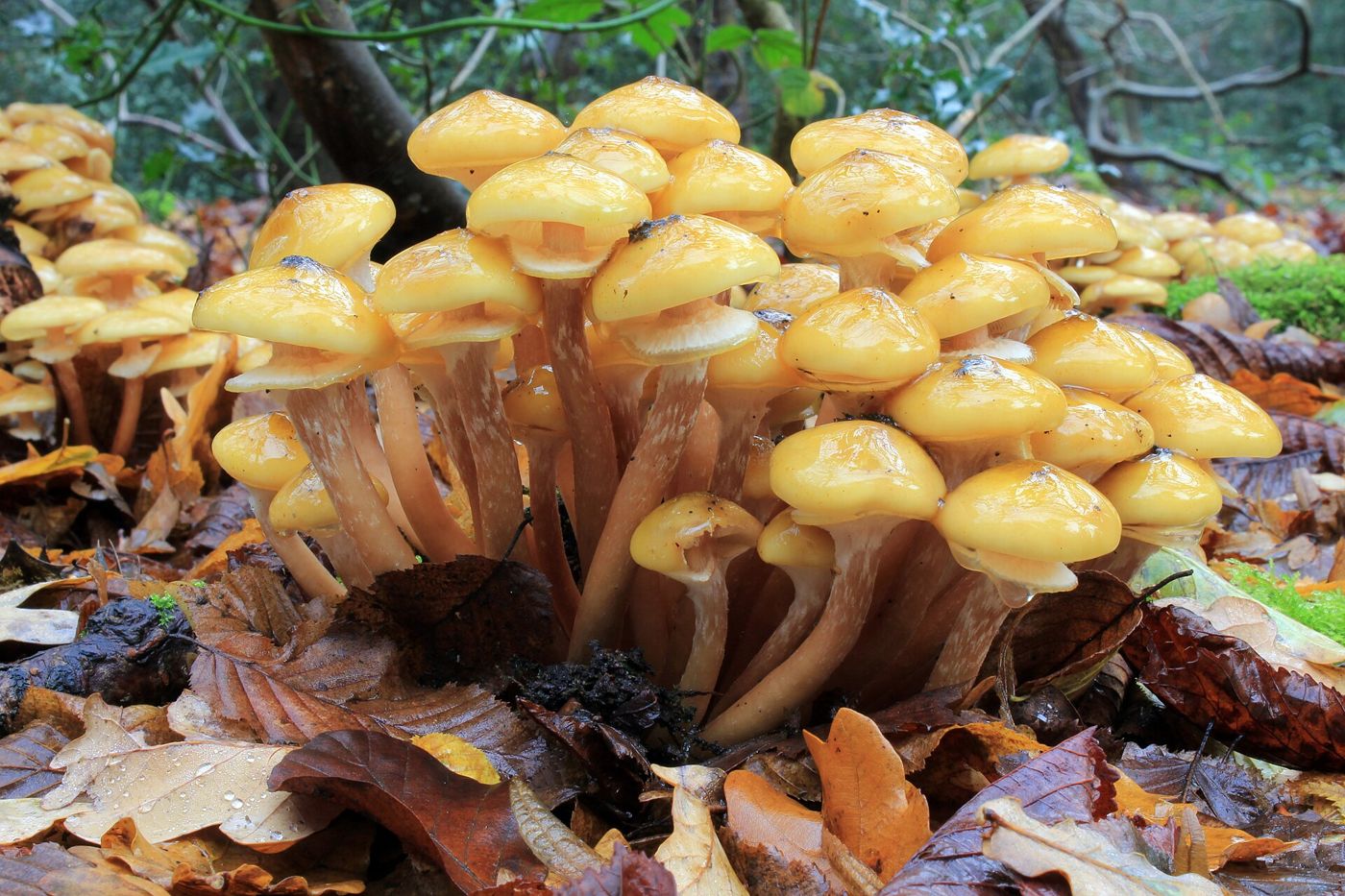
Honey fungus is the common name given to several closely related mushrooms in the genus Armillaria, most notably Armillaria mellea. Highly recognized by arborists, gardeners, and nature enthusiasts alike, honey fungus is both a vigorous saprobe that breaks down dead wood and a serious plant pathogen capable of causing white rot and root mortality in susceptible trees. Despite the sweet-sounding moniker, the name refers strictly to the golden, honey-tinted color of the caps rather than any sugary flavor or aroma. In temperate regions across the United States, the United Kingdom, Canada, and parts of Australia, these fungi are famous for producing spectacular flushes of dozens or even hundreds of overlapping mushrooms attached together at their stem bases.
Careful visual inspection of a mature honey fungus reveals several defining morphological traits. The caps typically measure between two and ten centimeters across, starting out convex with inrolled margins before flattening out with age, often retaining a slight central bump or umbo. The cap surface ranges from warm honey-yellow to dull ochre, tawny brown, or yellowish-buff, and is typically dotted with fine, dark, hair-like scales, especially concentrated near the center. Underneath the cap, the gills are whitish to creamy pink, becoming discolored or rusty-spotted as the fruit body ages. The gills are adnate to slightly decurrent, meaning they attach directly to the stem and occasionally run a short distance down it. The stem is tall, fibrous, and tough, often tapering toward the base where multiple stems fuse into a tight clump. On species like Armillaria mellea, a distinct, cottony or membranous ring encircles the upper portion of the stem, often edged with yellow or brown flakes, though some related species like Desarmillaria tabescens (the ringless honey mushroom) lack an annulus entirely.
Understanding where and when honey fungus appears is essential for narrowing down an identification. Armillaria species fruit predominantly from late summer through late autumn, often appearing suddenly following substantial rainfall when daytime temperatures begin to moderate. They are almost exclusively lignicolous, meaning they derive sustenance from wood, fruiting directly on decaying hardwood stumps, buried roots, or around the base of living deciduous and coniferous trees. When fruiting from subterranean roots, the mushrooms can appear to be growing out of bare ground or lawn grass, but digging gently at the soil surface invariably reveals hidden wood or the tough, black, cord-like fungal structures known as rhizomorphs, or bootlaces.
Because several hazardous woodland fungi also fruit in dense clusters on dead or dying wood, accurate identification requires distinguishing Armillaria from several toxic look-alikes. One of the most dangerous potential confusions is the deadly funeral bell, Galerina marginata, which contains lethal amatoxins. While funeral bells are typically smaller and possess watery brown caps with a rust-brown spore print, they frequently share the same decaying wood habitats and can occasionally grow intermingled with clusters of larger fungi. Another very common cluster-forming mushroom is the sulphur tuft, Hypholoma fasciculare, which features distinctive bright sulfur-yellow to greenish-yellow caps and gills that mature to an olive-brown or purplish-black shade, accompanied by a purple-brown spore print. The toxic jack-o'-lantern mushroom, Omphalotus illudens, also forms dense clusters near tree bases, but it displays bright orange flesh, deeply decurrent orange gills, and cream spores. Taking a spore print is a critical differentiator, as true honey fungus deposits a distinctly white to pale cream spore print, contrasting sharply with the brown, purple, or rust-colored prints of several toxic look-alikes.
Foraging for wild mushrooms carries significant health risks, and honey fungus represents a notorious challenge for gastrointestinal tolerance. Even when correctly identified by an experienced mycologist, Armillaria species are well known to cause severe nausea, vomiting, and cramping in a significant percentage of individuals, acting as a personal allergen or severe irritant. Folk wisdom and traditional tests—such as boiling a mushroom with a silver coin or spoon to detect toxins, testing if the cap skin peels easily, relying on pleasant aromas, or assuming that animal nibbling signifies safety—are completely baseless myths that have repeatedly led to critical hospitalizations. Only a trained fungal expert who has physically examined the actual, whole specimen in hand can confirm a wild mushroom's identity and edibility. In any situation where wild mushroom ingestion is followed by nausea, abdominal cramps, or any other distress, contact poison control or emergency medical services immediately, and ensure a fresh physical sample of the mushroom is preserved in a paper bag for toxicologists to analyze.
Whenever you come across clusters of mushrooms growing from a stump, fallen log, or tree base, document them thoroughly to build a reliable record for identification. Take sharp, well-lit photographs showing the cap surface, the attachment of the gills beneath, and the entire base of the stem where it meets the wood or soil. You can upload these photos to Shroomly to quickly explore probable species matches, study diagnostic traits, and review toxic look-alikes. Once you have a preliminary identification, bring your physical specimen and detailed field photos to your local mycological society or an experienced regional identifier to verify your findings safely.