


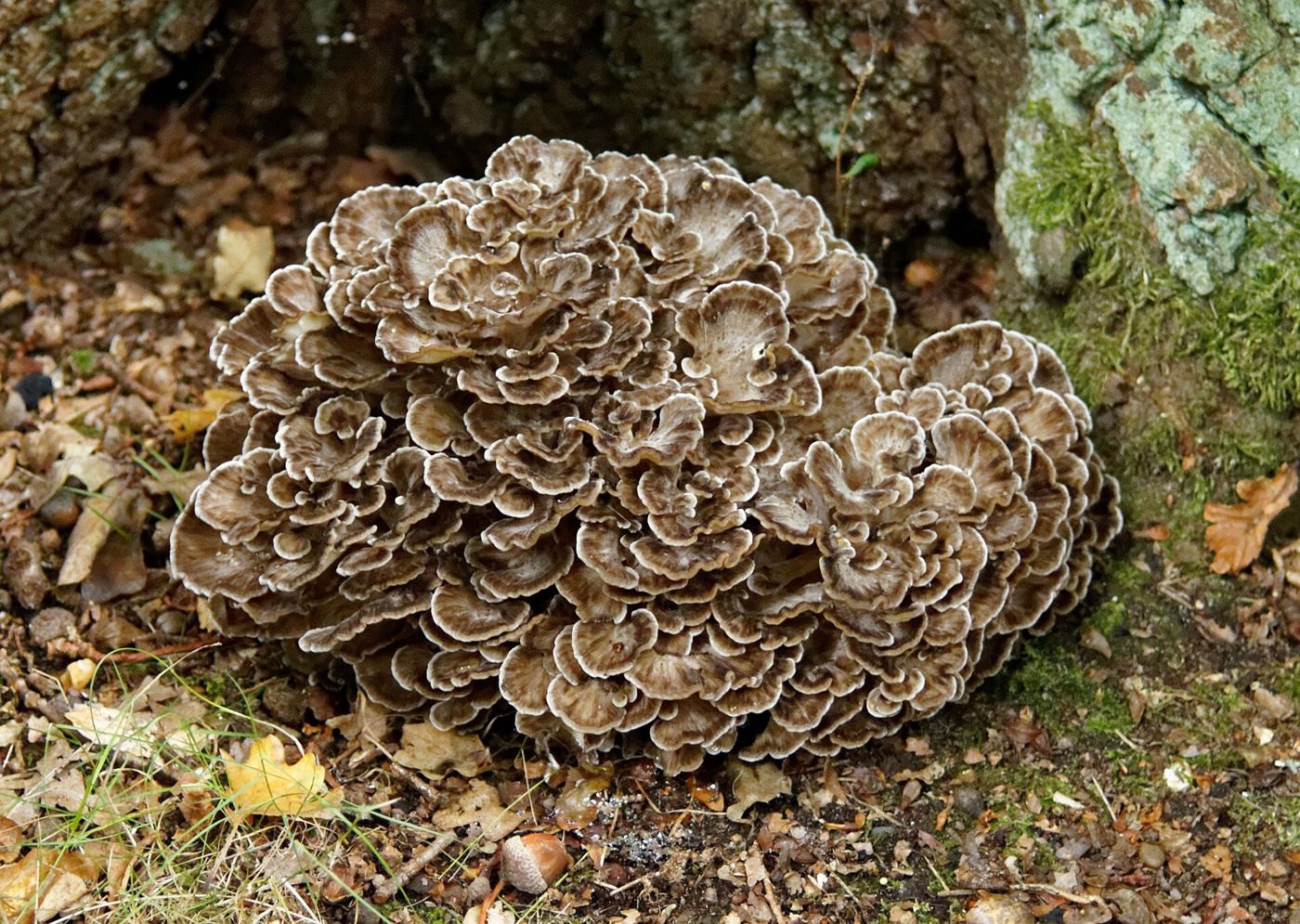
Hen of the woods (Grifola frondosa), widely known in Japan and among culinary enthusiasts as maitake, is one of the most recognizable and sought-after woodland fungi of autumn. The mushroom earns its common English name from its distinctive appearance: a large, ruffled, multi-capped cluster that looks remarkably like the fluffed feathers of a hen crouched at the foot of a tree. A single specimen can grow into an impressive rosette spanning thirty centimeters or more across, emerging from a shared central core that anchors the fungus deep into the ground or decaying root wood.
Examining the anatomy of Grifola frondosa reveals a complex branching structure. Instead of a single stem supporting an isolated cap, hen of the woods consists of dozens, and sometimes hundreds, of overlapping, spoon- or fan-shaped fronds that branch off a thick, subterranean base. The upper surfaces of these fronds range in color from pale smoky grey and beige to rich olive-brown or tan, often displaying subtle concentric bands of shading toward the wavy margins. The underside of each frond is covered in tiny, microscopic white to cream pores rather than true gills, and this pore layer runs slightly down the branched white stems. Young specimens are firm and pliable, whereas older fruiting bodies become tough, dry, and prone to mold or insect infestation.
In temperate regions of North America, Europe, and parts of Asia, hen of the woods typically fruits from late summer through the heart of autumn, usually after steady rains break late-summer heat. The fungus is parasitic and saprotrophic, causing a slow white butt rot in the heartwood of its hosts. It demonstrates a powerful preference for mature broadleaf trees, appearing almost exclusively at the base of living hardwoods or old stumps, with oaks (Quercus species) being its primary host. Because the mycelium persists inside the root system for many years, the mushroom frequently reappears in the exact same location year after year until the underlying wood is fully exhausted. It virtually never grows high up on tree trunks, which helps separate it from tree-dwelling bracket fungi.
Several other large, clustering polypores share the same woodland habitats and can cause confusion for beginners. Berkeley's polypore (Bondarzewia berkeleyi) also fruits around the base of hardwood trees, but it features much larger, thicker, and paler yellowish-white to cream caps with larger pores, lacking the fine, frilly grey rosettes characteristic of Grifola frondosa. Another common look-alike is the black-staining polypore (Meripilus sumstinei in North America and Meripilus giganteus in Europe), which produces similarly dense clusters of overlapping caps at the bases of hardwoods; however, handling or slicing the black-staining polypore causes its pore surface and cap edges to turn distinct dark brown or jet-black within a matter of minutes. While these particular polypores are not known to be deadly, confusing any wild fungus can carry serious risks.
Although hen of the woods is widely celebrated for its rich flavor and substantial texture, safety in wild mushroom identification must always come first. Dangerous folk tests, such as assuming that all mushrooms growing on wood are safe, or believing that wildlife nibbling a specimen proves its safety, are entirely false and dangerous. Toxic species, including deadly wood-rotting mushrooms like the funeral bell (Galerina marginata), thrive on decaying timber, and forest animals have digestive enzymes capable of breaking down fungal toxins that are lethal to humans. Edibility can never be confirmed by an app, a photograph, or a single checklist feature; only a seasoned mycologist who has physically inspected the intact specimen can verify whether a mushroom is safe to consume. If you ever suspect that someone has ingested an unidentified wild mushroom, contact your regional poison control center or emergency medical services immediately and retain the remaining fungus for identification.
If you encounter a promising rosette growing around the roots of an old oak tree, thorough photographic documentation is the best starting point for study. Take wide photographs showing how the mushroom attaches to the ground or the host tree, followed by clear, close-up images of the individual fronds, the color patterns along their upper surfaces, and the pore texture underneath. You can submit these photos to the Shroomly app to help narrow down candidate species and review potential look-alikes found in your area. Before making any assumptions, always connect with a local mycological society or regional expert to confirm your find safely.