


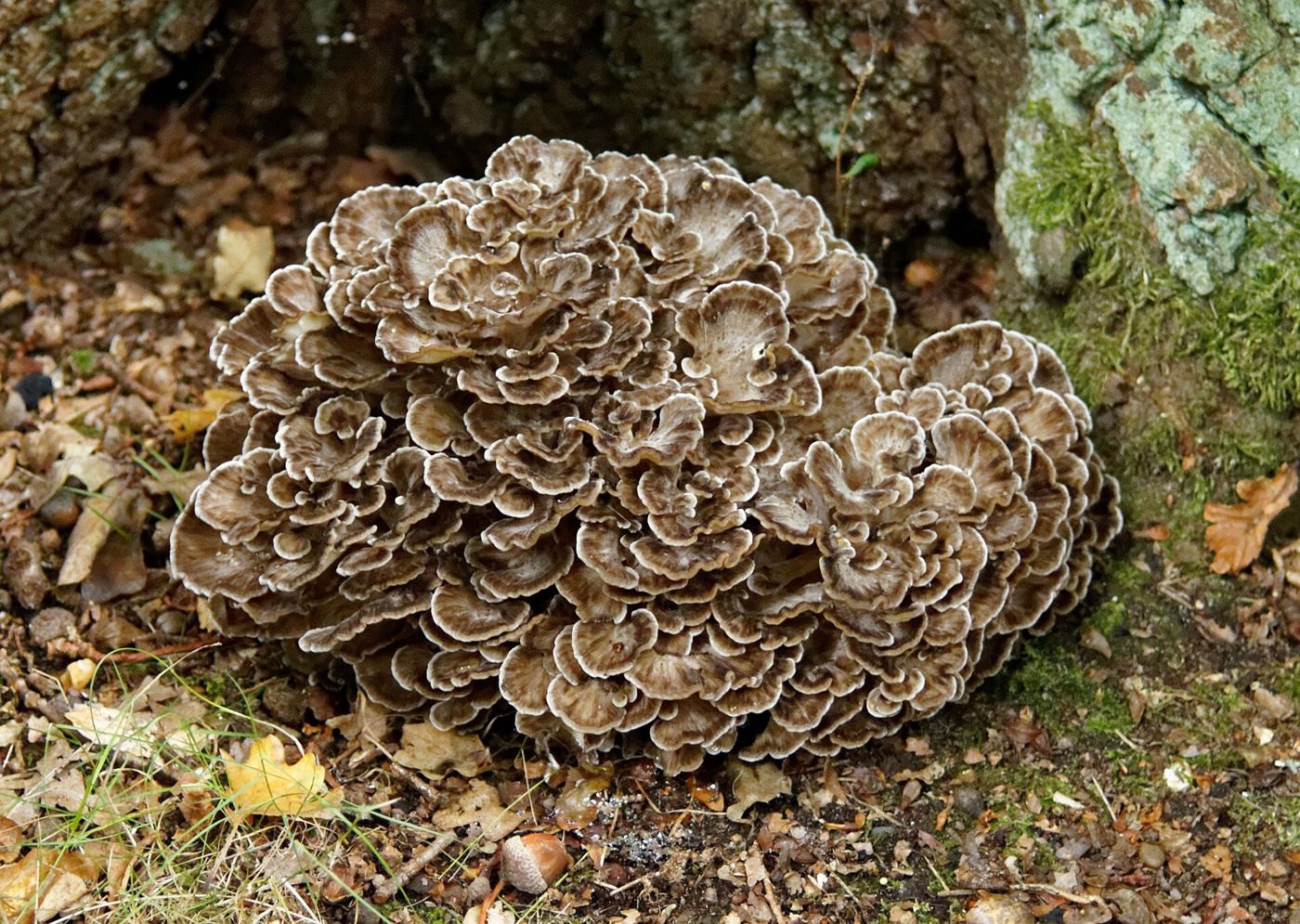
Hen of the woods, scientifically known as Grifola frondosa and frequently referred to in culinary contexts as maitake, is one of the most recognizable autumn polypores in temperate woodlands across North America, Europe, and parts of Asia. The fungus gets its common English name from its appearance, which closely resembles the ruffled plumage of a nesting hen tucked against the base of a tree. Rather than forming a conventional stem and umbrella cap, Grifola frondosa grows as a massive cluster composed of dozens, or even hundreds, of overlapping, petal-shaped fronds radiating from a thick central structure. It is parasitic and saprotrophic, causing a white rot in the heartwood of mature deciduous trees, especially oaks in the genus Quercus, and occasionally maples, beeches, or chestnuts. Foragers and naturalists typically search for it from late summer through mid-autumn, often returning to the same tree year after year as the underlying mycelium persists.
Careful anatomical inspection is the foundation of identifying Grifola frondosa accurately. Individual caps are fan-shaped or spoon-shaped, measuring anywhere from two to ten centimeters across, though the entire aggregate cluster can span well over fifty centimeters and weigh several kilograms. The upper surface of each frond is smooth to finely velvety, with subtle concentric zones of color ranging from pale smoky gray and tan to deep brownish-slate, often darkening toward the base. If you inspect the underside of the fronds, you will find a layer of tiny, circular pores rather than gills. These pores are white to pale cream when young and run slightly down the branchlets that support each frond. Crucially, the pores and flesh of a freshly picked hen of the woods do not change color rapidly when pressed or cut, remaining pale or only yellowing slightly as the mushroom ages.
Several other large woodland polypores share a similar clustered growth habit, making it essential to recognize key look-alikes. The black-staining polypore (Meripilus sumstinei in North America and Meripilus giganteus in Europe) also fruits near the bases of hardwood trees and produces overlapping rosettes, but its fronds are typically larger and leathery. Its defining characteristic is a slow, dramatic color change: when bruised, cut, or handled, its white pores and flesh turn dark brown to ink-black over the course of several minutes. Another frequent point of confusion is Berkeley's polypore (Bondarzewia berkeleyi), which forms sprawling clusters at tree bases during summer and early autumn. Berkeley's polypore differs by producing significantly larger, thicker, and paler fan-shaped caps that lack the delicate frilled appearance of Grifola frondosa, along with much coarser, angular pore mouths.
Differentiating these species highlights why relying on traditional folk tests or superficial shortcuts is dangerous when identifying wild mushrooms. Persistent myths suggest that any fungus growing on living wood is harmless, that a pleasant aroma guarantees safety, or that mushrooms nibbled by squirrels, slugs, or insects can be trusted. In reality, fungal biology does not conform to human safety rules. Wildlife possess specialized metabolic enzymes that digest toxins that are incapacitating or lethal to humans, and many severely toxic mushrooms smell pleasantly sweet or nutty. While the direct look-alikes of Grifola frondosa cause digestive distress rather than life-threatening organ failure, confusing bracket fungi with other woodland species or misidentifying poisonous gilled fungi growing adjacent to tree roots remains a serious hazard for careless foragers.
Because mushroom identification demands precise botanical scrutiny, no wild fungus should ever be eaten based solely on photographs, automated applications, or internet field guides. Even experienced foragers encounter atypical specimens, weathered fruiting bodies, or contaminated growth that can make identification uncertain. Edibility can only be verified by a qualified mycological expert who has physically handled and examined the fresh specimen in question. In the event that someone ingests an unidentified wild mushroom and begins to experience symptoms such as nausea, abdominal cramping, dizziness, or vomiting, medical help must be sought without delay. Contact local emergency services or a national poison control hotline immediately and keep a physical sample of the fungus in a paper bag for toxicologists to analyze; never wait to see if symptoms worsen, and never attempt unverified home remedies.
Building a reliable record of what you find in the woods requires thorough, multi-angle documentation. When you encounter a candidate rosette, take clear, well-lit photographs showing the entire specimen attached to its host tree, a close-up of the cap colors and margins, and a detailed macro shot of the pore surface beneath the fronds. Note whether the flesh bruises when handled and photograph the base where the fungal cluster emerges from the soil or wood. Submitting these clear images into Shroomly helps you quickly compare your find against likely polypore species and screen for known look-alikes in your region. Once the app narrows down the possibilities, always present the physical specimen to a local mycological society or professional mycologist to achieve confirmed, safe identification.