


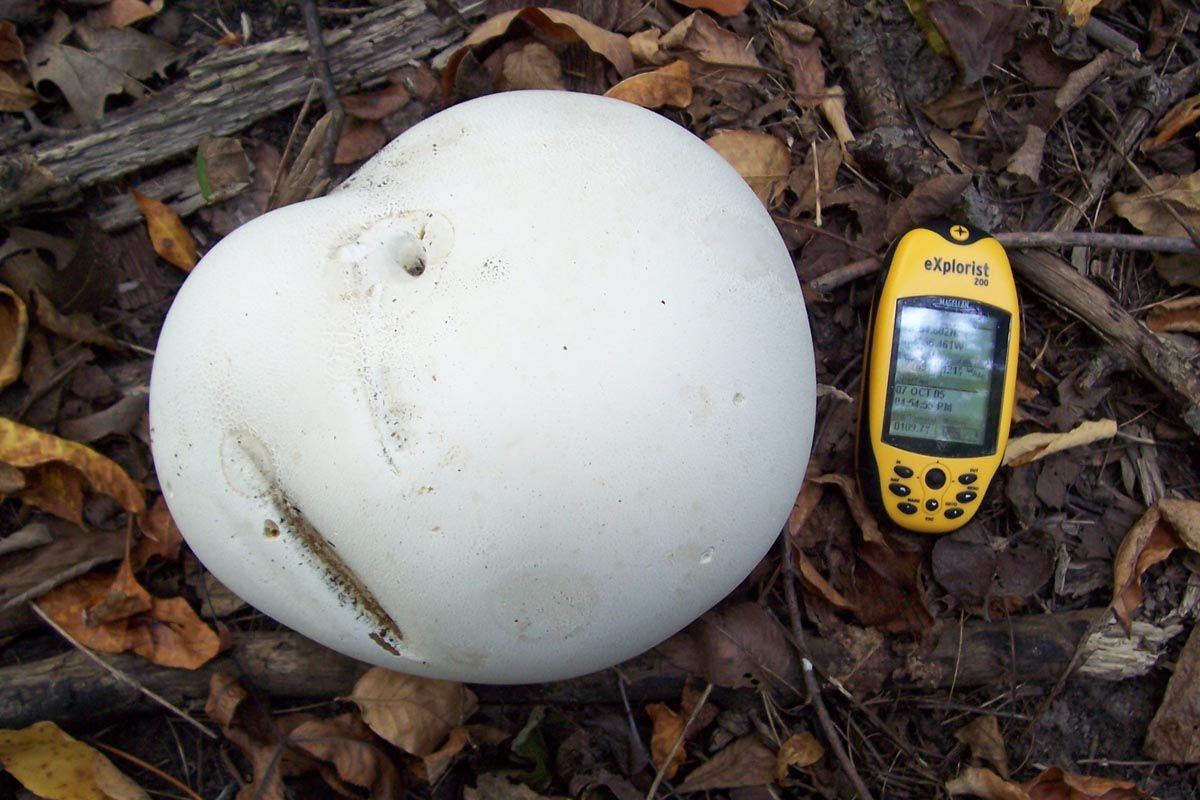
The giant puffball, known scientifically as Calvatia gigantea, is one of the most distinctive and widely recognized fungi in temperate regions across North America, Europe, and parts of Australasia. Unlike classic cap-and-stem mushrooms, a puffball produces its spores within a completely closed spherical or loaf-shaped structure called a gasterocarp. Fully developed specimens frequently measure between twenty and fifty centimetres across, with occasional individuals reaching much larger dimensions. The exterior skin is initially smooth, leathery, and paper-white to pale cream, resting directly on the ground with only a thin, root-like mycelial cord anchoring it into the underlying soil.
Giant puffballs are saprotrophic organisms, meaning they obtain their nutrients by decomposing dead organic matter within the ground. Foragers and nature enthusiasts most often encounter them from late summer through the middle of autumn, particularly after heavy seasonal rains break late-summer dry spells. Typical habitats include nutrient-rich pastures, golf courses, open deciduous woodland borders, cemeteries, and undisturbed grassy meadows. Because they rely on extensive underground fungal networks, puffballs frequently reappear in the exact same location year after year, sometimes forming loose arcs or large fairy rings across open ground.
The developmental stage of a puffball is critical to understand when studying the species. In its early stage, the interior flesh, known to mycologists as the gleba, is firm, dense, and uniformly pure white, resembling the texture of fresh tofu or cream cheese. As the fungal structure matures over several days, the internal flesh begins an irreversible chemical transition, turning yellow-green, then olive-brown, and ultimately degrading into a dry, powdery mass of trillions of microscopic spores. Once the exterior skin dries out and cracks open, wind and rain disperse the powdery brown dust into the surrounding air. Inhaling large quantities of mature puffball spores can cause a serious inflammatory respiratory condition known as lycoperdonosis, so older, powdery specimens should always be handled with care.
Although a fully grown giant puffball has few direct visual look-alikes simply due to its immense size, smaller or developing specimens present serious identification hazards. The most perilous confusion occurs with the egg or button stage of deadly Amanita species, including the death cap (Amanita phalloides) and the destroying angels (such as Amanita bisporigera or Amanita virosa). Before these lethal mushrooms erupt into their familiar umbrella shape, they reside inside an unbroken white universal veil that sits at the soil surface like a small puffball. Slicing the specimen cleanly in half from top to bottom immediately reveals the difference: an immature Amanita will display the faint outline of a compressed cap, stem, and embryonic gills inside, whereas a true puffball shows homogenous, unbroken white flesh without any internal structure. Another common group of look-alikes belongs to the genus Scleroderma, commonly known as earthballs. Earthballs possess a thicker, scaly or warty skin and, when cut open, reveal an interior gleba that turns purple-black or dark marbling even when quite young, and ingestion of these fungi causes severe gastrointestinal poisoning.
Relying on widespread folk wisdom or casual rules of thumb to determine the identity or safety of any wild fungus is exceptionally dangerous. Myths suggesting that animals only consume safe mushrooms, that pleasant-smelling fungi are edible, or that peeling the outer skin removes toxins have no scientific foundation and have led to fatal poisonings. Furthermore, puffballs readily absorb environmental contaminants, heavy metals, and agricultural pesticides from runoff in managed turf or roadside ditches, which can cause significant illness regardless of species. Never attempt to consume any wild-gathered mushroom based solely on photographs, personal assumptions, or automated tools, as only a qualified mycologist who physically inspects the specimen can verify its identity. If you or someone you know ever suspect accidental ingestion of a toxic wild fungus, contact regional emergency medical services or your national poison control centre immediately and retain the remaining fungal material for laboratory identification.
Whenever you encounter a suspected puffball in a meadow or woodlot, thorough documentation is the best way to study it safely and accurately. Photograph the specimen in its natural habitat, noting nearby tree species, soil conditions, and surrounding vegetation. Capture clear, high-resolution photographs of the outer skin texture, the base where it connects to the soil, and a full cross-section showing the internal flesh from top to bottom. You can upload these images to Shroomly to quickly explore candidate species, learn their botanical traits, and compare potential toxic look-alikes. For definitive verification, share your findings and physical samples with an expert at your local mycological society before drawing conclusions about any wild find.