


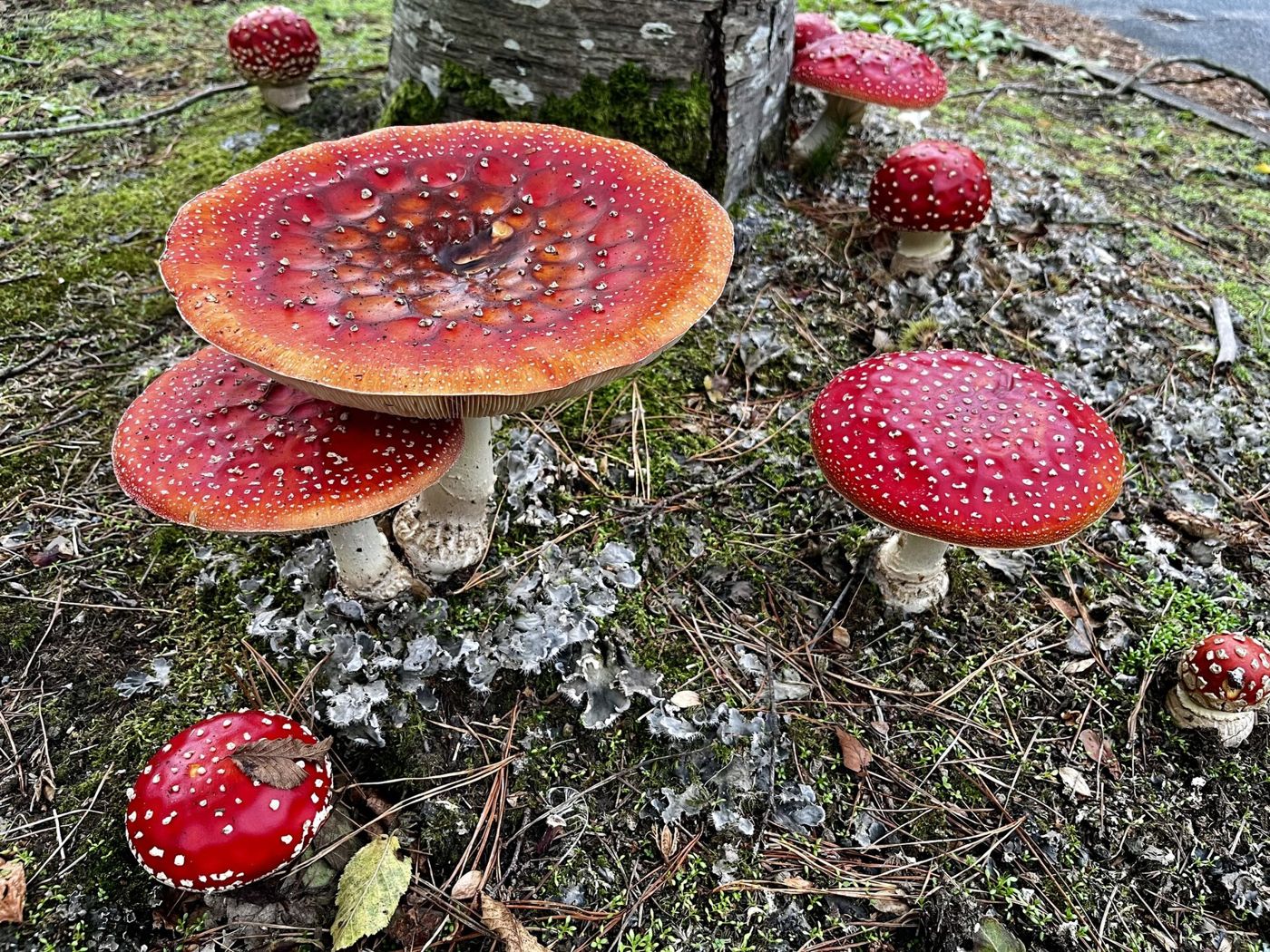
Fly agaric, Amanita muscaria, is probably the most famous mushroom in the world. It's the red-and-white toadstool of fairy tales, garden ornaments and holiday cards. Because the image is so familiar, many people assume they would recognize one instantly. In practice, real fly agarics vary more than the illustrations suggest. Weather, age and regional variety all change how they look, and some of their relatives range from mildly toxic to dangerous or deadly. This profile covers the features to check, where and when the species grows, and the look-alikes worth knowing about.
Start with the cap. In Europe and western North America, a typical fly agaric cap is bright scarlet to orange-red. It begins as a rounded dome and opens to flat or slightly upturned, often reaching the size of a side plate. The white or creamy specks scattered across it are not part of the cap skin. They are fragments of the universal veil, a membrane that wrapped the whole young mushroom and tore apart as it grew. Those warts sit loosely on the surface and can be rubbed or washed off. Underneath, the gills are white to cream and free from the stem, and the spore print is white. The white stem usually carries a soft, skirt-like ring near the top. At the base it swells into a bulb ringed with scaly bands or ridges of veil tissue, rather than the loose, sac-like cup seen in species such as the death cap.
Fly agaric is mycorrhizal, which means it lives in partnership with the roots of living trees. That is why you rarely find it far from them. Birch is its classic partner, but it also grows readily with pine, spruce and fir, and sometimes with other trees. Look in mixed woods, heaths, parks and gardens with mature birches or conifers, usually from late summer through autumn, peaking after rain in cooler weather. It occurs naturally across much of the temperate and boreal Northern Hemisphere. It has also been introduced with pine and birch plantings to parts of Australia, New Zealand, South Africa and South America, so Australian readers often find it under introduced pines in autumn.
The species is not as uniform as its reputation suggests. In eastern North America the common form is often yellow to orange and is usually treated as Amanita muscaria var. guessowii, sometimes called Amanita chrysoblema in its paler forms. Some populations have whitish or buff caps. Even a classic red specimen can fade to orange or pale yellow in sunlight or after heavy rain, and a downpour can strip away most or all of the warts. A bald, faded fly agaric can be mistaken for a red Russula such as the sickener (Russula emetica). Russulas, however, have brittle, crumbly flesh and lack both a ring and a bulbous, veil-ringed base. In other words, the white spots alone are neither necessary nor sufficient for identification.
The more serious look-alikes are other amanitas. Caesar's mushroom (Amanita caesarea) in southern Europe, and the similar Amanita jacksonii in North America, also have orange-red caps. They have yellow gills and a yellow stem rising from a thick white sac-like volva, and their caps usually lack warts. These species are prized by some experienced collectors, which is exactly why confusion is risky in both directions. The panther cap (Amanita pantherina) has a brown cap with white warts and is generally regarded as more toxic than fly agaric. The blusher (Amanita rubescens) has pinkish-brown caps with greyish or pinkish warts, and its flesh slowly reddens where damaged. Young fly agarics still wrapped in their veil can look like white eggs or puffballs, the same trap posed by deadly death cap and destroying angel buttons. Fly agaric itself contains ibotenic acid and muscimol. These toxins can cause confusion, agitation, drowsiness, vomiting and, in severe cases, seizures or coma, and folk ideas about boiling or drying it make it safe are unreliable. If anyone, including a child or pet, may have eaten one, call poison control or emergency services immediately and keep a sample of the mushroom.
Because so many amanitas share warts, rings and swollen bases, identification has to rest on the whole mushroom rather than a single trait. No folk test helps here: silver spoons, peeling the cap, smell, or seeing slugs or squirrels nibbling it tell you nothing about toxicity. Only an expert who has examined the actual specimen can confirm what it is, and some deadly species closely resemble popular edible ones. If you find a red or orange toadstool and want to know what it is, photograph the top of the cap, the gills, the ring and the stem base. Dig gently around the base rather than snapping it off so the bulb or volva is visible. Shroomly can then suggest likely species and flag toxic look-alikes such as the panther cap. Treat that as a starting point, not a verdict, and confirm the identification with a local mycological society or experienced expert.