


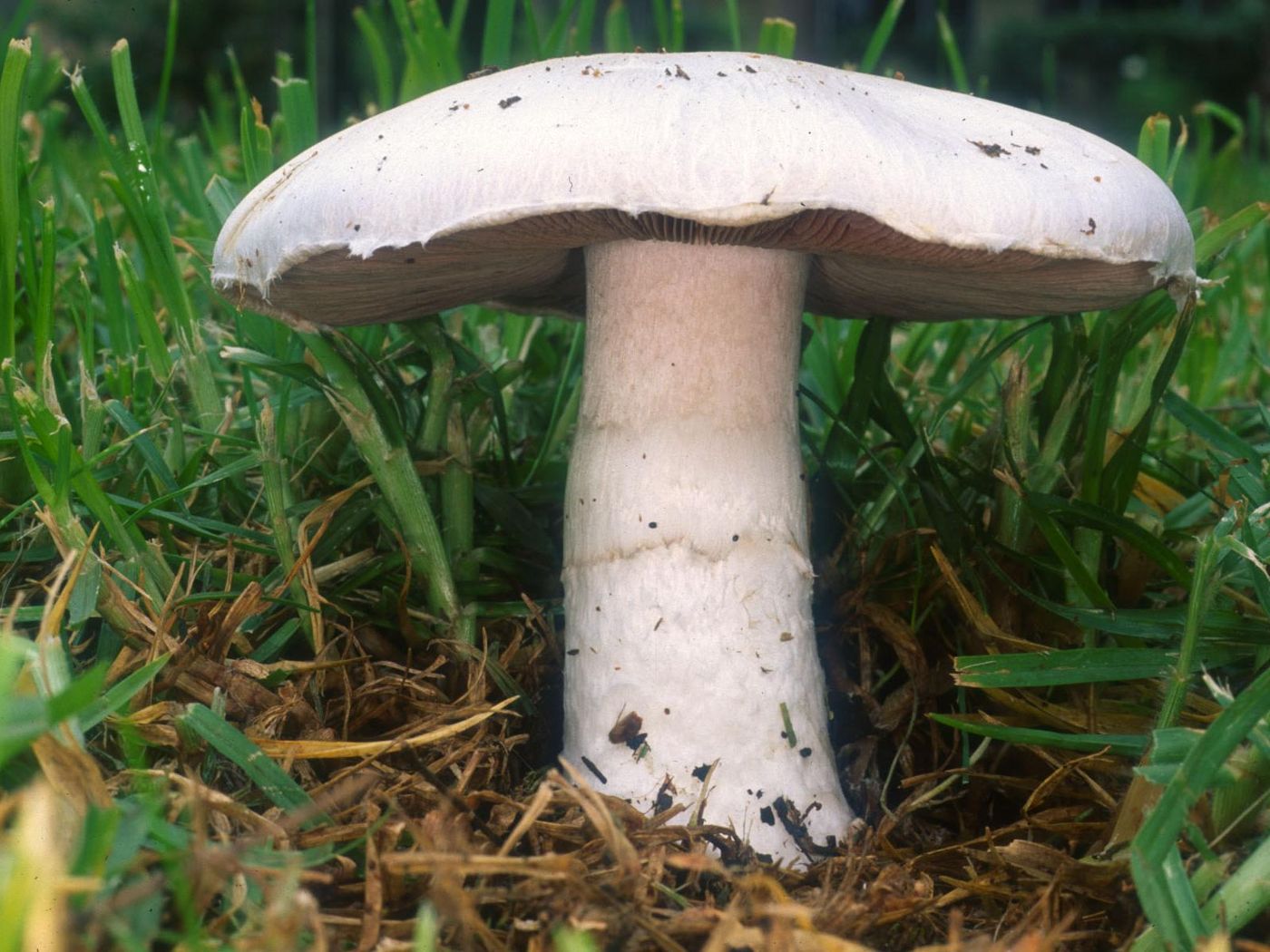
The field mushroom, scientifically known as Agaricus campestris, is one of the most widely recognized wild fungi across North America, the United Kingdom, Europe, and Australia. As a saprotrophic species, it plays an essential ecological role by breaking down decaying organic matter within pasture soils and turf. You will rarely find this mushroom in deep woodlands; instead, it thrives in open, sunny expanses such as well-grazed livestock pastures, country meadows, parklands, and suburban lawns that have not been treated with heavy artificial fertilizers. The main fruiting window spans from late summer through the middle of autumn, typically triggered by a sudden drop in temperature following a heavy, soaking rainfall.
Recognizing Agaricus campestris requires careful examination of multiple features simultaneously. The cap begins hemispherical or rounded before expanding into a broadly convex or nearly flat disc, typically measuring between two and four inches across. Its surface is dry, smooth, or slightly fibrous, ranging in color from clean white to ivory or soft grayish-cream. Beneath the cap, the gills are entirely free from the stem and crowded close together. In very young specimens, the gills display a distinct, pale flesh-pink hue that gradually darkens through rosy brown to a deep, dark chocolate brown as the spores mature. The stem is relatively short, stout, and white, tapering slightly toward the base, and carries a delicate, thin, membranous ring that often collapses or falls away as the mushroom reaches full maturity.
For generations, various folk tests have been circulated to supposedly tell an edible field mushroom apart from a poisonous one, but all of these traditional rules of thumb are completely false and dangerous. A widespread myth claims that if the skin of the cap easily peels away from the edge to the center, the mushroom is safe to consume. In reality, the skin of several severely toxic mushrooms, including deadly destroying angels, peels away just as readily. Similarly, old beliefs that a poisonous mushroom will tarnish a silver coin or spoon, or that wild animals will only nibble harmless species, have no scientific basis. Flesh reactions are an important diagnostic step instead: when the stem base or cap of a true field mushroom is scratched or cut, the white flesh remains virtually unchanged or develops only a very faint, slow reddish or pink flush, never a rapid or bright yellow stain.
The most frequent source of confusion in grasslands is the yellow stainer, Agaricus xanthodermus. This species often fruits in the very same fields, meadows, and park edges during the autumn months and looks nearly identical from above. However, the yellow stainer carries gastrointestinal toxins that cause severe stomach cramping, nausea, and vomiting. If you cut the base of a yellow stainer's stem, the flesh immediately bruises an intense, vivid chrome yellow before dulling to a dirty brownish-gray over time. Furthermore, the yellow stainer emits a distinct, disagreeable chemical odor reminiscent of carbolic soap, iodine, or ink, which becomes especially overpowering when crushed. In North America and Australia, foragers must also watch out for Chlorophyllum molybdites, the green-spored parasol, a large lawn-dweller that causes intense digestive illness and can be recognized by its pale greenish gills and green spore print.
By far the most catastrophic look-alikes belong to the genus Amanita, including pale forms of the death cap (Amanita phalloides) and several varieties of destroying angel (such as Amanita virosa and Amanita bisporigera). While these deadly fungi primarily associate with the root systems of living trees, they frequently fruit on the margins of fields, near scattered hedgerow trees, or along grassy parkland lawns where tree roots extend underground. Unlike the field mushroom, deadly Amanitas possess gills that remain persistently white throughout their entire life cycle and produce a pure white spore print. Most importantly, an Amanita emerges from a universal veil, leaving a distinct, cup-like membrane called a volva wrapped around the subterranean base of the stem. Pulling a mushroom up without inspecting the buried base has led to fatal mistakes, as people overlook the hidden volva and mistake a young Amanita button for an Agaricus.
Because wild fungi can show considerable natural variation and toxic species frequently grow within feet of benign ones, never attempt to consume a wild mushroom based solely on photographs, general descriptions, or automated tools. Only an experienced mycological expert who has physically inspected the intact, fresh specimen can verify a mushroom's identity with the precision required for safety. If you or someone you know ever suspect that a wild mushroom has been ingested, do not attempt home remedies or wait for abdominal pain to develop. Contact emergency medical services or your regional poison control center immediately, and ensure you collect any remaining mushroom pieces, including the stem base and surrounding soil, to assist toxicologists in making a prompt identification.
When documenting wild mushrooms you encounter in fields and lawns, always practice a thorough, structured identification routine. Begin by inspecting the upper cap surface for color, texture, and remnants of veils, then inspect the underside to note whether the gills are free from the stem and what color they display. Gently excavate the very bottom of the stem from the turf using a small knife or trowel to ensure you capture the entire base intact, checking for subterranean volval cups or immediate color changes when bruised. Capturing clear, well-focused photographs of the cap, gill attachment, stem ring, and stem base allows Shroomly: Mushroom Identifier to provide probable species matches and highlight dangerous look-alikes for you to study. Always pair these insights with a reputable regional field guide and consult your local mycological society to continue learning safely.