


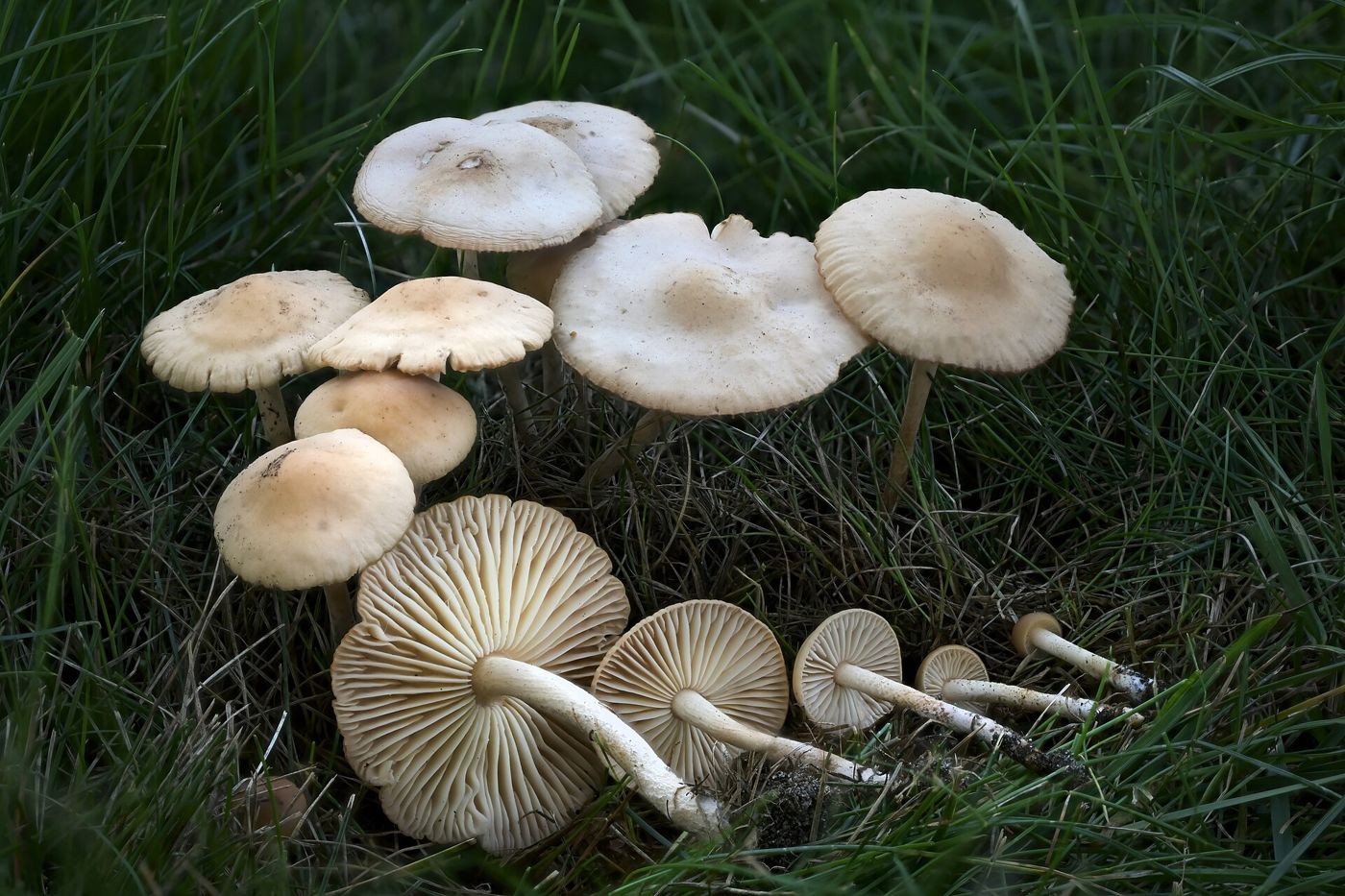
The fairy ring champignon, known scientifically as Marasmius oreades, is one of the most widespread and recognizable grassland fungi across temperate regions of North America, the British Isles, Europe, and parts of Australasia. Walkers and homeowners frequently encounter it in manicured lawns, pastures, golf courses, parklands, and grassy road verges. Rather than decomposing dead wood, Marasmius oreades is a saprotrophic soil-dwelling organism whose subterranean mycelium spreads outward through turf. As the fungal network feeds on organic debris in the soil, it releases nitrogen, which often stimulates a lush, dark green ring of fast-growing grass right where the fruiting bodies emerge.
In terms of seasonality, Marasmius oreades generally fruits from late spring through late autumn, making repeated appearances whenever conditions are favorable. Substantial moisture is the primary trigger, with flushes commonly erupting within one to two days after sustained rain. What sets this fungus apart from many other lawn dwellers is a biological capability called marcescence. Unlike fragile mushrooms that quickly turn into a decaying black slurry when dried out, fairy ring champignons can shrivel into stiff, papery buttons during dry spells and then completely rehydrate, expand, and continue shedding viable spores once damp weather returns. This remarkable adaptation allows colonies to endure hot summers and fruit repeatedly in the same spot for decades.
Careful visual inspection reveals several key botanical features that define Marasmius oreades. The cap typically measures between two and five centimeters across, starting out convex with an inrolled margin before flattening out with a distinct, broad central elevation known as an umbo. Cap coloration is hygrophanous, meaning it alters with moisture levels, displaying a warm buff, light tan, or pale cinnamon hue when moist and drying to a pale cream or buff leather shade. Underneath the cap, the gills are conspicuously distant, broad, and pale buff or cream, remaining free or only narrowly attached to the stem. The stem itself is slender, solid, pale, and exceptionally tough and fibrous. One classic diagnostic trait is the stem's pliancy: instead of snapping cleanly like brittle chalk, the stem of a true fairy ring champignon can often be twisted around a finger or bent sharply without breaking.
Despite their humble appearance, attempting to identify fairy ring mushrooms in the field comes with significant risk because several poisonous grassland species share the same habitat and fruiting schedule. The most hazardous confusion involves the ivory funnel (Clitocybe dealbata, and the closely related Clitocybe rivulosa), a pale, deadly species containing potent amounts of the toxin muscarine. While the ivory funnel can also fruit in rings in grass, it features crowded, decurrent gills that run slightly down the stem, a pure white to greyish cap without a distinct central umbo, and a brittle stem that snaps easily upon bending. Other lawn species, such as toxic fibrecaps (Inocybe species) with conical caps and brown spores, or young buttons of the poisonous green-spored parasol (Chlorophyllum molybdites), can also mislead the unwary.
Safe field mycology requires a commitment to rigorous observation and the complete rejection of traditional folklore. Common myths suggesting that poisonous mushrooms cause a silver spoon to tarnish, that peeling the cap skin removes toxins, or that fungi nibbled by birds or insects are safe for humans have been thoroughly debunked by modern toxicology. Lethal fungal toxins show no chemical reaction with silver, and many animals possess unique metabolic pathways that tolerate toxins fatal to people. Only an experienced mycologist who has physically handled and examined a fresh specimen can confirm a species' identity and edibility. If you suspect anyone has ingested an unknown wild mushroom, contact poison control or emergency medical services immediately and save a fresh sample of the mushroom in a paper container for clinical identification.
Studying grassland fungi like Marasmius oreades offers a wonderful window into the hidden ecology beneath our feet, provided you approach every discovery with patience and caution. When examining mushrooms in your yard, capture sharp, well-lit photographs that clearly display the cap color, the underside showing gill spacing and attachment, and the entire stem base pulled gently from the ground. By submitting these clear photos to Shroomly, you can quickly explore likely species matches and review important toxic look-alikes to watch out for. Treat automated tools and field guides as helpful starting points, and always consult a local mycological society or professional expert to verify your findings safely.