


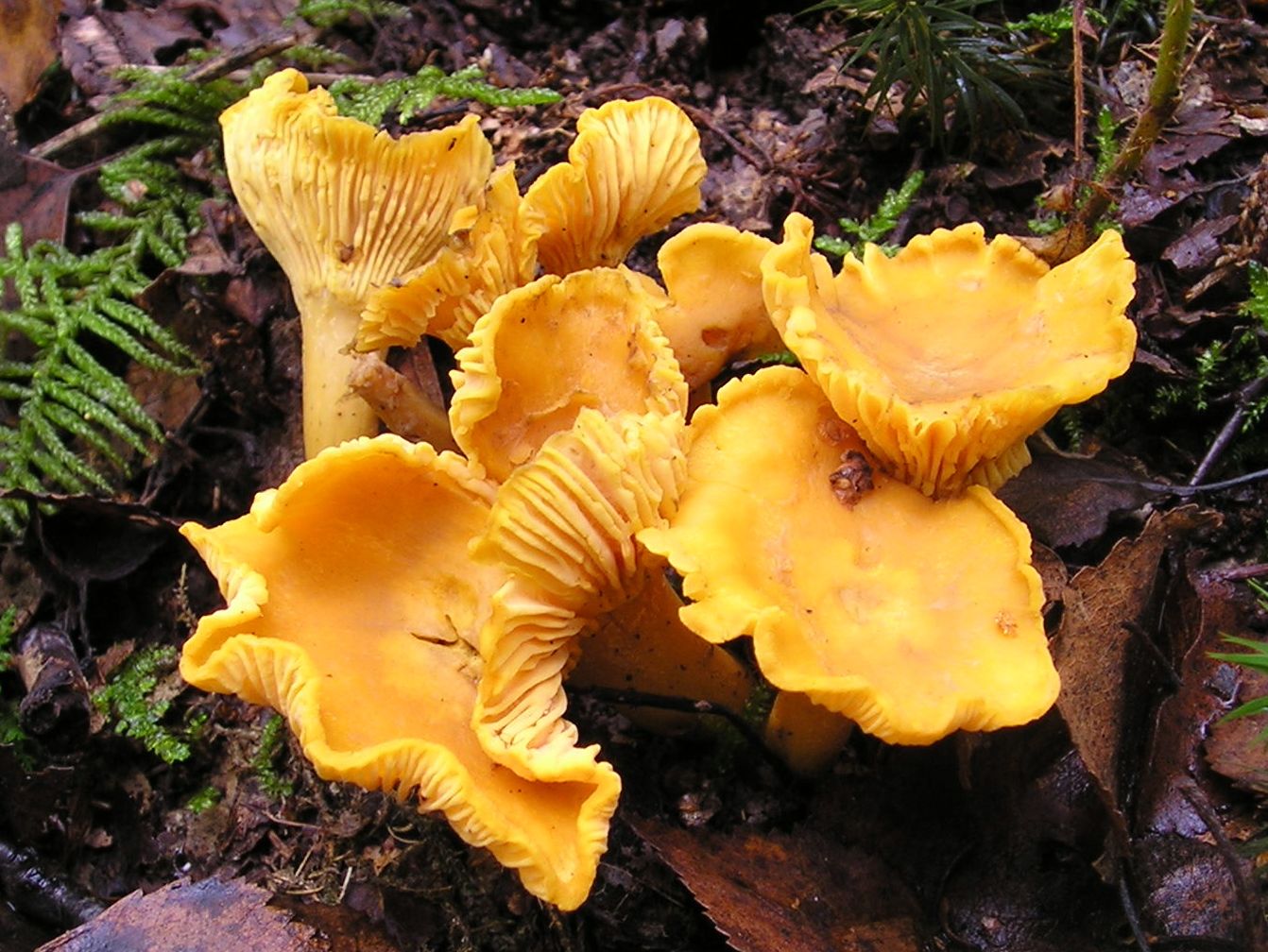
Golden chanterelles, encompassing species such as Cantharellus cibarius and closely related regional species like Cantharellus formosus, are among the most renowned and sought-after wild fungi in temperate woodlands across North America, Europe, and parts of Australia. A mature chanterelle typically displays a rich egg-yolk yellow to apricot-orange hue, with a cap that starts slightly convex before flattening and eventually developing a distinct vase-like or funnel shape with wavy, irregular margins. Perhaps the most critical identifying feature of a true chanterelle is its underside. Rather than possessing knife-sharp, blade-like true gills, chanterelles feature false gills, which are shallow, blunt ridges or veins that fork irregularly, form cross-veins, and run noticeably down the upper stem, a trait known as decurrent attachment. When cut down the center, a healthy chanterelle reveals solid, fibrous interior flesh that is pale white to cream, contrasting sharply with its golden exterior.
Understanding the habitat and growing habit of chanterelles is just as important as inspecting their physical shape. Chanterelles are mycorrhizal fungi, meaning they form mutually beneficial partnerships with the root systems of living trees, exchanging soil nutrients for plant sugars. Consequently, they are found in deciduous and coniferous forests, frequently forming associations with mature oaks, beeches, birches, firs, and pines. Crucially, chanterelles always grow directly from the forest floor, emerging from moss, leaf litter, or mineral soil. They grow singly or in scattered troops rather than in dense, fused clumps emerging directly from dead wood. In many temperate regions, fruiting begins during warm, rainy stretches of mid-summer and continues through late autumn, making them a fixture of the late summer and fall woodland landscape.
The most famous and hazardous look-alike that beginners encounter is the jack-o'-lantern mushroom (Omphalotus illudens in eastern North America and Omphalotus olearius in Europe). While jack-o'-lanterns share an eye-catching bright orange coloration, their anatomy is fundamentally different upon closer inspection. Jack-o'-lantern mushrooms have true, paper-thin, sharp-edged gills that do not fork in the manner of chanterelle ridges, and their internal flesh is deep orange throughout rather than pale white. Furthermore, jack-o'-lanterns are saprotrophic wood-decay fungi that fruit in dense, overlapping clusters directly attached to decaying stumps, logs, or buried tree roots. Consuming a jack-o'-lantern results in severe, prolonged gastrointestinal poisoning driven by toxic illudins, leading to intense vomiting, abdominal cramps, and dehydration.
Another common confusion species is the false chanterelle (Hygrophoropsis aurantiaca). This widespread mushroom often grows in coniferous needle duff or on rotten wood, sporting an orange cap that can resemble a young chanterelle from above. However, false chanterelles have true gills that are repeatedly and systematically forked, thin, and far more crowded, accompanied by hollow or flimsy stems and flesh that lacks the firm, solid structure of Cantharellus. While historically considered harmless by some, the false chanterelle is known to cause gastrointestinal upset in many people and should never be consumed. Many amateur foragers attempt to rely on folklore tests, such as checking whether a mushroom smells faintly of apricots, whether insects have chewed the cap, or whether a cap peels easily. In reality, smells are subjective, wildlife can safely consume fungi that are fatal to humans, and superficial physical tricks provide zero protection against dangerous toxins.
Because mistaking a toxic woodland mushroom for a harmless one can cause severe illness, precise identification requires confirming every morphological detail in concert. Cap color, under-cap ridge structure, stem solidity, internal flesh color, substrate, and forest tree associations must all align without exception. Only an experienced mycologist who has physically examined a fresh specimen can confirm a species with absolute certainty. If you or someone you know ever develops symptoms such as nausea, vomiting, dizziness, or stomach cramps after consuming any wild mushroom, do not wait for the illness to resolve or attempt home remedies. Contact regional poison control or emergency medical services immediately, and ensure any leftover raw trimmings or intact specimens are preserved in a paper container to assist medical toxicologists in identifying the fungus.
Whenever you encounter a bright golden fungus on the forest floor, taking clear, methodical photographs is the safest first step toward learning its true identity. Capture sharp images of the top of the cap, the underside showing how the ridges attach to the stipe, the base of the stem where it enters the earth, and a cross-section showing the internal color of the flesh. Submitting these detailed photos to Shroomly can help you quickly compare key traits against known species profiles and screen for dangerous look-alikes like the jack-o'-lantern. Use these tools as an educational springboard, and always consult a local mycological society or professional expert before drawing definitive conclusions about wild fungi.