


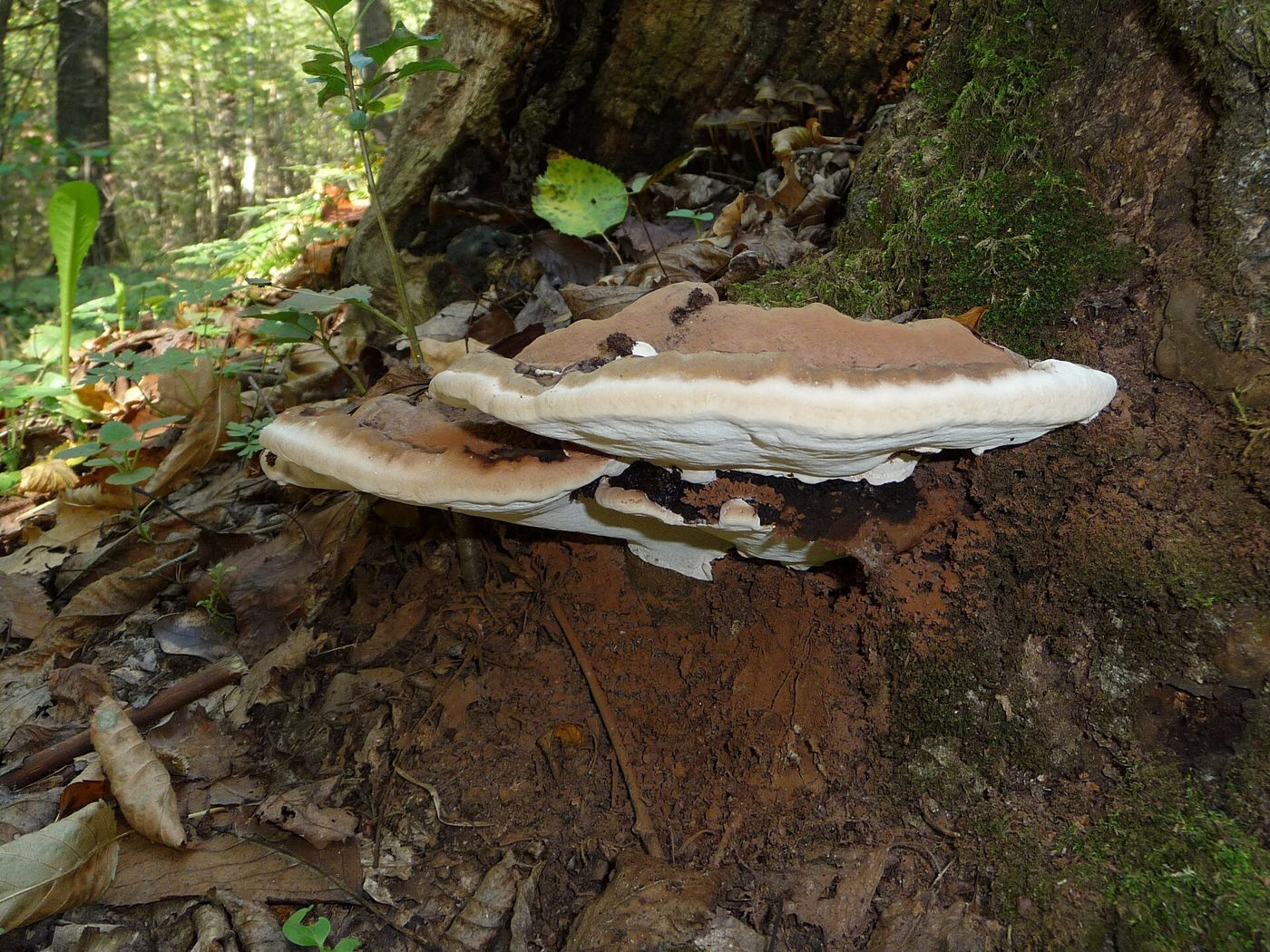
Bracket fungi are the shelf-like mushrooms that jut sideways from tree trunks, stumps, fallen logs and sometimes timber in gardens. Many of them are polypores, meaning that instead of gills they have a surface of tiny pores on the underside, each the opening of a tube where spores are produced. Because they grow on wood and often stay in place for weeks, months or even years, brackets are among the easiest fungi to find and photograph, yet they can be surprisingly hard to name. Colours fade in the sun, algae turn the tops green, and old specimens look very different from fresh ones. The good news is that a handful of features, checked in a sensible order, will narrow most brackets down to a small group, and sometimes to a single species.
The first thing to check is the underside, because it immediately splits brackets into broad groups. Most true polypores have pores, and it is worth looking closely at their size and shape: some are so fine you need a hand lens, others are large and angular, and some are stretched into slots or a maze-like pattern. The oak mazegill (Daedalea quercina) has thick, labyrinthine walls, while the blushing bracket (Daedaleopsis confragosa) has elongated pores that can look almost gill-like. Other wood fungi have no pores at all. Hairy curtain crust (Stereum hirsutum) has a smooth underside, which is one of the main ways to separate it from turkey tail (Trametes versicolor), whose underside is covered in small white pores. The beefsteak fungus (Fistulina hepatica) is unusual because its tubes are separate from one another, so under a lens the underside looks like a mass of tiny individual tubes rather than a single honeycomb. A few wood-growing fungi, such as oyster mushrooms and lenzites-type brackets, have gills or gill-like plates, which is why it is always worth turning the bracket over or photographing from below.
Next, consider texture and lifespan. Feel whether the bracket is soft and fleshy, tough and leathery, or hard and woody. Fleshy brackets such as chicken of the woods (Laetiporus sulphureus) and the giant polypore (Meripilus giganteus) are usually annual: they appear, release spores and then rot away within one season. Hard, woody brackets are often perennial and add a new layer of tubes each year. If you can see one cut or broken in cross-section, layered tubes are a strong clue to a perennial species such as artist's conk (Ganoderma applanatum) or the hoof fungus, also known as tinder fungus (Fomes fomentarius), which forms a grey, hoof-shaped bracket on birch and beech. Thin, flexible brackets that grow in overlapping tiers, like turkey tail, form yet another group. Shape matters too: a hoof, a flat shelf, a fan, a rosette or a thin crust spreading over bark all point in different directions.
The tree itself is one of the most useful clues and is easy to record. Many brackets are linked to particular hosts. The birch polypore (Fomitopsis betulina) grows on birch and essentially nowhere else, appearing as a smooth, pale, kidney-shaped bracket on dead or dying trunks. Beefsteak fungus is strongly associated with oak and sweet chestnut. Note whether the tree is a conifer or a broadleaf, whether it is living or dead, and whether the fungus is high on the trunk, at the base or on buried roots. Fungi at the base of a tree, such as hen of the woods (Grifola frondosa) or the giant polypore, can look like ground mushrooms but are actually growing from roots, so it is worth looking for a connection to wood. If you cannot identify the tree, a photo of the bark and leaves alongside the fungus helps enormously.
Simple observations of colour change and surface detail can then separate close relatives. The fresh pore surface of artist's conk is white and turns dark brown when scratched, which is how it earned its name. The giant polypore and the black-staining polypore bruise black when handled, while the blushing bracket may turn pinkish where touched. Look at the upper surface as well: is it hairy, velvety, smooth, crusted or shiny as if varnished? Are there concentric zones of colour, and do the bands differ in texture as well as hue? A rusty brown dusting of spores on the bracket or the bark below is common in Ganoderma species, and a spore print taken on white paper can confirm spore colour when it is not obvious. Size is less reliable than many people expect, because the same species can produce small and very large brackets depending on age and conditions.
It is a common belief that bracket fungi are all harmless, and while many are too tough to be tempting, that assumption is not safe. The cinnamon bracket (Hapalopilus rutilans) has caused serious poisonings in Europe, and chicken of the woods, often promoted as a beginner's mushroom, is known to cause gastrointestinal reactions in some people. Some reports link adverse reactions to specimens growing on certain host trees such as yew, which is another reason host identification matters. Folk tests offer no protection here or anywhere else: whether a bracket smells pleasant, whether slugs or squirrels have nibbled it, or whether it passes some kitchen trick says nothing about its toxins. Only an expert who has examined the actual specimen can confirm whether a wild fungus is edible, and even well-known edible brackets have look-alikes. If anyone may have eaten a wild fungus and you suspect poisoning, call poison control or emergency services immediately and keep a sample of the fungus for identification. Touching brackets is generally not a concern, though washing your hands afterwards is sensible.
When you find a bracket you want to identify, take several photos rather than one. Photograph the top surface, the underside close up so the pores or gills are visible, the edge and thickness of the bracket, and the way it attaches to the wood, then add a wider shot showing the whole tree or log. If the fungus has a stem or grows from the base of a tree, include that too, since for ground-level mushrooms the cap, gills and stem base are the features that matter most. Shroomly can use these photos to suggest likely species and flag toxic look-alikes, which gives you a strong starting point and a list of features to double-check. Treat any app result as a suggestion, not a verdict on safety, and confirm your identification with a local mycological society or an experienced expert who can examine the specimen in person.