


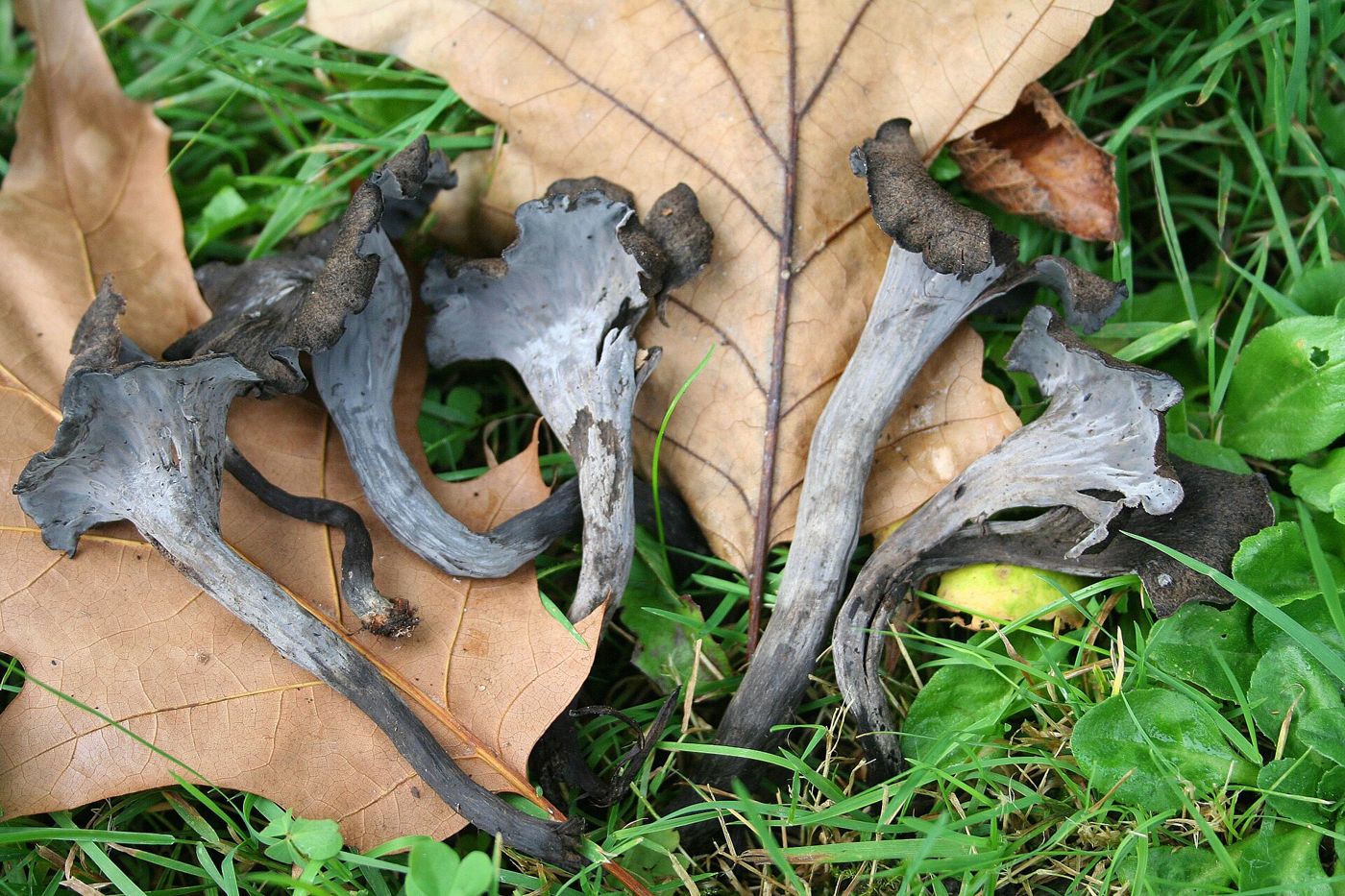
Black trumpet mushrooms, often called black trumpets or horn of plenty, belong to the genera Craterellus and sometimes closely related Cantharellus species depending on region. They are notable for their thin, funnel- or trumpet-shaped fruiting bodies that are hollow from the cap into the stem and for a generally dark, sooty grey to black color that can look brownish in dry spells. Because they lack the obvious cap-and-stem silhouette of many mushrooms and sit low in leaf litter, they can be easy to miss, but their unique shape makes them fairly straightforward to identify with a careful look.
Habitat and season are important identification clues. In temperate North America and Europe you’ll typically find black trumpets from mid-summer into late fall in deciduous woodlands, especially beneath oaks, beech, and maples; they favor mossy or well-rotted leaf litter and sometimes form scattered groups or loose clusters. They do not usually grow on wood like many bracket fungi, nor in neat rings like lawn species. Noticing the tree partners and the forest floor where they appear helps narrow things down, since many look-alikes prefer different substrates or times of year.
Key physical features include the hollow, trumpet-shaped body; a smooth to slightly wrinkled inner surface rather than true gills; and thin, often fragile flesh that can tear easily. Colors range from deep grey-black to dark brown, sometimes with a lighter or orangey rim on younger specimens. The underside and stem are continuous—there’s no clear separation between cap and stem—so when you pick one it looks like a single thin cup. Smell can be subtly fruity or smoky in some species, but smell alone is unreliable for safety or species confirmation.
Several look-alikes can cause confusion. Young chanterelles (Cantharellus cibarius) can sometimes be mistaken at a glance because they share a vase-like form, but chanterelles usually have forked, blunt ridges rather than a smooth hollow interior and are more golden to orange in color. Some small brown to grey mushrooms and decayed leaf fragments also mimic the dark appearance; these non-targets are often stiffer, have a true cap-and-stem, or grow on wood. There are no commonly reported deadly species that are exact visual matches to true black trumpets, but some toxic or inedible fungi can be misidentified when specimens are damaged or unusually colored, so caution is essential.
Spore print, microscopic features and seasonality are the surest ways to separate close look-alikes. Black trumpets typically have a pale, cream to salmon-colored spore print, and under a microscope the spores’ shape and size help confirm the genus. If you’re learning to identify them, take notes on habitat, photograph the fruiting body from multiple angles, collect a spore print on white and dark paper, and compare features with reliable field guides. Avoid relying on folk tests—peeling the cap, silver spoons, or whether animals eat a mushroom are not safe or accurate indicators of edibility.
When edibility comes up: many people prize Craterellus species for culinary use, but never assume a mushroom is safe to eat from photos, apps or a single trait. Only an experienced mycologist who has examined the actual specimen can confirm edibility, and some dangerous mushrooms can resemble edible ones in the field. If anyone becomes ill after ingesting wild mushrooms, call your local poison control center or emergency services immediately and keep a sample of the mushroom for identification. For safe identification, photograph the cap shape and interior, the underside or hymenium, and the stem base; let Shroomly suggest likely species and toxic look-alikes, then confirm with a local mycological society or an expert before consuming anything.