


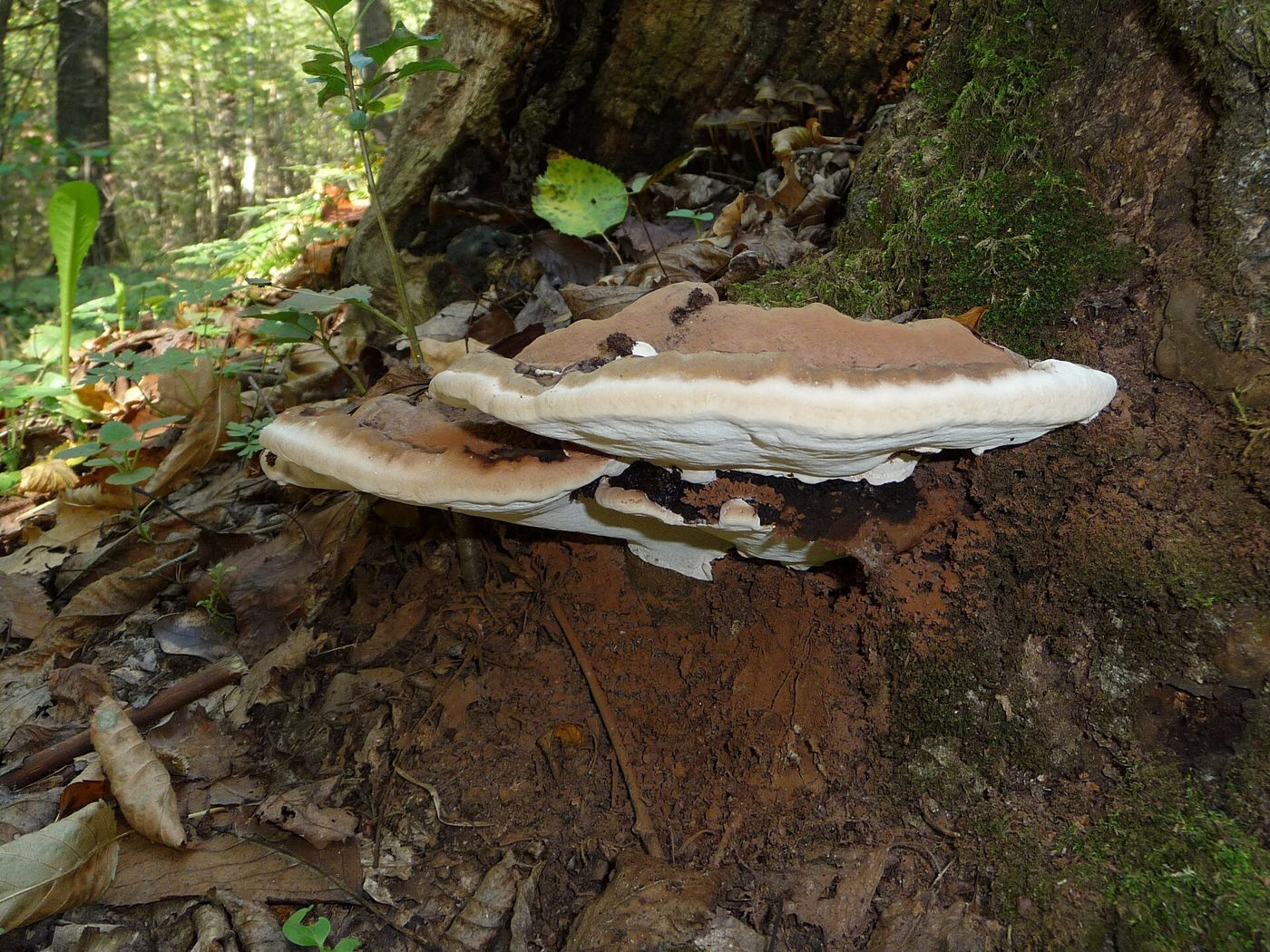
Artist's conk, known scientifically as Ganoderma applanatum, is one of the most widely distributed and easily recognized bracket fungi in the temperate world. Its popular name comes from a unique physical quirk: the fresh white underside of the mushroom instantly bruises dark sepia brown when scratched or etched with a fine point. Historically, illustrators and outdoors enthusiasts have used this smooth pore surface as a natural canvas to create permanent, detailed etchings that remain intact as the specimen dries. Beyond this novelty, the fungus serves a vital ecological role in forest ecosystems, acting as both a parasitic heart-rot pathogen of weakened trees and a saprotrophic recycler of fallen logs and stumps.
Recognizing Ganoderma applanatum in the wild begins with examining its distinctive shelf-like structure. The fruit body forms a semicircular, fan-shaped bracket that attaches directly to the host tree without a distinct stem. The upper surface is typically dull grey, weathered brown, or cocoa-coloured, characterized by irregular concentric ridges and a hard, woody texture. During peak sporulation periods, the top surface is often coated in a fine, powdery dusting of cinnamon-brown spores that have drifted upward on forest air currents. The growing outer margin of the shelf is usually blunt and creamy white during spring and summer, contrasting sharply with the older, darker zones closer to the bark.
Unlike common fleshy mushrooms that feature gills beneath the cap, artist's conk belongs to the polypore group, meaning its spore-bearing hymenium consists of millions of microscopic pores. The underside is remarkably flat and smooth, showing a pale white or creamy tone while the fungus is actively growing. A key identification trait is the permanent brown discoloration produced whenever these delicate pores are crushed or scored. Internally, the flesh is dark brown, fibrous, and exceedingly tough, often revealing stratified layers of pores when sliced open, with each distinct layer representing a year of seasonal growth.
Because it is a perennial fungus, artist's conk does not rot away after a single season. Instead, the fruiting body persists on the tree trunk for years, continually expanding outward and downward, sometimes reaching impressive spans exceeding thirty or forty centimetres across. While it can be found throughout the year, active growth and spore release peak from late spring through autumn. The fungus primarily colonizes broadleaf hardwoods, showing a particular affinity for beech, oak, maple, birch, and poplars, though it occasionally appears on coniferous trees. Its presence on a living tree is an important indicator of advanced internal heartwood rot, which can eventually make the limb or trunk structurally unstable.
Foragers and nature enthusiasts must separate Ganoderma applanatum from several other prominent bracket fungi that share similar woodland niches. The tinder conk (Fomes fomentarius) also grows on birch and beech, but it produces a much thicker, rounded, hoof-shaped bracket rather than a flat, broad shelf, and its pore surface does not bruise dark brown on contact. Red-belted conks, such as Fomitopsis mounceae or Fomitopsis pinicola, can look similar in broad outline, but they generally feature a varnished resinous top and a distinct band of yellow, orange, or red along the outer growing margin. Related species within the genus Ganoderma, such as the varnished shelf fungi Ganoderma tsugae or Ganoderma lucidum, can be distinguished by their shiny, reddish-brown lacquered caps that look as though they have been freshly shellacked.
From an edibility perspective, artist's conk is completely inedible due to its dense, woody, and cork-like consistency. While bracket fungi are rarely associated with acute, life-threatening poisonings, wild mushrooms should never be consumed based on assumptions, visual similarities, or casual rules of thumb. Folk tests, such as peeling the outer skin, checking if insects have fed on the bracket, or boiling the flesh with silver, have no scientific basis and can lead to dangerous errors. Only an experienced mycologist who has directly examined an actual specimen can confirm a species with certainty. If an unknown wild fungus is ingested and illness or poisoning is suspected, contact local emergency services or a national poison control centre immediately and preserve a physical sample for expert diagnosis.
Whenever you encounter a bracket fungus on a walk through the woods, taking clear, well-framed photographs is the best first step toward an accurate identification. Be sure to photograph the top surface to capture the ridge patterns and color, the underside to document the pore structure and any bruising reactions, and the point where the shelf attaches to the tree trunk, noting the host tree species whenever possible. You can upload these photos to the Shroomly app to compare the diagnostic features against Ganoderma applanatum and its look-alikes, before sharing your observations with a local mycological club or regional expert to confirm what you have found.