


Most failed mushroom identifications start before anyone opens a field guide. They start the moment someone snaps a mushroom off at ground level, drops it into a plastic bag with half a dozen others and carries it home in a warm pocket. By the time an expert or an app sees it, the stem base is missing, the cap is bruised and the gills have turned to mush. Knowing how to collect a specimen properly is one of the most useful identification skills you can learn, and it costs nothing more than a little patience and a few household items.
Before touching anything, take photographs where the mushroom is growing. Capture the cap from above, the gills or pores from below, the stem from the side and the surrounding ground, including any nearby trees, buried wood, grass, moss or dung. Context photos matter because many fungi are tied to particular habitats, and once a mushroom is lifted out of the ground you can never reconstruct exactly what it was growing on. If several mushrooms of the same kind are present, photograph young buttons and mature caps together, since species can change shape and colour dramatically as they age.
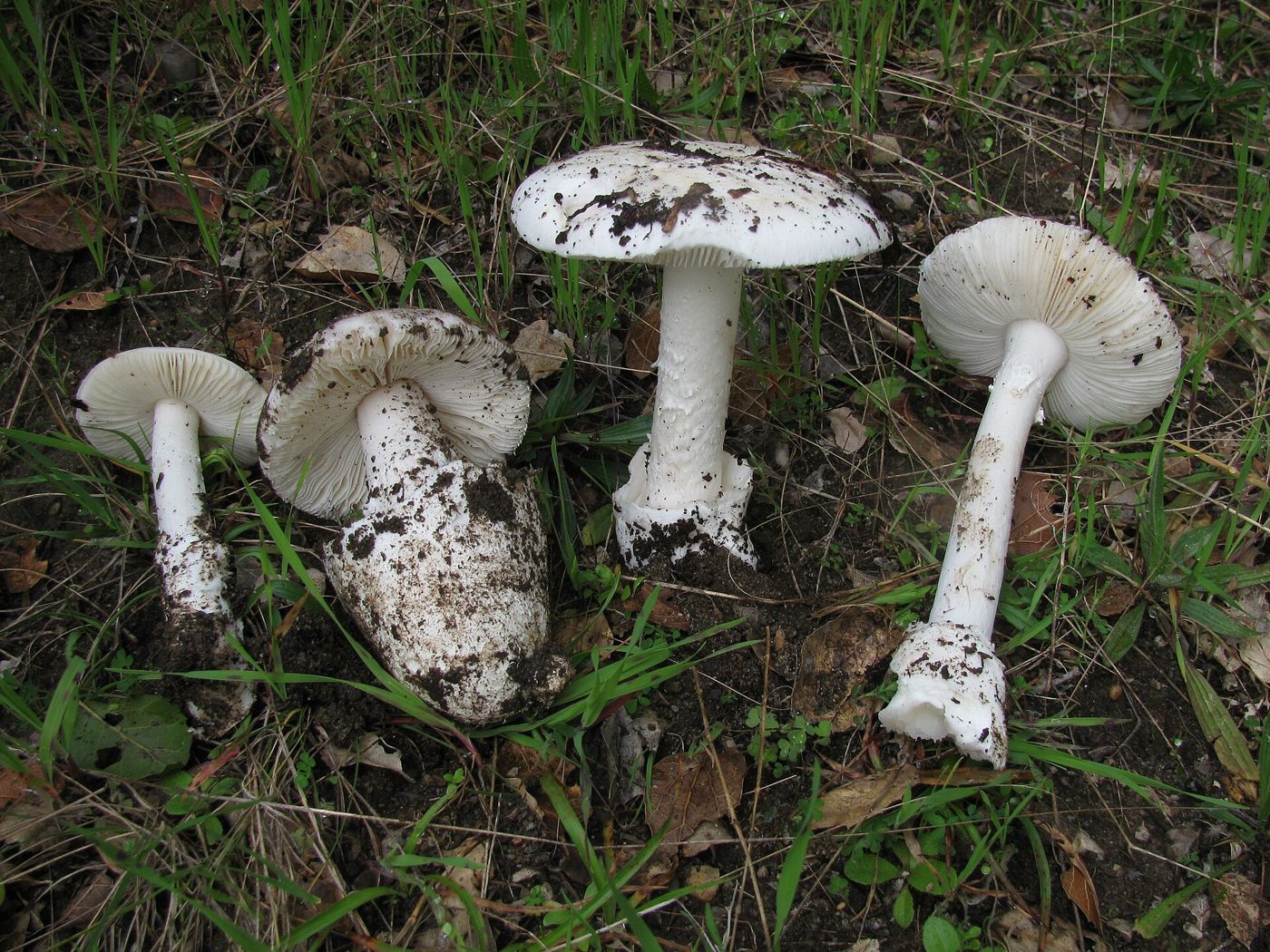
The single most important rule is to collect the whole mushroom, including the very base of the stem. Use a knife, trowel or even a stick to loosen the soil around the stem and lift it out gently rather than pulling or cutting it. This matters most with Amanita species, the group that includes the death cap (Amanita phalloides) and the destroying angels such as Amanita virosa and Amanita ocreata. Many of them have a volva, a sac-like cup or swollen bulb at the stem base, that is often partly or wholly buried in soil or leaf litter. A mushroom cut off at ground level can lose the very feature that would have flagged it as potentially deadly, and look like a harmless white or brownish mushroom instead. The same care helps with rooting stems, mycelial threads and bulbous bases that are clues for many other genera.
How you carry specimens is almost as important as how you dig them up. Wrap each kind separately in waxed paper, a paper bag or a small paper envelope, and place them in a rigid basket or box so they are not crushed. Avoid plastic bags, which trap moisture and make fungi sweat, soften and decay quickly. Never mix unknown mushrooms with anything you hope might be edible, because fragments of a toxic species can end up in the wrong pile. Label each package with the date, location and habitat, and jot down details that fade fast: the colour of the fresh cap, any smell you notice, whether the flesh changes colour when cut or bruised, and whether it exudes milk or liquid. Do not taste specimens to identify them; despite old folklore, taste, smell, peeling caps, silver spoons or signs that animals have nibbled a mushroom cannot tell you whether it is safe.
Handling mushrooms for identification is generally low risk for adults, but it is sensible to wash your hands afterwards, keep specimens away from children and pets, and store them out of reach in the fridge if you cannot examine them straight away. At home, you can place a cap gill-side down on white and dark paper to take a spore print, which is one of the most useful extra clues you can give an expert. Collect sparingly, get permission where needed, respect protected sites and leave rare-looking fungi in place with photos only. And if anyone has eaten part of a wild mushroom and you are worried, call poison control or emergency services immediately and keep a sample of the mushroom, ideally a carefully collected whole specimen, to help those treating them.
Once you have a well-collected specimen, identification becomes much more reliable. Photograph the cap, the gills or pores, and the full stem right down to the base, then let Shroomly suggest likely species and highlight toxic look-alikes you should rule out. Treat that result as a starting point, not a verdict: some deadly mushrooms closely resemble popular edible ones, and only an expert who has examined the actual specimen can confirm what it is or whether it is edible. Bring your labelled specimen, notes and spore print to a local mycological society or an experienced expert, and you will learn far more than any single photo could tell you.