


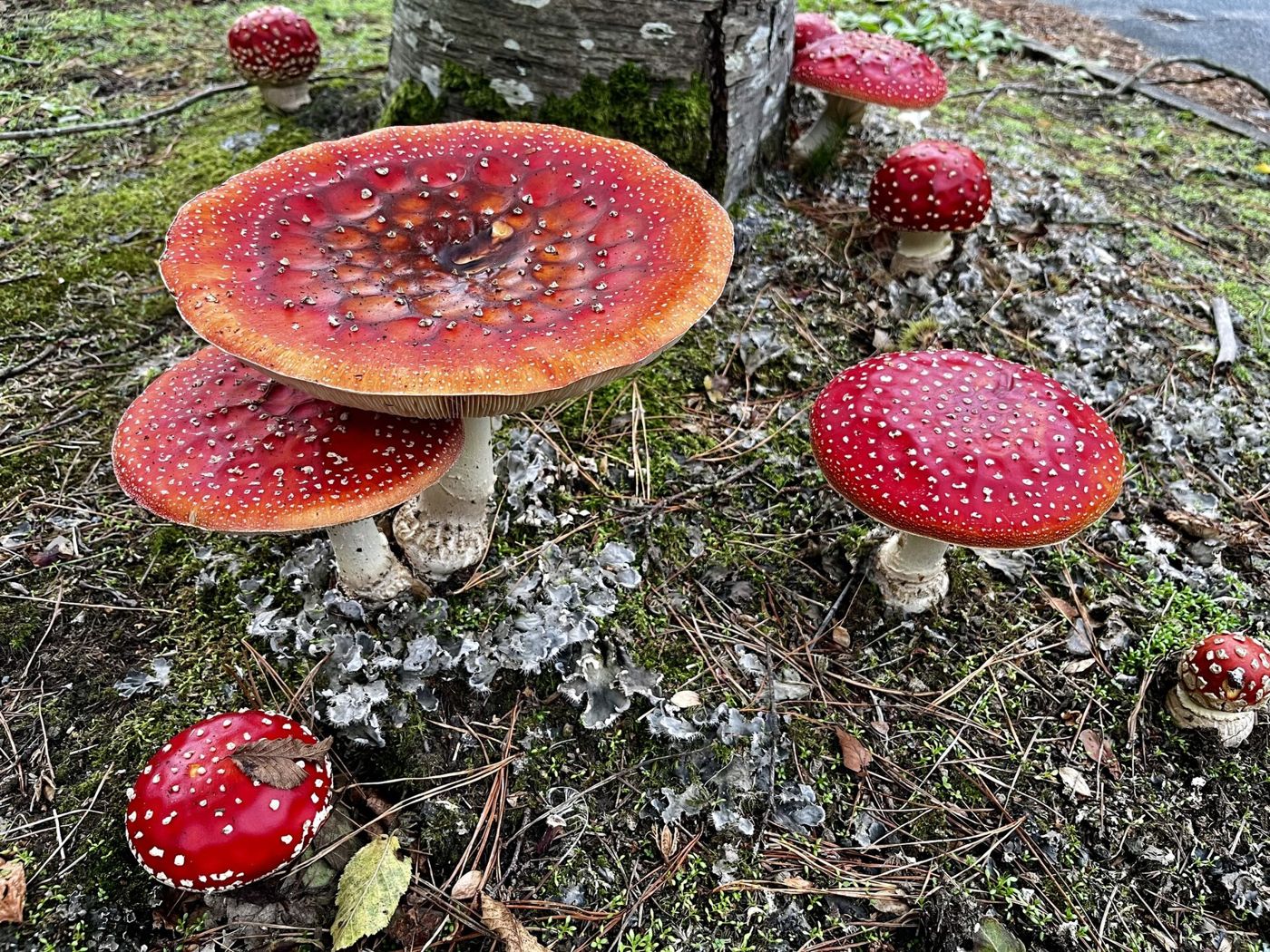
One of the most common reasons people misidentify wild mushrooms is that they compare a specimen in front of them with a photo of the same species at a completely different stage of life. A mushroom is not a fixed object like a leaf or a flower petal. The fruiting body pushes up from hidden mycelium, expands, releases spores and then decays, often within a few days, and almost every feature you might use for identification can change along the way. Understanding how mushrooms age is one of the simplest ways to avoid confident mistakes, and it explains why experienced identifiers prefer to see more than one specimen before naming anything.
The earliest stage is often called the button, and in some groups it is an egg. Many Amanita species, including the deadly death cap (Amanita phalloides) and destroying angels such as Amanita virosa, begin life fully enclosed in a universal veil. At this stage they can look like a smooth white or off-white ball and are easily confused with young puffballs. The only reliable way to tell the difference is to cut the specimen in half from top to bottom and look for the outline of a developing cap, gills and stem inside. Even ordinary gilled mushrooms without an egg stage can be hard to place as buttons, because the cap is tightly rounded, the gills are hidden or pale, and features like the ring and the shape of the stem base have not fully developed.
As the mushroom expands, the cap shape usually changes dramatically. Caps that start out egg-shaped, bell-shaped or tightly convex commonly broaden to convex, then flatten, and in some species turn upward at the margin or become shallowly funnel-shaped in old age. A small central bump called an umbo may become more or less obvious as the cap spreads. This is why field guides often describe a cap as convex becoming flat rather than giving a single shape, and why an older, upturned specimen may not match a neat illustration of a young one. Size is similarly unreliable on its own, since a fresh button and a fully opened cap of the same species can differ several times over in diameter.
Gill colour is another feature that shifts with age, and it is one of the most important. In many species the gills start pale and darken as the spores mature, because the colour you see is largely the colour of the spores coating the gill surface. The field mushroom (Agaricus campestris) typically has pink gills when young that turn chocolate brown and eventually blackish brown. Webcaps in the genus Cortinarius often have pale, violet or yellowish young gills that become rusty brown as their spores ripen. Amanita species, by contrast, generally keep white or pale gills throughout their lives because their spores are white. This matters enormously: a young Agaricus with pale gills can be confused with a white Amanita, which is exactly why a spore print from a mature cap and a careful look at the stem base are so valuable.
Veils and surface decorations also come and go. A partial veil often covers the gills of a young mushroom and tears as the cap opens, leaving a ring on the stem, a ragged fringe on the cap edge, or in some species almost nothing at all. Rings can slip down the stem, collapse or be lost entirely. Cortinarius species have a cobweb-like veil that may survive only as a faint band of rusty fibres. The white warts on the fly agaric (Amanita muscaria) are remnants of the universal veil, and rain can wash them off, leaving a smooth red cap that may also fade toward orange in sunlight or with age. A fly agaric without its warts looks surprisingly different, and the same principle applies to the patches on panther caps and other Amanitas. The volva at the base of an Amanita can be buried, fragile or left behind in the soil, so an older specimen picked without its base may hide the very feature that would reveal it as dangerous.
Older mushrooms bring their own problems. Some caps are hygrophanous and change colour dramatically as they dry, so the same specimen can look dark and water-soaked in the morning and pale by the afternoon. Bruising and staining reactions may weaken or become confusing in aged flesh. Shaggy ink caps (Coprinus comatus) dissolve their gills into black liquid, slugs and insects hollow out stems, and parasitic moulds can coat or distort a fruiting body until its original features are barely recognisable. Smell and texture shift too as tissue breaks down. None of these changes makes an old mushroom any safer, and decay can introduce additional risks, so a battered or rotting specimen is a poor basis for any conclusion. As with every mushroom, no single trait, photo or rule of thumb can confirm that a wild mushroom is edible; only an expert who has examined the actual specimen can do that, and several deadly species closely resemble popular edible ones at one stage or another.
The practical lesson is to look for a range of ages whenever you find a group of mushrooms. Note whether you have a button, a fully opened cap or a fading specimen, and if possible photograph several individuals side by side: the top of the cap, the gills underneath, the stem and ring, and especially the very base of the stem, dug up rather than snapped off. Shroomly can then suggest likely species and highlight toxic look-alikes based on those details, and including more than one growth stage gives it far more to work with than a single button or a weathered old cap. Treat the result as a starting point for learning, not a verdict on edibility, and confirm any identification with a local mycological society or an experienced expert who can examine the specimens in person.