


If you have ever wondered how a mushroom suddenly appears in a spot where none grew before, the answer usually begins with a spore. Spores are the microscopic reproductive cells of fungi, typically only a few thousandths of a millimetre across, far too small to see individually. A single mushroom can release a huge number of them, often estimated in the millions to billions over its short life. The question of how far they travel has a two-part answer: most go almost nowhere, while a lucky few can go astonishingly far.
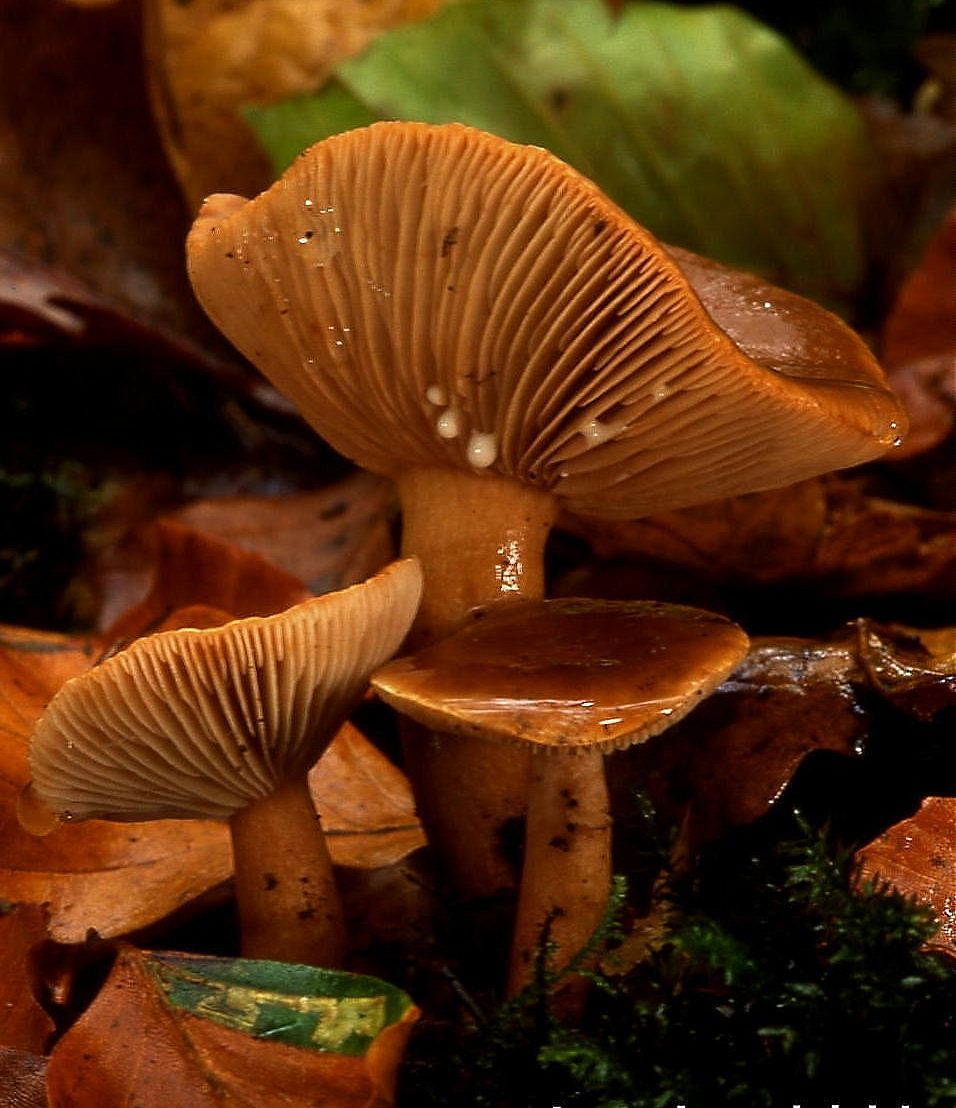
For the familiar gilled and pored mushrooms, the journey starts with a remarkable launch. Many of these fungi produce what mycologists call ballistospores. A tiny droplet of water, known as Buller's drop after the mycologist A. H. R. Buller, forms at the base of each spore. When it merges with a film of water on the spore's surface, the sudden shift in mass flings the spore off its perch. The leap is minuscule, only a fraction of a millimetre, but it is enough to clear the spore from the gill or tube surface so it can fall out of the cap. This is why gill spacing and the strictly vertical orientation of gills and tubes matter so much: a mushroom growing at a tilt can trap its own spores.
Once spores drop below the cap, they are at the mercy of the air. In still conditions under the forest canopy, most settle within a few metres of the parent mushroom, which is one reason the same species often turns up in patches. Research has suggested that some mushrooms give their spores a helping hand by releasing water vapour, which cools the air around the cap and creates small convection currents that can lift spores upward and away even when there is little breeze. Above the ground, gusts, turbulence and warm rising air can carry spores much higher, and because they are so light they can stay aloft for a long time.
That is where the long-distance stories come in. Fungal spores are routinely detected high in the atmosphere, and plant pathologists have documented rust fungi, which are relatives of mushrooms, spreading across continents on prevailing winds. Scientists have also found that fungal spores are a significant part of the tiny particles floating in the air we breathe, and some studies suggest they may even play a role in cloud and rain formation. However, distance comes at a cost. Spores carried far from home face drying out and ultraviolet light, and only a tiny proportion land somewhere with the right food, moisture and, for many forest species, the right partner tree. Producing vast numbers of spores is how fungi beat these long odds.
Not every fungus relies on wind. Puffballs and earthstars release clouds of spores when raindrops or passing animals squeeze them. Bird's nest fungi use the force of falling raindrops to splash out tiny spore packets. Stinkhorns coat their spores in a foul-smelling slime that attracts flies, which then carry spores away on their bodies. Truffles and other underground fungi cannot use air currents at all, so they produce strong aromas that lead squirrels, deer, wild boar and other animals to dig them up, eat them and spread the spores in their droppings. Humans move spores too, on boots, tools, vehicles and soil, which helps explain how some fungi, including the death cap (Amanita phalloides), have become established far outside their native range.
Spores are also useful to people trying to understand which mushroom they are looking at. The color of a spore print, made by leaving a cap gills-down on paper for a few hours, can narrow down the possibilities considerably. It is one clue among many, though, and it can never tell you on its own whether a mushroom is safe. Several deadly species, including the death cap and destroying angels, drop white spores just like some popular edible mushrooms, and only an expert who has examined the actual specimen can confirm edibility.
If a new mushroom has popped up in your garden or on a walk, it is a good reminder of how widely spores travel, and a good opportunity to learn what it is. Photograph the cap from above, the gills or pores underneath, and the full stem including the base, carefully dug out rather than snapped off, since features like a volva can sit just below the soil. Shroomly can then suggest likely species and flag toxic look-alikes to watch for. Treat that as a starting point, and confirm any identification with a local mycological society or an experienced expert before drawing any conclusions about the mushroom in front of you.