


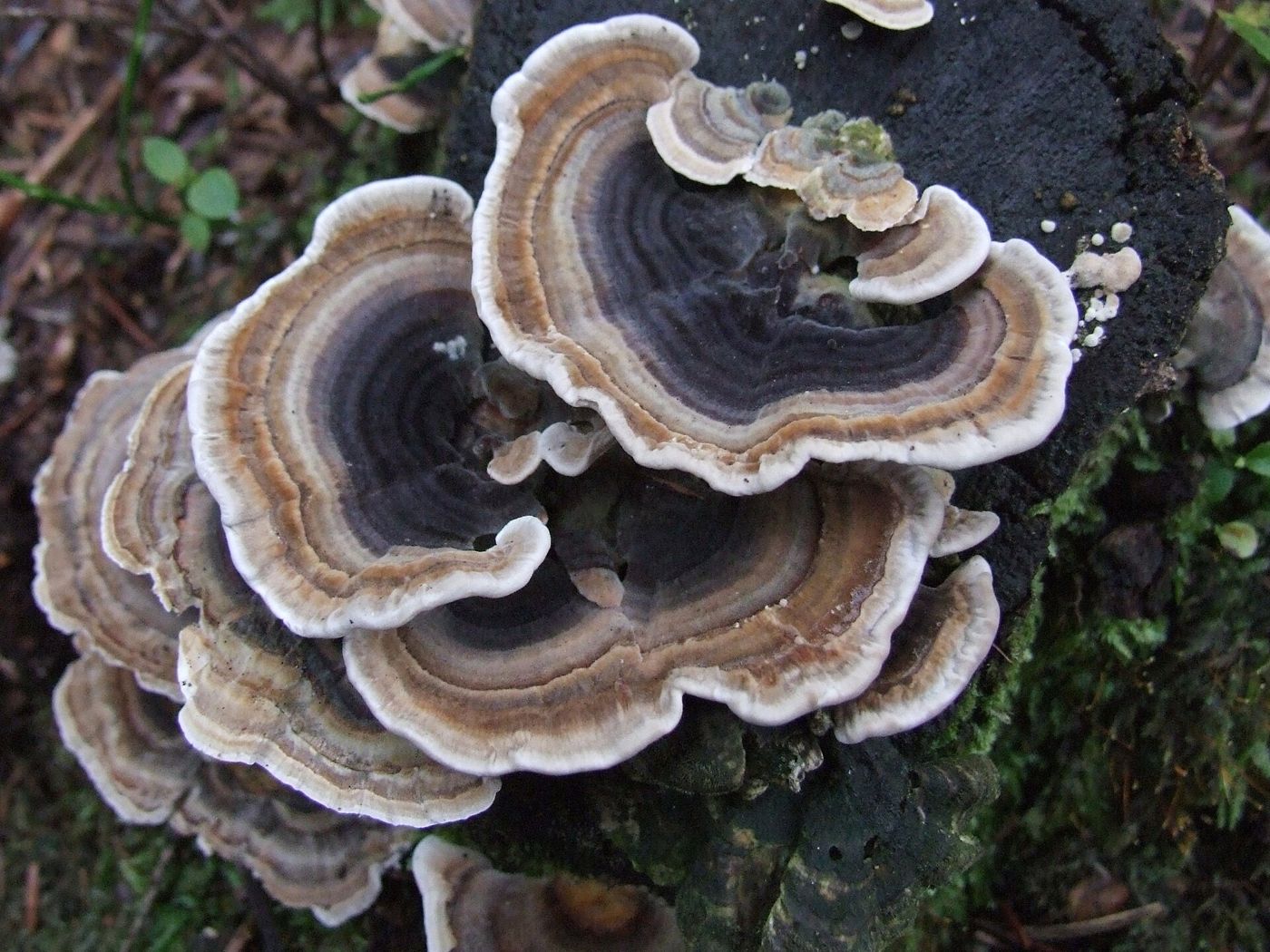
Walk through almost any woodland and you will find logs that are soft enough to push a finger into, stumps that crumble into brown blocks, and fallen branches bleached pale and stringy. Nearly all of that is the work of fungi. Wood is one of the toughest natural materials on Earth, and very few organisms can digest it. Fungi are by far the most important wood decomposers in most forests, and the way they do it explains why so many mushrooms and brackets appear on dead trees, stumps and buried roots.
To understand wood decay, it helps to know what wood is made of. It is built mainly from three substances: cellulose, long chains of sugar that give wood its strength; hemicellulose, a more loosely structured sugar polymer that binds the cellulose fibers together; and lignin, a complex, irregular compound that glues everything together and makes wood rigid and resistant to attack. Cellulose and hemicellulose are potentially rich food, but lignin wraps around them like armor. Fungi do not swallow wood. Instead their thread-like hyphae grow into it, release enzymes and other chemical agents outside their cells, and absorb the smaller molecules that result. The mushrooms and brackets we see are only the spore-producing fruiting bodies; the real work happens inside the wood, where the mycelium can spread for years before anything appears on the surface.
White rot fungi are the specialists that can break down lignin itself, along with cellulose and hemicellulose. They produce powerful oxidizing enzymes, including peroxidases and laccases, that attack lignin's tangled structure. Because lignin is responsible for much of wood's brown color, wood affected by white rot often turns pale, bleached, spongy or stringy, and it may peel apart in fibrous strands. Many familiar fungi are white rotters, including turkey tail (Trametes versicolor), oyster mushrooms (Pleurotus ostreatus), artist's conk (Ganoderma applanatum) and honey fungus (Armillaria species). Some researchers have proposed that the evolution of lignin-degrading enzymes in fungi helped change how carbon was stored on land hundreds of millions of years ago, although the details of that idea are still debated.
Brown rot fungi take a different approach. Rather than fully dismantling lignin, they rely largely on a chemical shortcut: they generate highly reactive molecules (a process often linked to what chemists call Fenton chemistry) that rapidly break apart cellulose and hemicellulose, then digest the fragments. The lignin is left behind in a modified form. The result is wood that turns reddish-brown, shrinks, loses its strength and cracks into small cube-shaped pieces that crumble to powder between your fingers. Brown rot is especially common on conifers. Well-known brown rot fungi include chicken of the woods (Laetiporus sulphureus), the red-belted conk (Fomitopsis pinicola) and dry rot (Serpula lacrymans), which is notorious for damaging timber in damp buildings. The leftover lignin-rich residue breaks down slowly and is thought to contribute to long-lasting organic matter in many forest soils.
There is also a third, less conspicuous category called soft rot, caused mainly by fungi in the Ascomycota group. Soft rot tends to occur in wood that is very wet or in conditions where white and brown rot fungi struggle, such as wooden posts in contact with soil. It softens the surface layers of wood and can be hard to spot until the timber is noticeably weakened. Fungi sometimes also leave visible signatures in wood: the dark, wandering lines seen in spalted wood are zone lines formed where different fungal colonies meet and wall themselves off from one another, which is why woodworkers prize partly decayed timber for its patterns.
This recycling is far more than a curiosity. Without wood-decay fungi, dead trunks and branches would pile up, locking away nutrients such as nitrogen and phosphorus that living plants need. As fungi break wood down, they return those nutrients to the soil, create soft hollows used by insects, birds and small mammals, and prepare the ground for new seedlings, some of which germinate directly on rotting logs. It is worth remembering, though, that the type of rot is only a clue, not an identification. Many unrelated species cause similar decay, and some wood-growing fungi are toxic. Chicken of the woods, for instance, is widely discussed by foragers, yet it has look-alikes, it grows on different host trees, and some people react badly to it. No single feature, including what kind of wood a fungus grows on or what kind of rot it causes, can tell you that a wild mushroom is safe to eat; only an expert who has examined the actual specimen can confirm edibility, and some deadly species, such as the funeral bell (Galerina marginata), also grow on wood.
If you find a bracket or cluster of mushrooms on a log or stump and want to know what it is, start by noting the decay around it: is the wood pale and stringy, or brown and cracked into cubes? Then photograph the fungus from several angles, including the top of the cap, the gills or pores underneath, and the base of the stem or the point where it attaches to the wood. Shroomly can use those photos to suggest likely species and flag toxic look-alikes, giving you a strong starting point for learning about the fungi recycling your local woodland. For anything beyond curiosity, and especially before anyone considers eating a wild mushroom, confirm the identification with a local mycological society or an experienced expert who can examine the specimen in person.