


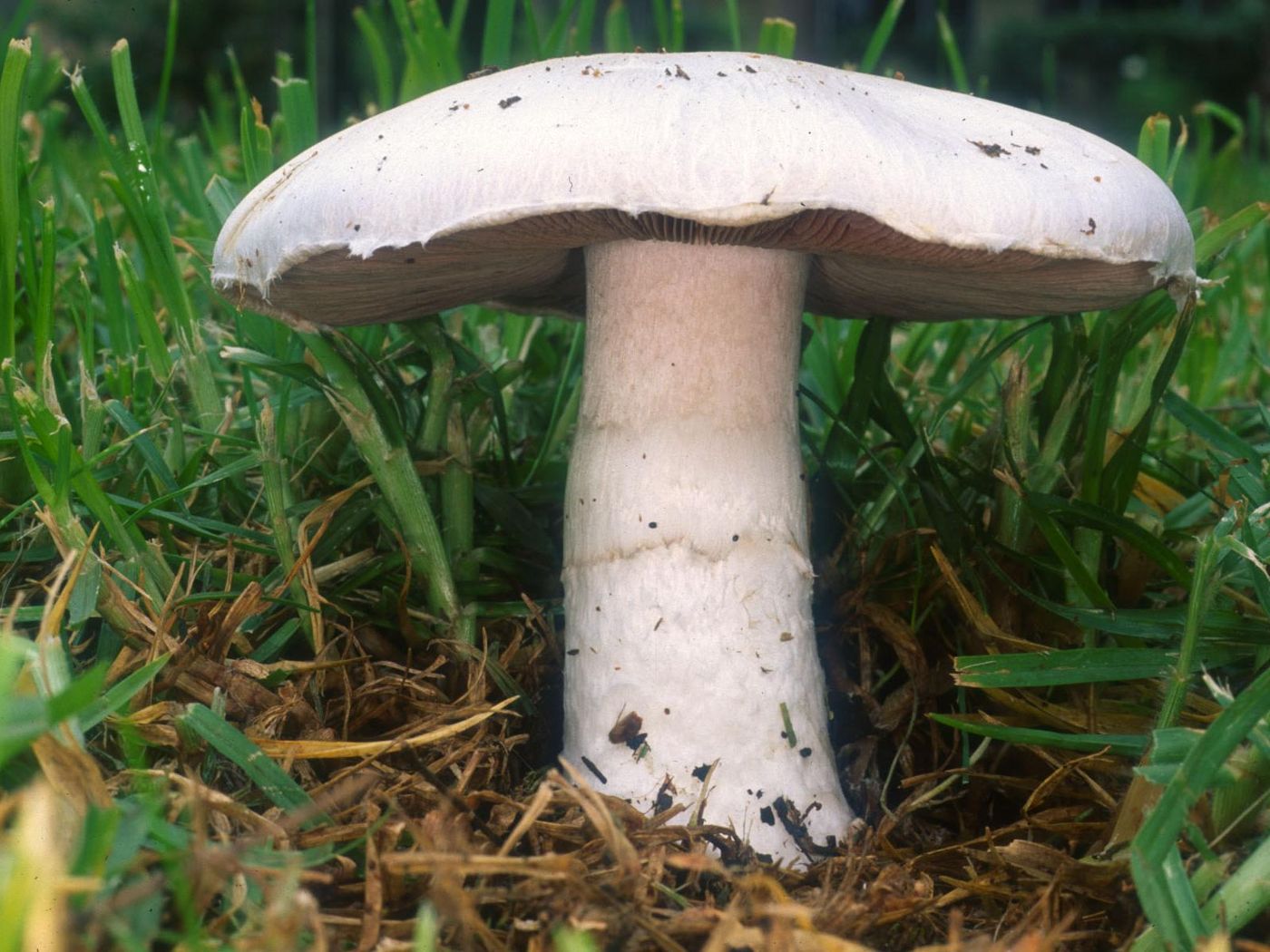
Field mushrooms and horse mushrooms are two of the best-known white grassland fungi in the Agaricus genus, the same group that includes the cultivated button mushroom. Both appear in pastures, meadows, parks and large lawns, mostly from late summer into autumn after warm, wet spells, and both are often found in loose groups, arcs or rings. Because they share a white cap, a ringed stem and gills that eventually turn dark chocolate brown, people regularly confuse them with each other. The more serious problem is that several toxic species share the same habitat and a similar look, so learning how these two differ is really about learning to look closely at every feature rather than trusting a general impression.
The field mushroom, Agaricus campestris, is the smaller and more delicate of the pair. Its cap is typically a few centimetres up to around ten centimetres across, white to off-white, sometimes with fine silky fibres or slight scaling, and it does not normally turn strongly yellow when bruised. The gills are free from the stem and are a distinctive bright pink in young specimens, darkening through pinkish brown to deep chocolate brown as the spores mature. The ring is thin and simple, often little more than a fragile ragged band that can disappear completely in older mushrooms. The stem is fairly short and tapers slightly towards the base without a swollen bulb or sac. It favours grazed or manured grassland, particularly old pastures used by horses, cattle or sheep, and is far less common on heavily fertilised modern fields.
The horse mushroom, Agaricus arvensis, is a noticeably bigger and more robust fungus, with caps that can reach well beyond the size of a field mushroom. The cap is white to creamy and tends to develop yellowish tones with age or handling, though this yellowing is slow and diffuse. Its gills start out a pale greyish pink rather than vivid pink, then darken to brown. The most useful features are the ring and the smell. The ring is large, membranous and hangs like a skirt, and its underside often shows a pattern of cottony patches arranged like the teeth of a cogwheel, a trait often described as a double ring. The flesh typically smells of aniseed or almond. Horse mushrooms grow in grassland and sometimes along woodland edges, and closely related species such as the wood mushroom, Agaricus sylvicola, grow in woods and add another layer of confusion. Taxonomists are still revising this group, and in North America and Australia the names used for horse mushroom look-alikes do not always match European ones.
The most common harmful mix-up in this group is with the yellow stainer, Agaricus xanthodermus, which causes gastrointestinal poisoning in many people. Its yellowing is the key difference from the horse mushroom: when the stem base of a yellow stainer is cut or scratched, it turns a sudden, bright chrome yellow, and the flesh gives off an unpleasant inky or phenolic smell, especially when warmed. The horse mushroom yellows more gently and smells of aniseed instead. Smell is subjective, however, and both stainers and non-stainers vary, so experienced foragers treat these tests as clues that must agree with everything else, not as proof on their own. Other toxic Agaricus species, including the inky mushroom Agaricus moelleri, can also look similar.
Far more dangerous is the overlap with deadly white Amanitas such as the destroying angel (Amanita virosa), the Western destroying angel (Amanita ocreata) and pale forms of the death cap (Amanita phalloides). These can appear at the edges of grassland near trees, and young buttons can look strikingly like young Agaricus caps. The differences are critical: Amanitas keep white gills throughout their life and drop a white spore print, while Agaricus gills turn pink and then brown and drop a dark brown print. Amanitas also have a sac-like volva at the stem base, which is often buried in soil and is easily snapped off or missed if a mushroom is picked rather than dug out whole. Unopened buttons hide the gills entirely, which is why they are especially risky. Folk tests do not help here; a silver spoon will not darken, peeling the cap proves nothing, and animals or slugs eating a mushroom say nothing about whether it is safe for people.
It is worth repeating that no single trait, rule of thumb or photograph can establish that a wild mushroom is safe to eat. Field and horse mushrooms are popular with foragers, but people are poisoned every year after mistaking a yellow stainer or a white Amanita for one of them, and amatoxin poisoning from Amanitas can be fatal. Only an expert who has examined the actual specimen, including the full stem base, the gill colour and a spore print, can confirm an identification. If anyone has eaten a wild mushroom and you are worried, call poison control or emergency services immediately and keep a sample of the mushroom for identification.
If you find white mushrooms in a field or lawn and want to know what they are, dig one up carefully so the whole stem base comes with it, then photograph the top of the cap, the gills from underneath, the ring and the base of the stem, ideally with a cut stem showing whether it stains. Shroomly can use those photos to suggest likely species such as Agaricus campestris or Agaricus arvensis and to flag toxic look-alikes like the yellow stainer or white Amanitas that you should rule out. Treat that result as a starting point, then confirm it with a local mycological society or an experienced expert who can examine the mushroom in person.