


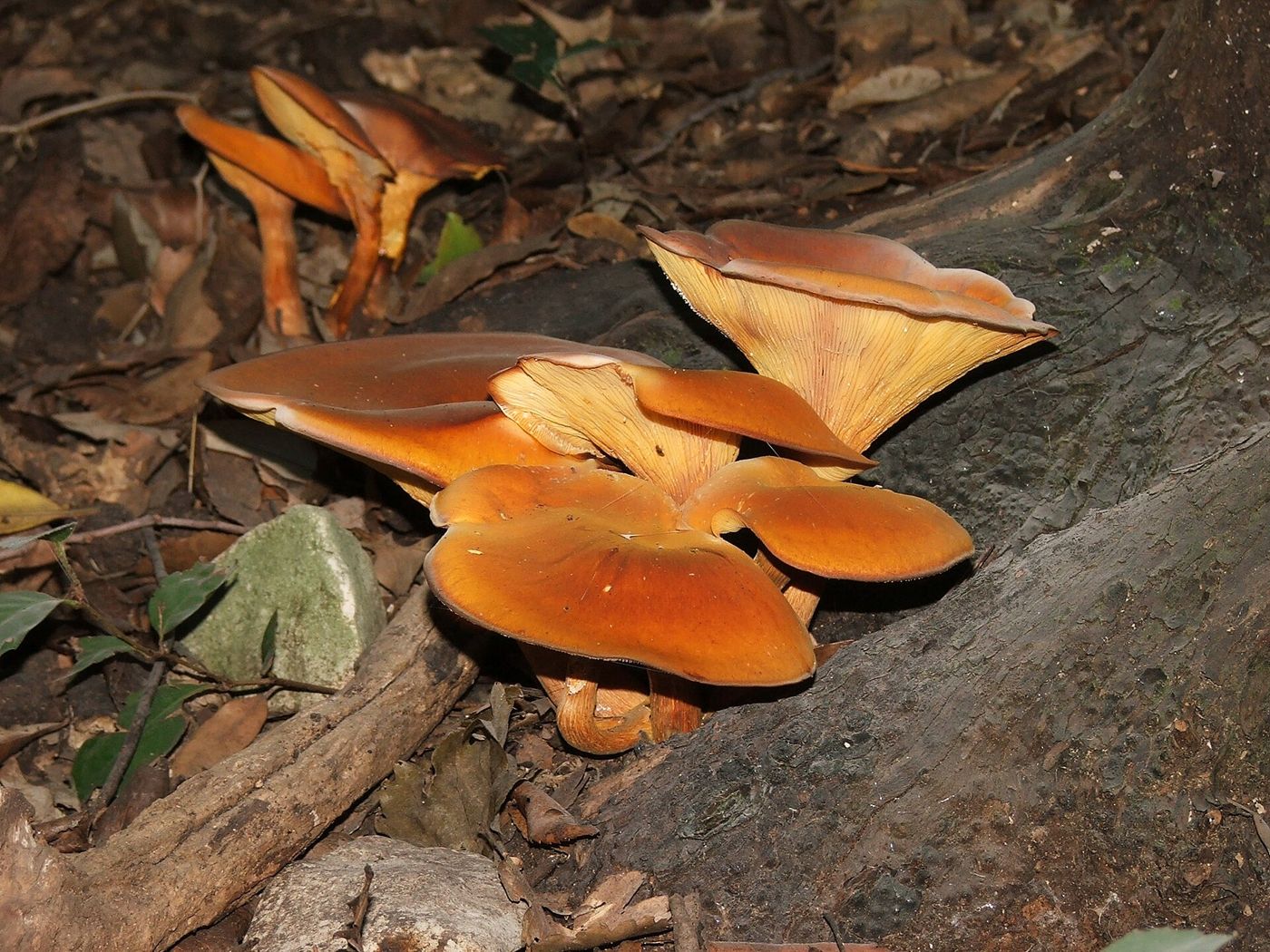
Every autumn, people find a dense cluster of orange or golden mushrooms at the base of a tree or bursting from an old stump and ask the same question: is this honey fungus or a jack-o'-lantern? The confusion makes sense. Both groups grow in tight bunches on wood or buried roots, both appear from late summer into autumn, and both can look warm orange in the right light. They are not closely related. Honey fungus belongs to the genus Armillaria, including Armillaria mellea and Armillaria ostoyae. Jack-o'-lanterns are species of Omphalotus: Omphalotus olearius in Europe, Omphalotus illudens in eastern North America and Omphalotus olivascens in western North America. Telling them apart takes a careful look at several features together, not a single quick check.
Colour is the first clue, but it can mislead. Jack-o'-lanterns are a strong, uniform pumpkin orange across the cap, gills and stem. Honey fungus is usually honey-yellow, tawny or brown, often darker at the centre of the cap. Weather, age and the species involved shift these colours a lot. A sun-faded jack-o'-lantern can look dull, and a young, wet honey fungus can look surprisingly orange. A more reliable check is to cut a mushroom lengthwise. The flesh of a jack-o'-lantern is orange to yellowish-orange all the way through. Honey fungus flesh is white to pale cream. This contrast is one of the most dependable field differences, but it should still be weighed alongside the others.
The cap surface and the stem add more evidence. Honey fungus caps typically carry small, dark, hair-like scales, concentrated toward the centre, though these can wash off in rain. Jack-o'-lantern caps are smooth and often develop a central depression or shallow funnel shape as they age. Many honey fungus species, including Armillaria mellea, have a membranous or cottony ring (annulus) on the upper stem. Jack-o'-lanterns never have a ring. One important exception is the ringless honey fungus, Armillaria tabescens (also placed in the genus Desarmillaria). It is common around oaks in the southeastern United States and lacks a ring, so it is the honey fungus most easily mistaken for a jack-o'-lantern. There, flesh colour and cap texture matter even more.
Look under the cap as well. Jack-o'-lantern gills are bright orange, crowded and strongly decurrent, meaning they run well down the stem. In fresh specimens they can give off a faint green bioluminescent glow in complete darkness, which is how the mushroom got its name. You cannot rely on seeing the glow, because it is weak and often absent. Honey fungus gills are whitish to cream when young, darkening and often spotting brown with age. They are attached to the stem and may run slightly down it. A spore print does not help much here, because both groups drop white to pale cream or yellowish spores. That is a good reminder that one test rarely settles an identification.
Where and how they grow tells part of the story too. Honey fungus is a well-known parasite and decomposer of trees and shrubs. Peeling back bark on an infected stump or root may reveal white fan-shaped mycelium and black, bootlace-like strands called rhizomorphs, which are a strong sign of Armillaria. Jack-o'-lanterns grow from buried roots or the base of hardwoods, especially oaks in North America and olive and other broadleaf trees in Europe. Because they emerge from underground roots, they can look as though they are growing from soil or grass near a tree. Both can fruit in large numbers, so the size of the cluster is not a distinguishing feature.
The safety picture matters more than the botany. Jack-o'-lanterns are poisonous. They contain compounds including illudins that cause severe vomiting, cramps and diarrhoea, and the mushroom is regularly eaten by people who mistake it for chanterelles or honey fungus. Honey fungus is not a safe alternative either. It causes digestive upsets in a significant number of people, its reactions are inconsistent, and the deadly funeral bell (Galerina marginata) grows on the same kinds of wood and can appear in the same places. Only an expert who has examined the actual specimen can confirm what a mushroom is and whether it is edible, and some deadly species look like popular edible ones. Folk tests such as a silver spoon turning dark, a cap that peels, a pleasant smell or seeing an animal nibble it tell you nothing about safety. If anyone has eaten one of these mushrooms and you are unsure what it was, call poison control or emergency services immediately and keep a sample of the mushroom for identification.
If you find an orange cluster on a stump this season, photograph it well before you disturb it: the top of the cap, the gills from underneath, the full stem including any ring, and the base where it meets wood or soil. A cut cross-section showing the flesh colour is especially useful for this pair. Shroomly can use those photos to suggest likely species, including toxic look-alikes such as Omphalotus and Galerina, and point you to the features worth checking. Treat that as a starting point, not a verdict. For anything you are thinking of eating, take the specimen to a local mycological society or an experienced expert who can examine it in person and confirm what it is.