


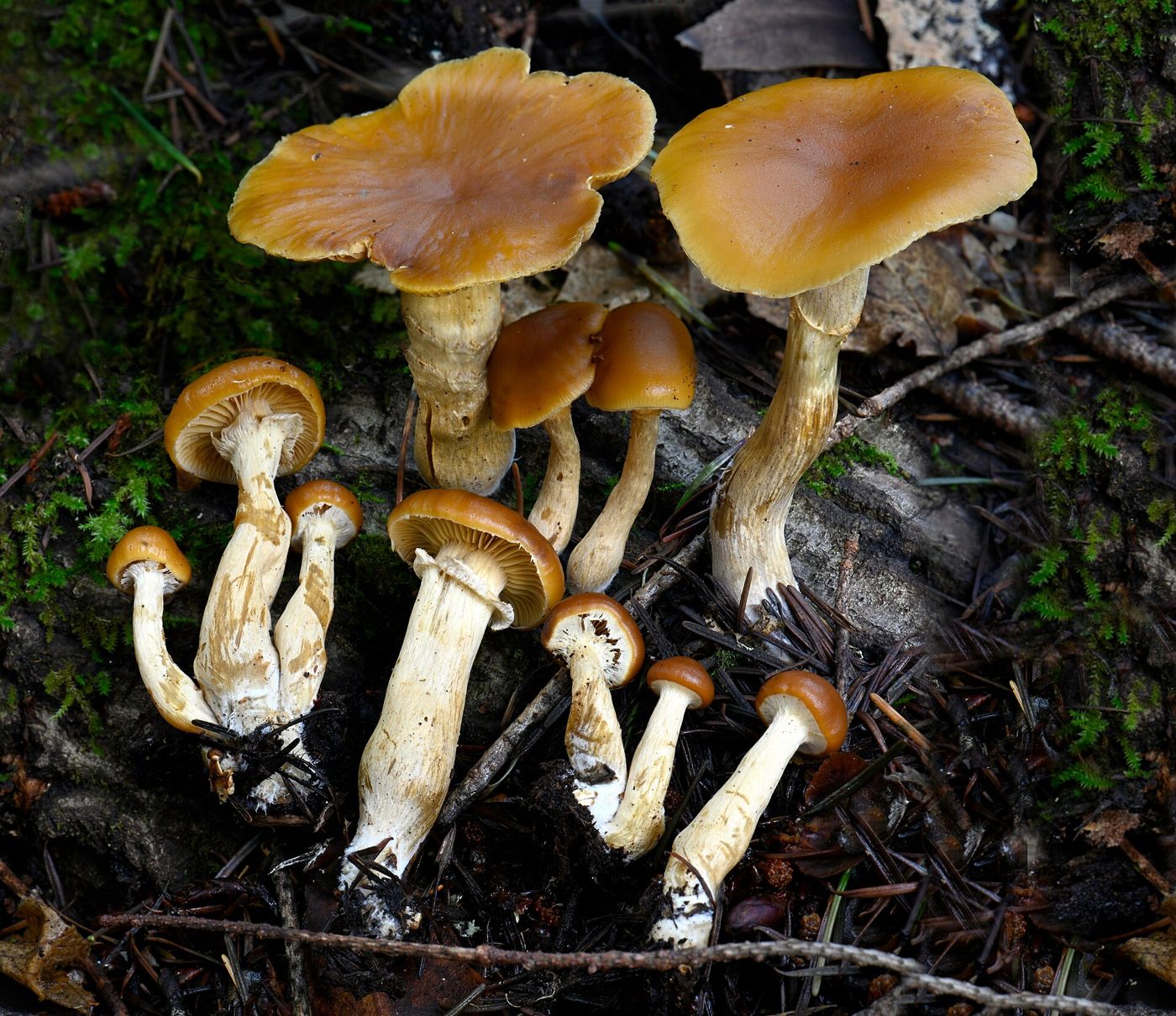
Autumn brings a dramatic flush of wood-decaying fungi to temperate forests across North America, Europe, and Australia, drawing foragers and nature enthusiasts outdoors in large numbers. Among the most abundant woodland sights are honey mushrooms, a collective name for several species in the genus Armillaria, including Armillaria mellea. However, these widespread fungi share their woodland habitat, timing, and general brown coloring with one of the most dangerous mushrooms in the world: the funeral bell, scientifically known as Galerina marginata. Because both species colonize decaying logs, tree stumps, and buried roots, learning the precise physical differences between them is one of the most critical lessons in field mycology.
The single most reliable diagnostic feature separating honey fungus from the funeral bell is the color of the spore deposit. Honey fungus species produce an abundant, pale spore print that ranges from pure white to pale cream. In contrast, the funeral bell produces a distinctly warm, rusty cinnamon to ochre-brown spore print. This underlying spore color also influences the appearance of mature gills. When young, the gills of honey fungus are whitish to pale yellow, sometimes developing faint reddish-brown flecks as they age, and they attach directly to the stem, often running slightly down it. The gills of Galerina marginata begin pale yellow-brown and turn a deep rusty brown as billions of dark spores mature, terminating abruptly at or just before the stem.
Beyond the gills, the texture and coloration of the cap surface offer vital clues to an observant naturalist. Honey fungus caps typically feature small, dark, upright scales or fibrous tufts clustered tightly around the center of the cap, giving them a slightly rough or velvety texture that feels dry to the touch. The caps of the funeral bell, however, are completely smooth and bald. They are also hygrophanous, meaning their color changes drastically depending on moisture levels; wet caps appear dark honey-brown or watery amber, but as they dry out from the center outward, they fade to a dull ochre or pale tan, creating a distinctive two-toned appearance that honey fungus rarely displays.
Stem anatomy also helps differentiate the two species, though weathering and age can make these features tricky to assess. Honey fungus stems are typically sturdy, fibrous, and tough, often tapering toward the base and anchored by black, root-like fungal cords called rhizomorphs hidden beneath the bark. The stem of a funeral bell is far more fragile, hollow in age, and typically adorned with a delicate, membranous ring that can easily erode in heavy rain. Below this faint ring zone, the stem of Galerina marginata frequently displays subtle, silvery-white longitudinal fibers contrasting against a darker brown base, whereas honey fungus stems remain fibrous and coarsened throughout.
Relying on traditional rules of thumb or folk tests when identifying wood-dwelling mushrooms is extraordinarily dangerous. Beliefs that poisonous mushrooms tarnish a silver coin, that boiling destroys all toxins, that easily peeled caps are safe, or that wild animals avoid toxic fungi are completely false and have led to fatal poisonings. The funeral bell contains potent amatoxins, the exact same class of cellular toxins found in the infamous death cap, which survive cooking and slowly destroy liver and kidney tissue. Symptoms often do not appear until six to twenty-four hours after ingestion, by which point internal damage is already underway. If anyone is suspected of having consumed a toxic wild mushroom, call local emergency services or a poison control center immediately, keep an intact specimen of the mushroom in a paper bag for clinical identification, and never wait for symptoms to develop.
A particularly perilous scenario occurs during cluster foraging, where a gatherer cuts an entire clump of mushrooms assuming they all belong to the same species. In mixed woodland environments, it is entirely possible for Galerina marginata and Armillaria to fruit within inches of each other on the exact same fallen tree trunk. No photograph, identification tool, or single physical trait can ever guarantee that a wild mushroom is safe to consume. Only a qualified regional expert who has physically inspected the fresh specimen can confirm its identity, as lethal look-alikes can deceive even seasoned foragers.
Whenever you find clustered mushrooms growing on dead wood, take the time to photograph them thoroughly before disturbing the colony. Capture crisp images of the cap surface, get low to photograph the gill structure and ring zone, and document the entire base of the stem where it meets the wood. You can upload these detailed photos to Shroomly to quickly explore likely species matches and study known toxic look-alikes side by side. Once you have a working identification, always verify your observations with a local mycological society or professional expert to build your fungal knowledge safely.