


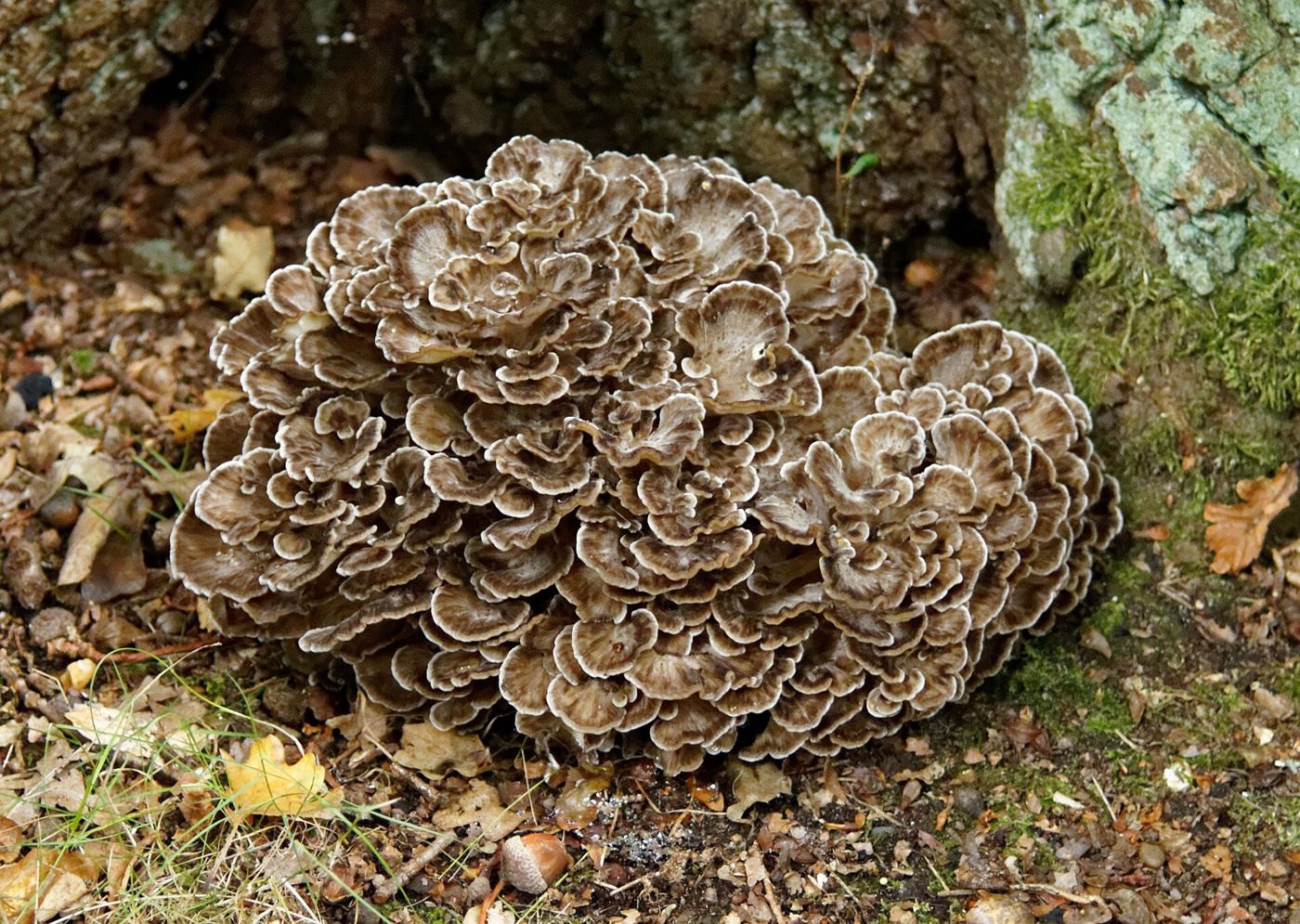
Few sights excite autumn walkers more than a huge, ruffled fungus spreading around the foot of an old tree. In North America that rosette is often hen of the woods, Grifola frondosa, also sold in shops under its Japanese name maitake. But hen of the woods is not the only polypore that grows this way. The black-staining polypore, known as the giant polypore, is a frequent stand-in: Meripilus giganteus in Britain and Europe and the closely related Meripilus sumstinei in North America. A third candidate, Berkeley's polypore (Bondarzewia berkeleyi), adds to the confusion in eastern North America. All three are large, clustered and found at tree bases, so knowing which features truly separate them is worth the effort before anyone starts making assumptions.
Hen of the woods is built from dozens, sometimes well over a hundred, small, spoon- or fan-shaped caps branching from a shared, thick base. Each cap is usually only a few centimetres across, thin and somewhat flexible, in shades of grey, grey-brown or smoky tan, often with faint radiating streaks. Turn a frond over and you will see a white to cream pore surface running down toward the stalk-like branches. The overall effect resembles a fluffed-up sitting hen, which gives the species its name. It is strongly associated with oaks, appearing at or near the base of living or dying trunks and stumps, typically from late summer through autumn. It is widespread in eastern North America and occurs in Europe, though it is generally considered uncommon in Britain, where many large tree-base rosettes turn out to be the giant polypore instead.
The black-staining polypore forms fewer but much bigger fronds. Individual caps are commonly the size of a hand or larger, thicker and more leathery, and coloured tan, ochre or brown with darker concentric zones. In Britain and much of Europe, Meripilus giganteus is especially associated with beech, though it grows with other broadleaf trees as well; in North America, Meripilus sumstinei appears around oaks and other hardwoods, which places it in exactly the same habitat as hen of the woods. Its season overlaps too, running from summer into autumn. Size alone is a weak guide, because both species can form clusters large enough to fill a bucket, so the more reliable clue lies in how the tissue reacts.
That reaction is the black-staining that gives Meripilus its common name. If you press or scratch the white pore surface, or cut the flesh, the damaged area gradually darkens to brown and then black, often over a period of several minutes up to an hour or so. Older specimens may already show black edges where they have been knocked by animals or weather. Hen of the woods does not do this; its pores and flesh stay pale when handled. Berkeley's polypore also lacks black staining, but it tends to have fewer, broad, creamy-white to pale tan caps with relatively large, angular pores, and it is notably tough. Because staining can be slow, it helps to note the colour of a freshly broken edge, wait, and look again rather than judging in the first few seconds.
None of this makes bruising a safety test. Staining is one useful character among many, and it only helps when the mushroom has already been narrowed to a polypore growing at a tree base. It says nothing on its own about whether a mushroom is safe to eat, and neither do other folk rules such as whether wildlife has nibbled it, how it smells, or whether a cap peels. Some people also mistake gilled clusters at tree bases for polypores; the jack-o'-lantern (Omphalotus species) and honey fungus (Armillaria species) both grow in tufts on or around wood, and both have gills rather than pores. Only an expert who has examined the actual specimen can confirm what it is and whether it is edible, and it is worth remembering that in other groups of fungi some deadly species closely resemble popular edible ones.
These fungi are also interesting for tree owners. Hen of the woods is associated with root and butt rot in oaks, and Meripilus giganteus is known for decaying the roots of beech and other broadleaf trees, sometimes weakening them enough to fall without much outward warning. If either appears repeatedly around a tree near a house, path or play area, an arborist can assess the tree's stability. Leaving the fruiting body in place does no harm to anyone and lets it release its spores, and a photograph often tells you more than picking would.
If you find a large frilly fungus at the base of a tree and want to know what it is, start by taking clear photos: the top of the caps, the underside showing the pore surface, the point where the cluster attaches to wood or soil, and a close-up of any area you have gently pressed after waiting to see whether it darkens. Note the tree species too, because oak versus beech can be a meaningful clue. Shroomly can use those images to suggest likely species and flag look-alikes such as Meripilus or Bondarzewia, giving you a strong starting point. Treat that result as a guide rather than a final answer, and confirm any identification with a local mycological society or an experienced expert who can examine the specimen in person. If anyone has eaten a wild mushroom and you are worried, call poison control or emergency services immediately and keep a sample of the mushroom for identification.