


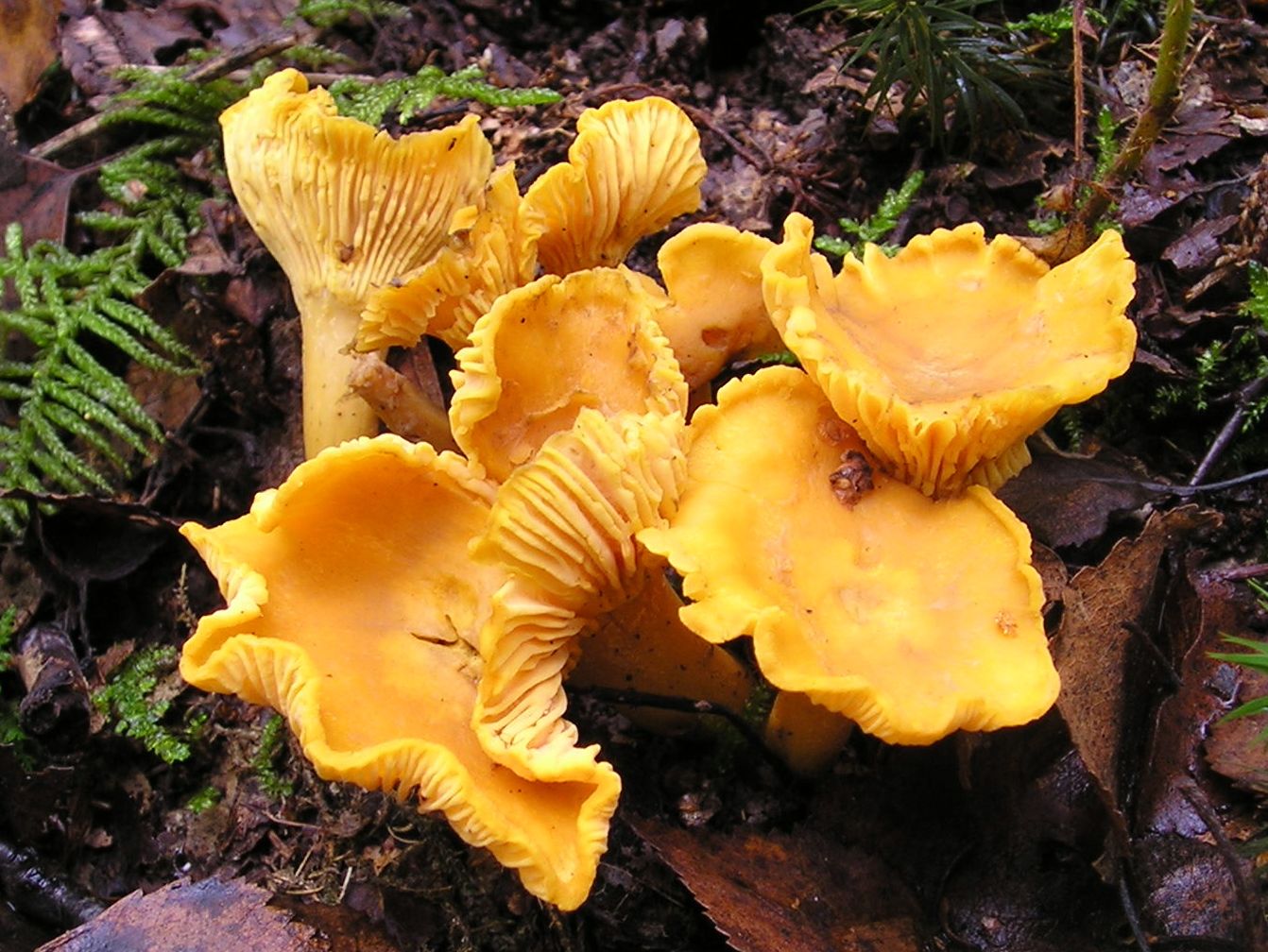
Hedgehog mushrooms and chanterelles are often found on the same woodland walk, at the same time of year, wearing remarkably similar colours. Both can be pale cream, buff, apricot or soft orange, both have a fleshy cap on a short stem, and both form partnerships with the roots of trees rather than rotting wood. From above, especially in dim light or in a quick phone photo, they can look almost interchangeable. The difference becomes obvious the moment you turn one over, and that single habit of checking the underside is the foundation of telling these two groups apart.
The hedgehog mushroom, best known in Europe as Hydnum repandum, gets its name from the underside of its cap, which is covered in crowded, soft, downward-pointing spines, often called teeth. They are pale, similar in colour to the cap or a little lighter, and they rub or break off fairly easily. Mycologists now recognise that Hydnum is a group of several closely related species rather than one, and in North America names such as Hydnum umbilicatum, the depressed hedgehog with a small dimple in the cap centre, are commonly used. The cap is often irregular and lumpy, the flesh is white and somewhat brittle, and many specimens slowly bruise orange where handled. The spore print is white to pale cream.
Chanterelles, with Cantharellus cibarius as the classic European example and a number of related Cantharellus species in North America, have no teeth at all. Instead the underside carries what are called false gills: shallow, blunt-edged ridges that fork and cross-connect and run well down the stem, so there is no clean line where cap ends and stem begins. The cap is often wavy and vase-shaped with age, the flesh is pale and tears into fibrous strands like string cheese, and the spore print is whitish to pale yellow or faintly pinkish. Many people describe a fruity, apricot-like smell, but smell varies between individuals and specimens and is never a reliable way to confirm identity or safety.
Habitat overlaps heavily. Both are mycorrhizal and appear on the ground in mixed, broadleaf and conifer woodland, frequently among moss and leaf litter, from summer into autumn, and in mild climates hedgehogs can persist well into late autumn and winter. Because they share ground and season, location alone will not separate them. What it can do is help you rule out some look-alikes: a cluster growing from a stump, buried roots or the base of a trunk is a warning sign, because the toxic jack-o'-lantern mushrooms (Omphalotus olearius in Europe and Omphalotus illudens in eastern North America) grow in tight clumps from wood and have true, sharp-edged gills rather than ridges or spines.
Each of these mushrooms has its own set of confusions to watch for. Chanterelle look-alikes include the false chanterelle (Hygrophoropsis aurantiaca), which has thin, crowded, true gills and a more uniformly orange colour, the jack-o'-lanterns mentioned above, and, most seriously, orange-brown webcaps such as the deadly webcap (Cortinarius rubellus), which have true gills, a rusty brown spore print and can cause severe kidney damage. Hedgehogs are less commonly confused with deadly species, but they share the toothed underside with other tooth fungi such as Sarcodon, Hydnellum and Phellodon, which tend to be tougher, often scaly, darker or zoned, and in some cases intensely bitter. Seeing spines does not by itself confirm a hedgehog, just as seeing orange does not confirm a chanterelle.
It is worth being plain about edibility. Folk rules such as peeling the cap, testing with a silver spoon, noticing that slugs or squirrels have nibbled it, or judging by a pleasant smell do not tell you whether a wild mushroom is safe, and some deadly species look like popular edible ones. Only an experienced expert who has examined the actual specimen in hand, including the underside, stem base, flesh and spore print, can confirm what it is. If anyone has eaten a wild mushroom and you are unsure what it was, call poison control or emergency services immediately and keep a sample of the mushroom for identification.
If you find a pale orange mushroom and want to know which group it belongs to, photograph it from above, then turn it over and take a sharp close-up of the underside so the spines, ridges or gills are clearly visible, followed by the stem and its base, including where it emerges from the soil or wood. Shroomly can use those photos to suggest likely species, highlight whether the features point toward Hydnum, Cantharellus or something else, and flag toxic look-alikes such as Omphalotus, Hygrophoropsis and Cortinarius. Treat that result as a starting point, then confirm your find with a local mycological society or an experienced expert who can examine the mushroom in person.