


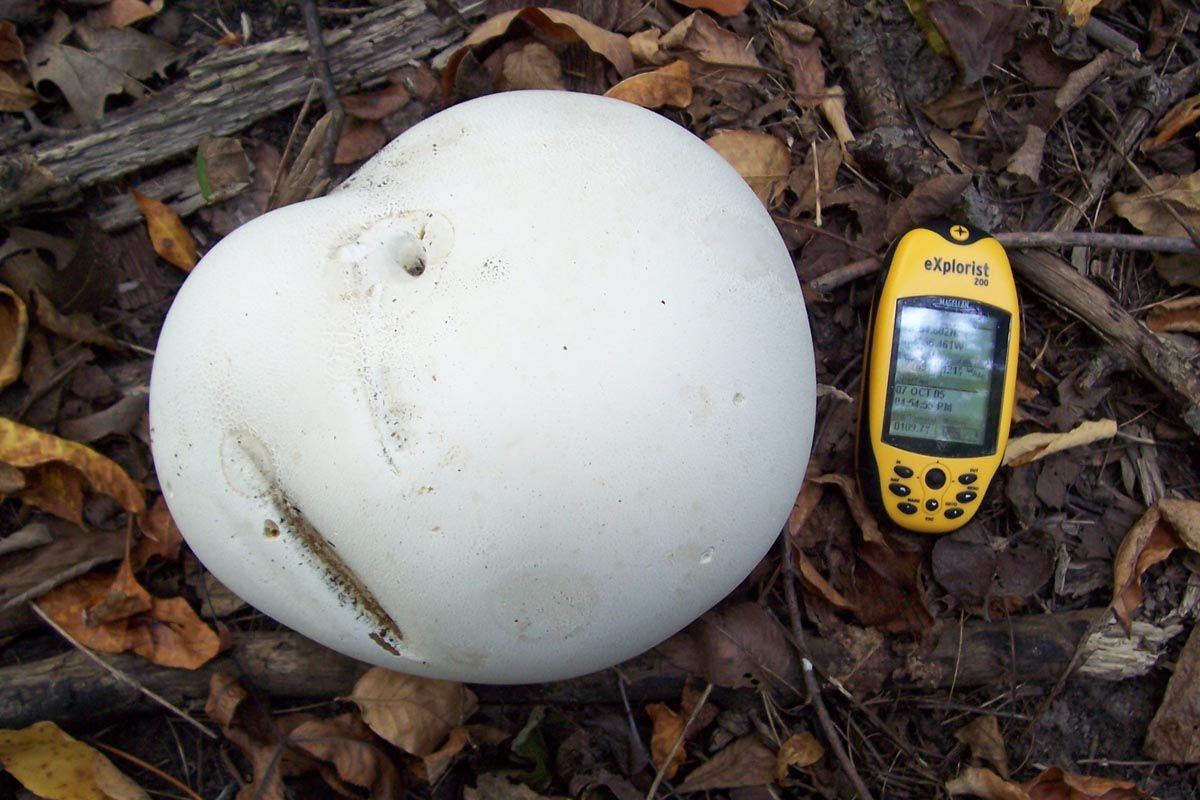
Puffballs are among the most recognisable fungi in the world, and two species account for a large share of the puffballs people find and photograph: the giant puffball, Calvatia gigantea, and the common puffball, Lycoperdon perlatum. Both are rounded, both start out white, and both eventually turn into a bag of powdery brown spores. Beyond that they are surprisingly different in size, surface, shape and the places they choose to grow. Knowing those differences helps you put a name to what you have found, but it is just as important to understand that several harmful fungi can pass for a puffball at a glance, and that no single feature makes a wild mushroom safe.
Size is the most obvious clue. A mature giant puffball is typically somewhere between the size of a grapefruit and a football, and exceptional specimens can grow much larger. Its skin is smooth, white and slightly leathery, sometimes compared to suede or kid leather, and it has no real stem; the ball sits directly on the ground, attached by a thin cord of mycelium that snaps easily. The common puffball, by contrast, is usually only a few centimetres across and is shaped like an upside-down pear or a small club, with a distinct narrowed base that works like a stem. Its surface is covered in tiny cone-shaped spines, larger ones surrounded by smaller ones, that rub off with handling and leave a faint net-like pattern on the skin beneath. That spiny, gem-studded look is the source of its other common name, the gem-studded puffball.
How each species releases its spores is another useful difference. As the common puffball matures, it develops a small opening at the top, called an ostiole. When a raindrop or a passing animal presses on the papery skin, a puff of brown spore dust jets out of that pore. The giant puffball has no such opening. Instead, its outer skin cracks and flakes away as it ages, exposing an olive-brown spore mass that is dispersed gradually by wind, rain and contact. If you find a large white ball breaking up in patches like old plaster, you are probably looking at an ageing Calvatia gigantea rather than a giant version of the common puffball.
Habitat and season help confirm the picture. Giant puffballs are mainly grassland fungi, turning up in meadows, pastures, field margins, parks, gardens and along hedgerows, often near nettles or other signs of rich soil, from late summer into autumn in temperate parts of Europe and North America. They can appear in the same spot year after year. The common puffball is more typically a woodland species, growing on the ground among leaf litter and needles in both broadleaf and conifer woods, as well as along paths and woodland edges, from summer through autumn and often in groups. If your small puffballs are growing in clusters directly on rotting stumps or logs, you may have the stump puffball, Lycoperdon pyriforme, a related species that prefers decaying wood.
The real reason to look closely at any puffball is its look-alikes. Earthballs, especially the common earthball (Scleroderma citrinum), are toxic and can resemble a puffball from the outside, but they have a thick, tough rind, often with a scaly yellowish surface, and an interior that becomes firm and purplish-black rather than staying soft and white. More dangerous still, the young egg stage of deadly Amanita species, including the death cap (Amanita phalloides) and destroying angels, can look like a small white puffball sitting in the soil. The only way to tell is to slice the specimen top to bottom: a true puffball at the immature stage is uniformly white and featureless inside, like a marshmallow, while an Amanita egg reveals the outline of a cap, gills and stem developing within. Small, white, rounded fungi of common-puffball size are where this mix-up is most likely, which is why experienced foragers treat them with particular caution. Even then, a clean white interior is a check, not a guarantee, and edibility can only be confirmed by an expert who has examined the actual specimen. Folk tests such as watching whether animals nibble a fungus, peeling the skin, or rubbing it with a silver spoon tell you nothing about toxicity.
If anyone eats a wild puffball or any fungus they are unsure about and you suspect poisoning, call poison control or emergency services straight away, and keep a sample of the mushroom so it can be identified. Do not wait to see whether symptoms develop, because some of the most dangerous mushroom toxins act slowly and cause serious damage before people feel unwell.
When you come across a puffball, the most useful thing you can do is record it well. Photograph it from the side to show its overall shape and the base, take a close-up of the surface to capture any spines, cracks or scales, and if you can do so safely, photograph a clean vertical cross-section showing the interior. Note whether it was growing in grass, in woodland soil or on wood. Shroomly can use those photos to suggest likely species, including whether you are looking at Calvatia gigantea, Lycoperdon perlatum or a related puffball, and to flag toxic look-alikes such as earthballs and Amanita eggs. Treat that result as a starting point for learning, not a verdict on edibility, and confirm any identification with a local mycological society or an experienced expert who can examine the specimen in person.