


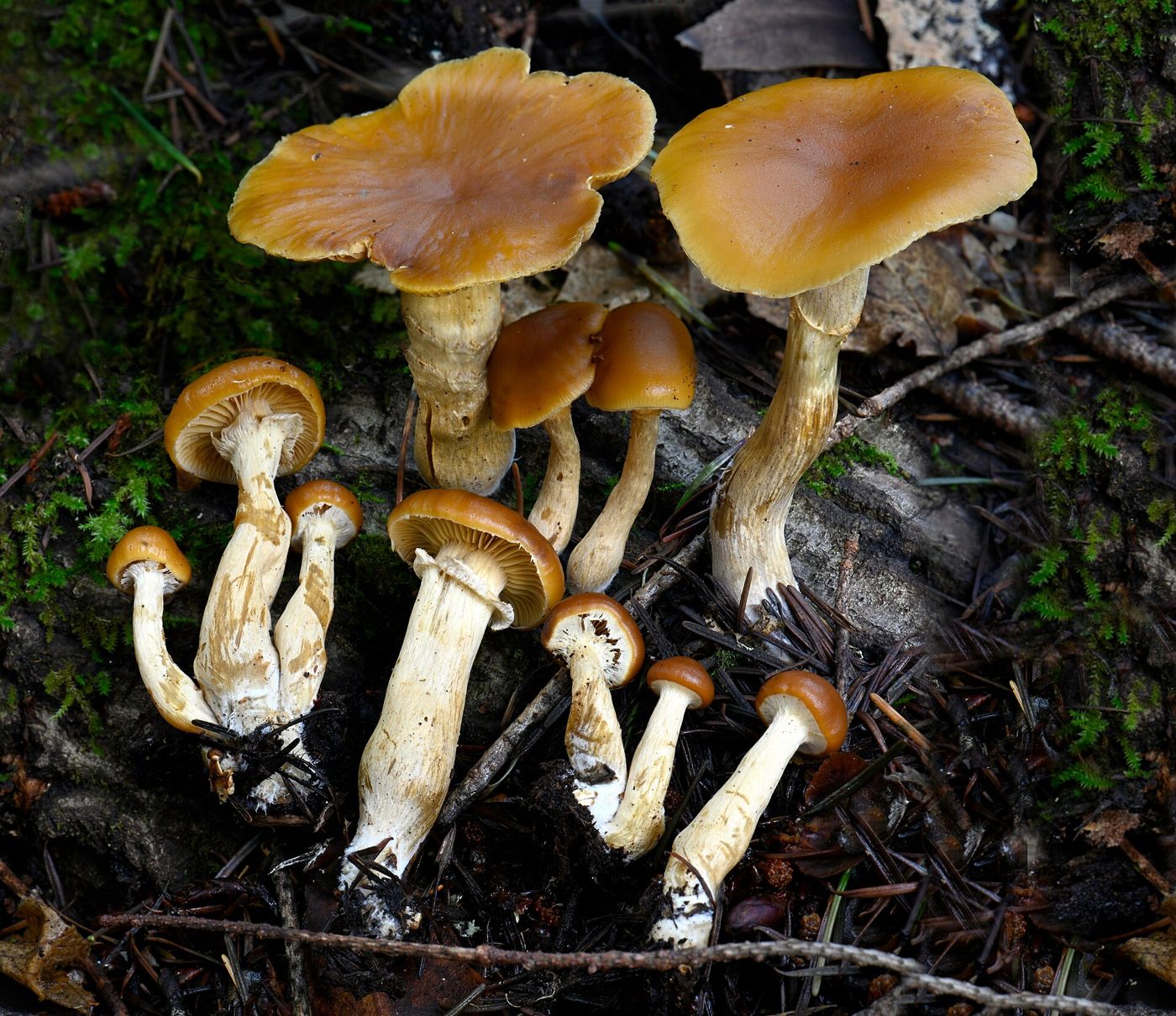
The funeral bell, scientifically classified as Galerina marginata and historically known by names such as the deadly skullcap, is one of the most hazardous wild fungi found across North America, Europe, Asia, and parts of Australia. Despite its modest size and unassuming brown coloration, this small woodland mushroom produces lethal amatoxins. Amatoxins are heat-stable bicyclic octapeptides that directly inhibit RNA polymerase II, halting protein synthesis and causing massive cellular death within the liver and kidneys. The insidious nature of amatoxin poisoning lies in its delayed timeline; severe gastrointestinal distress typically does not appear until six to twenty-four hours after ingestion, by which point the toxins have already entered the bloodstream and begun damaging vital organs.
Recognizing the morphology of Galerina marginata requires careful observation because its physical characteristics can change depending on moisture and age. The cap generally measures between one and four centimeters across, starting out convex or bell-shaped before flattening with maturity. It is distinctly hygrophanous, meaning its appearance shifts dramatically as it dries: waterlogged caps appear honey-colored to tawny-brown with faintly translucent striations along the margin, while dry caps fade to a pale yellowish-ochre. Beneath the cap, the gills are moderately crowded, initially pale buff before ripening into a dull rusty-brown shade corresponding to its rusty-brown spore print. The stem is slender, often hollow in older specimens, and bears a faint, membranous ring that can easily weather away or adhere tightly to the stem as a brownish smudge.
A primary reason the funeral bell causes accidental poisonings is its habitat and deceptive resemblance to other wood-dwelling fungi. Galerina marginata is a saprotrophic species that fruits predominantly on decaying wood, especially rotting conifer logs, fallen hardwood branches, and woodchip mulch. Because wood-decaying mushrooms frequently grow in dense clusters, the funeral bell often appears in the exact same microhabitats as popular edible or sought-after wild species. It can be dangerously mistaken for the honey fungus (Armillaria mellea), velvet shank (Flammulina velutipes), or the sheathed woodtuft (Kuehneromyces mutabilis). Alarmingly, funeral bells have even been documented fruiting directly interspersed within clusters of other species on the very same log, making individual stem-by-stem scrutiny vital whenever woodland fungi are encountered.
Pervasive foraging myths make the funeral bell particularly dangerous to unsuspecting outdoor enthusiasts. Dangerous folk tests claim that deadly mushrooms only grow from the ground, that any mushroom growing on wood is non-lethal, or that boiling or peeling will destroy fungal poisons. In truth, amatoxins cannot be neutralized by cooking, freezing, parboiling, or drying, and wood-rotting species like Galerina marginata contain concentrations high enough to prove fatal. Similarly, observing insects or woodland rodents chewing on a cap does not indicate it is safe for humans, as many animals possess different digestive enzymes or metabolic tolerances. If anyone suspects that a person or pet has swallowed any part of a funeral bell, do not wait for stomach pain or nausea to develop; contact poison control or emergency medical services immediately and retain every remaining fragment of the mushroom in a paper bag for clinical identification.
Because lethal look-alikes can disguise themselves among seemingly mundane woodland clusters, thorough visual examination is essential whenever documenting wild fungi. To build a reliable record for identification, photograph the specimen in natural lighting, capturing the upper surface of the cap, the attachment and color of the gills underneath, and the full length of the stem down to where it attaches to the wood or substrate. Submitting clear photos to Shroomly can help pinpoint candidate species and highlight potential toxic look-alikes like Galerina marginata, providing crucial context before you seek confirmation from an experienced local mycological society. Ultimately, no mushroom should ever be considered safe to consume based on a photo, automated match, or rule of thumb, as only a qualified expert who has physically inspected the specimen can determine its true identity.