


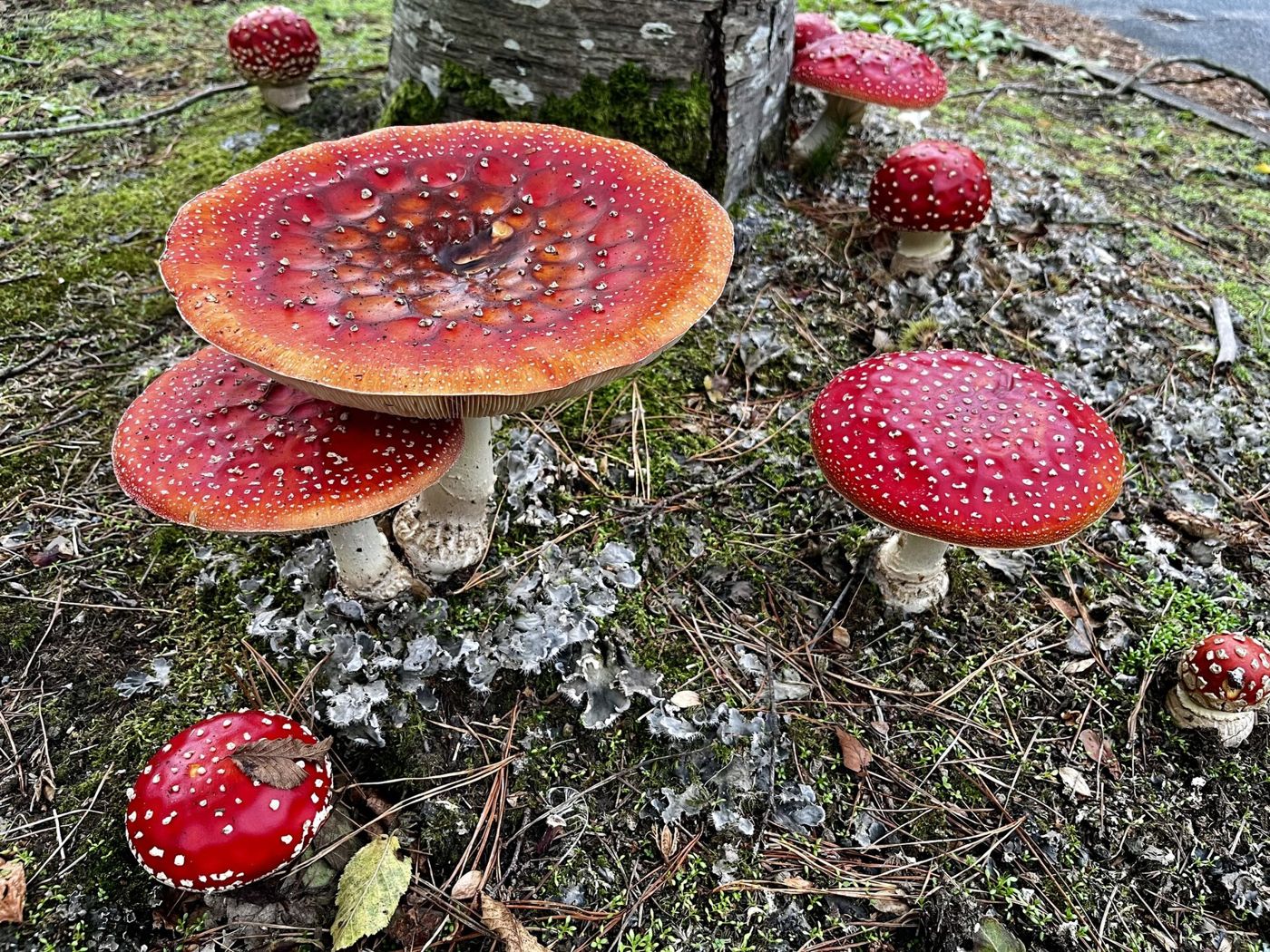
Fly agaric (Amanita muscaria) is probably the most recognizable mushroom in the world. Its red cap with white spots appears in fairy tales, video games and holiday decorations. Its close relative, the panther cap (Amanita pantherina), gets far less attention, yet the two are often mentioned together for good reason. They share the same basic Amanita body plan and contain the same group of toxins, ibotenic acid and muscimol. In the panther cap these toxins are generally considered more concentrated, and its poisonings are often described as more severe. People typing 'brown mushroom with white spots' into a search engine are frequently looking at a panther cap, a faded fly agaric, or one of several other brown Amanitas. Knowing how these species differ, and why none of them should be eaten, is useful for anyone who walks in woodland in summer and autumn.
The most obvious difference is cap color, but it is less reliable than it seems. A typical fly agaric has a bright scarlet to orange-red cap covered in white to slightly yellowish warts. These warts are fragments of the universal veil that enclosed the young mushroom. Some populations are different, though. In parts of eastern North America the common form, often called Amanita muscaria var. guessowii, is yellow to orange. Heavy rain can also wash the red pigment out of older caps, leaving them pale orange or even buff. The panther cap has a cap that ranges from olive-brown to hazel or dark brown, and its warts are usually small, neat and pure white. A rain-faded fly agaric next to a pale panther cap can look surprisingly similar. Rain can also wash the warts off both species completely, which is why cap color and spots alone should never decide an identification.
The stem base is where the two species separate most clearly, and it is also why the whole mushroom must be dug up gently rather than snapped off. Fly agaric has a swollen bulb ringed with several concentric bands or scaly rows of white volval tissue, a bit like the rings on a stacked set of bracelets. The panther cap has a rounded bulb topped by a neat, free rim of volva, often described as a rolled collar or gutter, sitting just above the bulb like the edge of a sock turned down. Both species have white gills that are free from the stem, a white spore print and a skirt-like ring on the stem. On the panther cap the ring is usually smooth on top. Its cap edge also tends to show fine radial grooves, called striations, which are often less obvious on fly agaric. Experienced identifiers look at all of these features together, never at a single one.
Habitat and season overlap a great deal. Both are mycorrhizal, meaning they form partnerships with tree roots. Fly agaric is classically found under birch, pine and spruce. The panther cap is more often associated with broadleaf trees such as beech and oak, though it also grows under conifers. In the United Kingdom and much of Europe both fruit from late summer through autumn. In North America the naming is more complicated. Mushrooms once called Amanita pantherina there are now often treated as separate, closely related species, such as Amanita pantherinoides on the West Coast. Fly agaric has also been introduced with pine plantations in places like Australia and New Zealand. Because two species can grow under the same tree in the same week, location is a clue, not a confirmation.
Several other brown, spotted Amanitas complicate the picture further. The blusher (Amanita rubescens) has a pinkish-brown cap with greyish or dirty-white warts. Its flesh slowly turns pinkish-red where it is damaged or nibbled by insects, and it lacks the panther cap's neat collar at the bulb. The grey spotted amanita (Amanita excelsa, sometimes listed as Amanita spissa) has grey-brown caps with greyish veil patches and a ring that is grooved on its upper surface. Foragers sometimes seek the blusher, and that is exactly how panther cap poisonings happen. The differences are subtle, the features vary with age and weather, and the deadly death cap (Amanita phalloides) belongs to the same genus. No folk test helps here. Peeling the cap, watching whether slugs or squirrels eat it, cooking it, or rubbing it on silver says nothing about Amanita toxins. Only an expert who has examined the actual specimen can confirm an identification.
Eating either the fly agaric or the panther cap can cause poisoning that typically begins within roughly half an hour to a few hours. Symptoms may include nausea and vomiting, confusion, agitation, dizziness, drowsiness, muscle twitching, hallucinations and delirium. Severe cases can involve seizures or coma. Children and pets, especially dogs, are at particular risk. These mushrooms are sometimes discussed online as recreational or traditional substances, but their effects are unpredictable and toxin levels vary widely between individual mushrooms, so there is no safe way to experiment with them. If anyone may have eaten one, call poison control or emergency services immediately. Do not wait for symptoms, and keep a sample of the mushroom, including the stem base if possible, to help responders identify it.
If you find a spotted mushroom and want to know what it is, start with good photographs rather than guesses. Carefully dig up the whole mushroom, or photograph it in place if you prefer not to pick it. Capture the top of the cap, the gills and ring from below, and especially the bulb and any volval rings or collar at the base. Shroomly can then suggest likely species, such as fly agaric, panther cap or blusher, and highlight the toxic look-alikes you need to rule out. Treat that result as a starting point for learning, not as permission to eat anything. For a confirmed identification, take the specimen to a local mycological society or an experienced expert. Remember that some of the deadliest mushrooms on earth are Amanitas that closely resemble species people consider edible.