


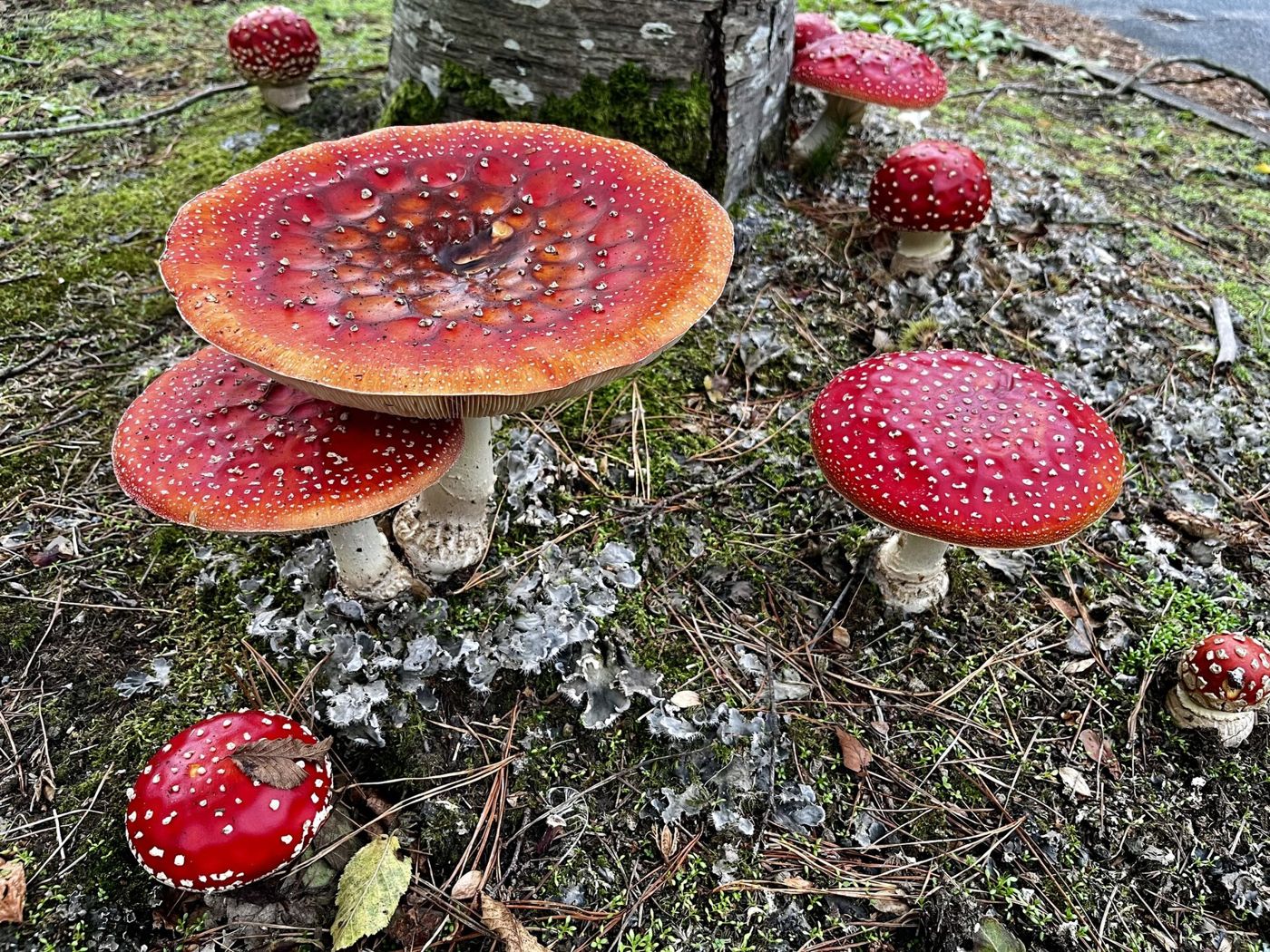
Few mushrooms are as recognisable as the fly agaric, the red toadstool with white spots that appears in fairy tales, video games and holiday decorations. Yet it has a surprisingly close relative that also wears a brilliant red-orange cap: Caesar's mushroom, Amanita caesarea. Both belong to the genus Amanita, both start life inside a protective universal veil, and both can turn up in late summer and autumn woodland. Because one of them has a long history as a prized table mushroom in southern Europe and the other is toxic, people often search for how to tell them apart. The honest answer is that the differences are clear on a complete, mature specimen, but the stakes are high, the genus contains some of the deadliest fungi on Earth, and no comparison guide can replace expert examination of the actual mushroom.
The fly agaric, Amanita muscaria, typically has a scarlet to orange-red cap scattered with white to cream wart-like patches, which are remnants of the universal veil. Its gills are white and free from the stem, its spore print is white, and its stem is white with a drooping white ring, or annulus, near the top. At the base, the stem swells into a rounded bulb that is usually encircled by one or more ragged rings or collars of white, scaly veil tissue rather than a loose sac. Fly agaric forms partnerships with trees, especially birch, pine and spruce, and is widespread across the UK, much of Europe, northern Asia and North America, and it has been introduced to parts of Australia and New Zealand with planted pines. In North America there are several regional forms, including yellow to orange varieties in the east, which is one reason colour alone is not a reliable guide. It contains ibotenic acid and muscimol, which can cause confusion, agitation, drowsiness, vomiting and other serious effects.
Caesar's mushroom, Amanita caesarea, is a species of warmer climates, found mainly in southern Europe and around the Mediterranean, with scattered records further north; it is essentially absent from the UK. Its cap is orange to orange-red and usually smooth, often lacking the white warts of the fly agaric, with a finely grooved margin in mature specimens. The most useful contrasts are underneath and below: the gills are yellow, the stem is yellow, and the ring is yellow, while the base of the stem sits inside a thick, white, cup-like volva, a loose sac that can be hidden in soil if the mushroom is snapped off rather than carefully dug out. It associates with oaks, sweet chestnut and other broadleaf trees, often fruiting in summer to early autumn after warm rain. In eastern North America, a similar group of species, including Amanita jacksonii, the American Caesar's mushroom, shows the same pattern of an orange-red cap, yellow gills and stem, and a white sac-like volva.
Putting these traits side by side, the clearest separators are gill colour, stem colour and the structure of the stem base. White gills and a white stem with a bulb ringed by scaly collars point towards fly agaric, while yellow gills, a yellow stem and ring, and a smooth white sac around the base point towards the Caesar's group. The white warts on a fly agaric cap are not dependable, because heavy rain can wash them off entirely, leaving a smooth orange cap that looks much more like Caesar's mushroom. Faded or sun-bleached fly agarics can also look orange or even yellowish. Likewise, the volva of either species is easily left behind in the ground, and a mushroom pulled up without its base has lost one of its most important identification features. This is why a quick glance at cap colour, or a single trait in isolation, can lead people badly astray.
There is an additional danger that makes this comparison more than an academic exercise. Very young Amanitas emerge from an egg-like universal veil, and at that stage the colours that separate species may barely be visible. Cutting a young Caesar's mushroom egg in half may show an orange cap inside, but eggs of the death cap, Amanita phalloides, and destroying angels can look superficially similar from the outside, and these species contain amatoxins that cause severe liver damage and can kill. Death caps grow under oaks and chestnuts too, in the same habitats as Caesar's mushroom, and have spread to parts of North America and Australia. Edibility can only be confirmed by an expert who has examined the actual specimen, and folk tests such as whether a cap peels, whether a silver spoon darkens, whether animals have nibbled it or how it smells tell you nothing about safety. If anyone has eaten a mushroom like these, or you suspect poisoning, call poison control or emergency services immediately and keep a sample of the mushroom for identification, without waiting for symptoms to appear.
If you want to identify a red or orange mushroom you have found, start by recording the whole fruiting body rather than just the cap. With Shroomly, photograph the top of the cap, the gills from underneath, the stem and ring, and the very base of the stem after carefully exposing it from the soil so any volva or bulb is visible, and note which trees are nearby. The app can suggest likely species, including fly agaric, Caesar's mushroom and the dangerous Amanitas they can be confused with, and highlight which features to check. Treat that result as a starting point for learning, not a verdict on edibility, and confirm any identification with a local mycological society or an experienced expert who can examine the specimen in person.