


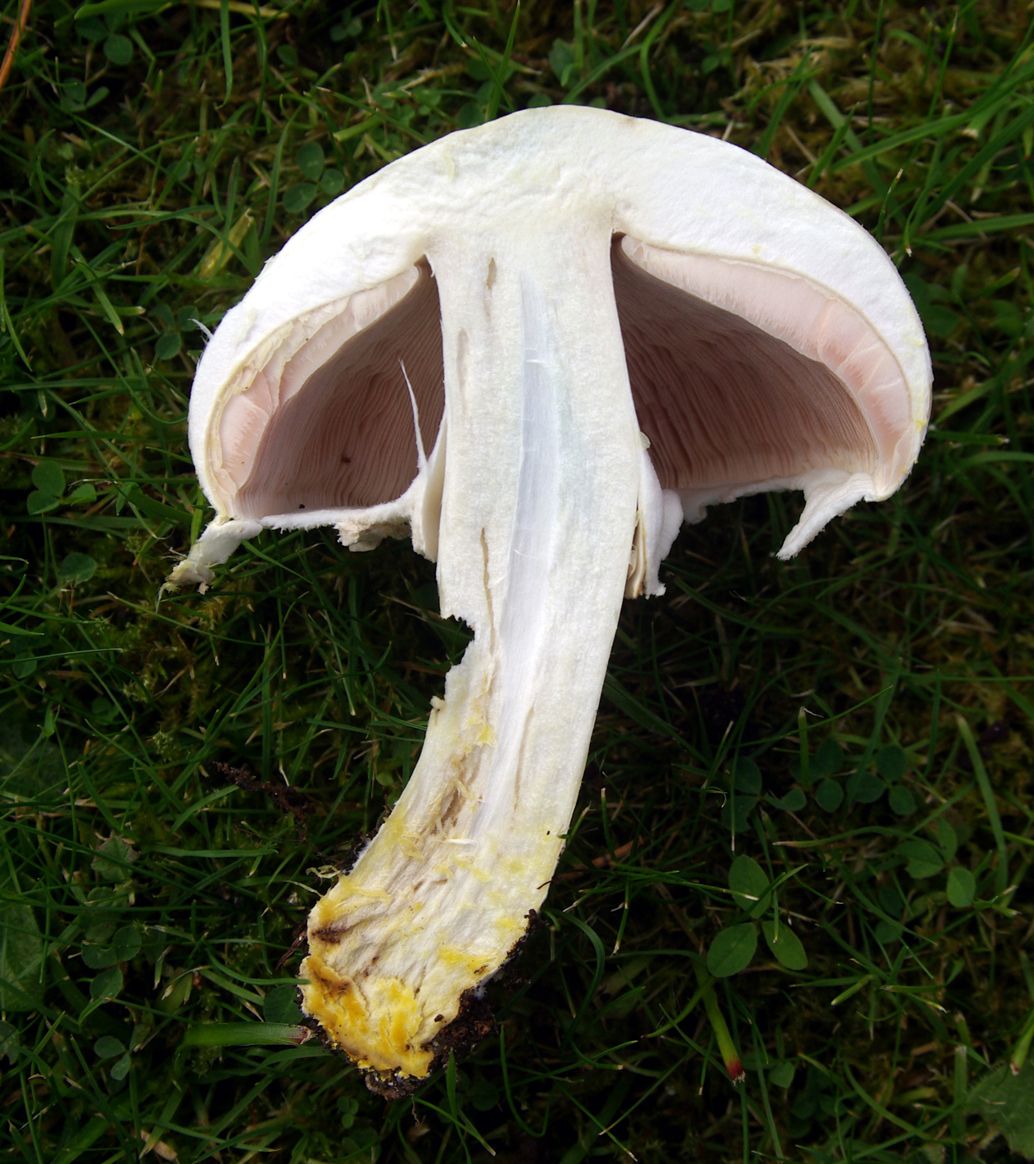
Every autumn and spring across North America, Europe, and Australasia, clusters of white, rounded mushrooms emerge overnight in lawns, pastures, and parks. Many nature lovers immediately suspect they have found the classic field mushroom, scientifically known as Agaricus campestris. Both the field mushroom and its toxic double, the yellow stainer or Agaricus xanthodermus, belong to the same genus and share an almost identical initial appearance. In their immature stages, both present smooth white caps, slender stems equipped with delicate rings, and gills that gradually transition from pale pink to a rich chocolate brown as their spores mature. This superficial resemblance makes the yellow stainer one of the most common causes of wild mushroom poisonings reported to medical centers each year.
The most critical physical difference between the two species lies in how their flesh reacts when damaged or bruised. To observe this trait, you must inspect the very bottom of the stem, often called the basal bulb, where the fungus meets the soil. When sliced or firmly scratched with a fingernail, the flesh of an Agaricus campestris remains white or develops a slow, faint pinkish-red blush. In sharp contrast, the base of an Agaricus xanthodermus stem immediately turns an intense, vivid chrome yellow upon being cut or bruised. This reaction is rapid and localized to the point of damage, but it can be fleeting; the bright yellow stain often oxidizes to a dull, muddy brown after ten to twenty minutes, which is why the discoloration must be observed immediately as the cut is made.
Scent provides another important identification clue, though it should always be evaluated alongside physical features rather than trusted in isolation. A fresh field mushroom carries a pleasant, mild fungal aroma identical to the common button mushrooms found in grocery stores. The yellow stainer, on the other hand, emits a distinct chemical or medicinal odor often compared to ink, phenol, or carbolic soap. Foragers sometimes rely on dangerous folk rules when assessing wild white mushrooms, believing that any mushroom with pink gills is inherently edible, that peeling the skin off the cap removes toxins, or that fungi nibbled by wild animals or insects must be safe for human consumption. Every one of these myths is false; gastrointestinal toxins in Agaricus xanthodermus are chemically stable and cannot be peeled away, and wild animals possess digestive systems capable of processing many toxins that sicken humans.
The consequences of mistaking a yellow stainer for an edible field mushroom are notoriously unpleasant. Ingesting Agaricus xanthodermus typically causes sudden and severe gastrointestinal distress, including violent stomach cramps, persistent vomiting, and debilitating diarrhea within a few hours of consumption. If you or someone you know ever suspects ingestion of a wild mushroom, call your local poison control hotline or emergency medical services immediately and retain a physical sample of the fungus in a paper bag for clinical identification. Never adopt a wait-and-see approach, and never attempt home remedies like inducing vomiting without explicit medical instruction.
Beyond the yellow stainer, foraging for white mushrooms carries an even graver danger: lethal look-alikes in the Amanita genus. Immature destroying angels, such as Amanita bisporigera and Amanita virosa, also produce pure white caps and grow in grassy areas near tree lines. Unlike Agaricus species, destroying angels maintain pure white gills throughout their lifecycle and possess deadly amatoxins that cause irreversible liver failure. Because distinguishing between subtle fungal traits requires meticulous evaluation of spore color, ring structure, and stem anatomy, no wild mushroom can ever be considered safe based on a photograph, an app match, or a single trait. Only a qualified professional mycologist who has physically examined the complete, intact specimen can confirm its identity with absolute certainty.
If you spot a cluster of white mushrooms in your lawn or along a trail, the safest and most rewarding path is to document them thoroughly rather than attempting to harvest them. Take clear, sharp photographs showing the cap surface, the color and spacing of the gills underneath, the ring on the stem, and the base of the stem dug intact from the ground to reveal any buried structures or staining reactions. Uploading your photographs to Shroomly can help you quickly cross-reference likely species and learn about dangerous look-alikes that occur in your region. For conclusive verification, always consult with your local mycological society before handling or identifying wild fungi in your neighborhood.