


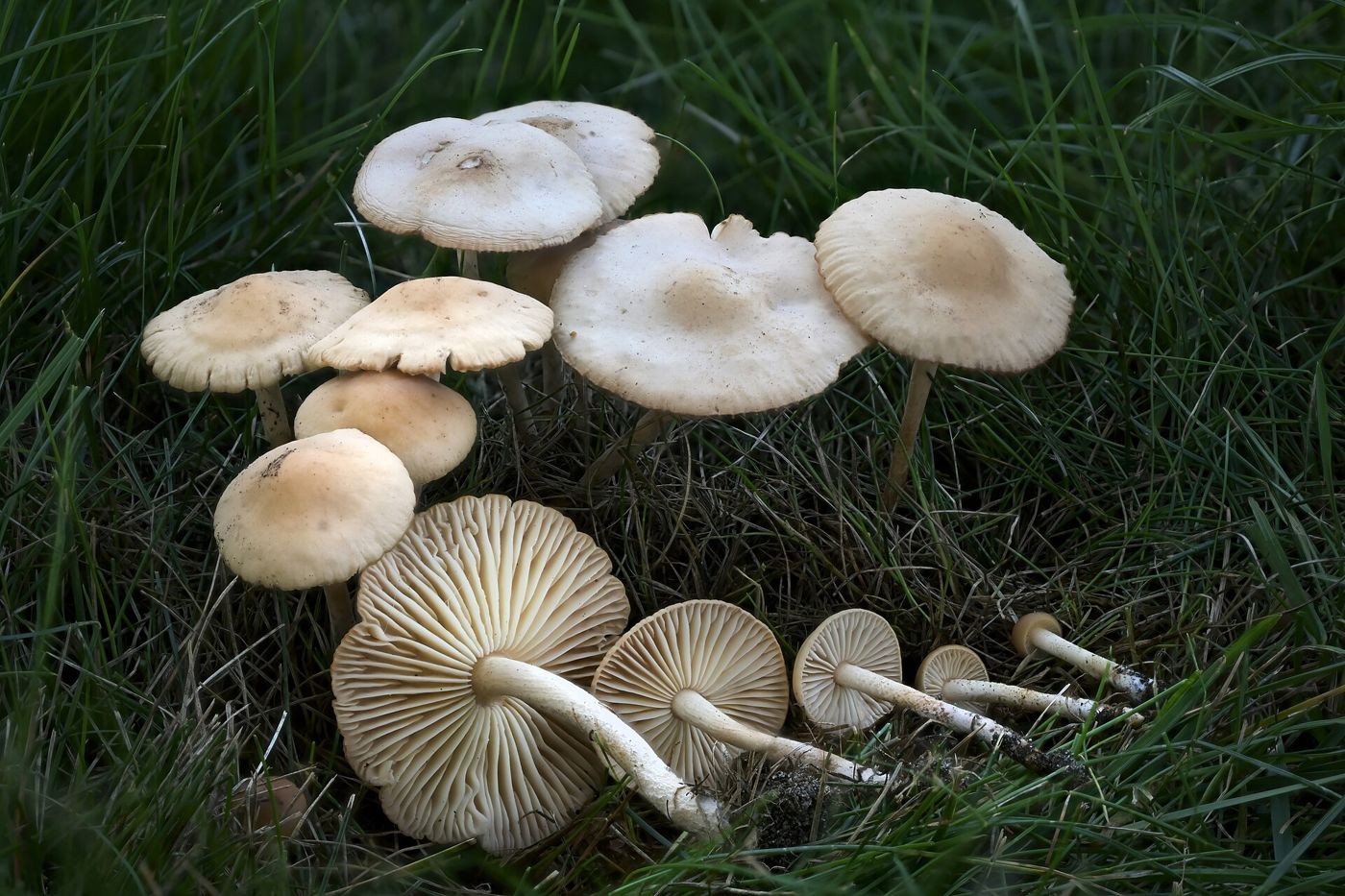
Suburban lawns, pastureland, and public parks often erupt with modest brownish or cream-colored mushrooms forming arcs and complete circles in the grass. While many foragers search these patches for the fairy ring mushroom, scientifically known as Marasmius oreades, these same manicured lawns can host potentially dangerous look-alikes. Foremost among them is the ivory funnel, Clitocybe dealbata, along with its close relative the fool's funnel, Clitocybe rivulosa. Because these fungi share the same grassland habitat, similar modest sizing, and can even grow intermixed within the very same arc of grass, understanding the key structural features that separate them is critical for any naturalist.
The most reliable anatomical difference between the two species lies in the gills situated on the underside of the cap. The gills of Marasmius oreades are notoriously distant from one another, appearing distinctly thick and widely spaced with shorter secondary gills tucked between them. These gills are free or just barely attached to the stem, leaving a slight gap before the stalk begins. By comparison, the gills of Clitocybe dealbata are thin, remarkably crowded together, and distinctly decurrent, meaning they run down the upper portion of the stem. Examining how the gills meet the stalk and observing whether they are sparse or tightly packed is one of the quickest ways to separate these two fungi.
The physical texture and behavior of the stem, or stipe, provide another critical diagnostic clue. The stem of Marasmius oreades is unusually tough, fibrous, and elastic; foragers often note that you can twist the stem completely around your finger or bend it into a knot without it snapping cleanly in half. In stark contrast, the stem of the ivory funnel is soft, pithy, and brittle, breaking apart easily under minimal pressure. Furthermore, while the cap of the fairy ring mushroom typically features a pronounced central bump called an umbo and exhibits a rich, warm buff-to-tan shade that fades as it dries, the ivory funnel usually develops a flattened or shallowly depressed center and retains a chalky, frosted-white to pale grayish-buff appearance.
Relying on simplistic tests or singular traits can easily lead to catastrophic errors in the field. Both Marasmius oreades and Clitocybe dealbata produce whitish to pale cream spore prints, which means a spore print alone cannot reliably distinguish between them. Foragers must also dismiss dangerous folk myths, such as the persistent beliefs that poisonous mushrooms blacken a silver spoon, smell bitter, or will not peel easily. The ivory funnel does not emit an unpleasant chemical warning odor, its cap skin can peel smoothly, and local insects or slugs will feed on it without hesitation. No folk rule or home test can substitute for methodical anatomical examination.
The stakes of a mistaken identification in the grass are exceptionally high due to the chemistry of the ivory funnel. Clitocybe dealbata contains high concentrations of muscarine, a toxin that targets the peripheral nervous system and induces severe sweating, blurred vision, excessive salivation, vomiting, stomach cramps, and dangerous heart rate reductions. Because toxic species can mimic harmless ones so closely, edibility can only ever be confirmed by a trained mycological expert who has physically examined the actual specimen in hand. If you suspect that a child, pet, or adult has ingested any wild mushroom, do not wait for symptoms to manifest and do not attempt home remedies; call poison control or emergency services immediately and collect intact specimens in a paper bag for clinical identification.
Documenting lawn fungi accurately requires clear, well-focused photographs of every angle before disturbing the surrounding turf. Be sure to photograph the top surface of the cap, the arrangement and attachment of the gills beneath, and the entire base of the stem gently lifted from the soil. Uploading these detailed images to Shroomly can help you quickly compare physical traits and explore likely species along with their toxic look-alikes. Once you have narrowed down the possibilities, always confirm the identity of any wild find with a local mycological society or verified regional fungal expert before drawing any conclusions.