


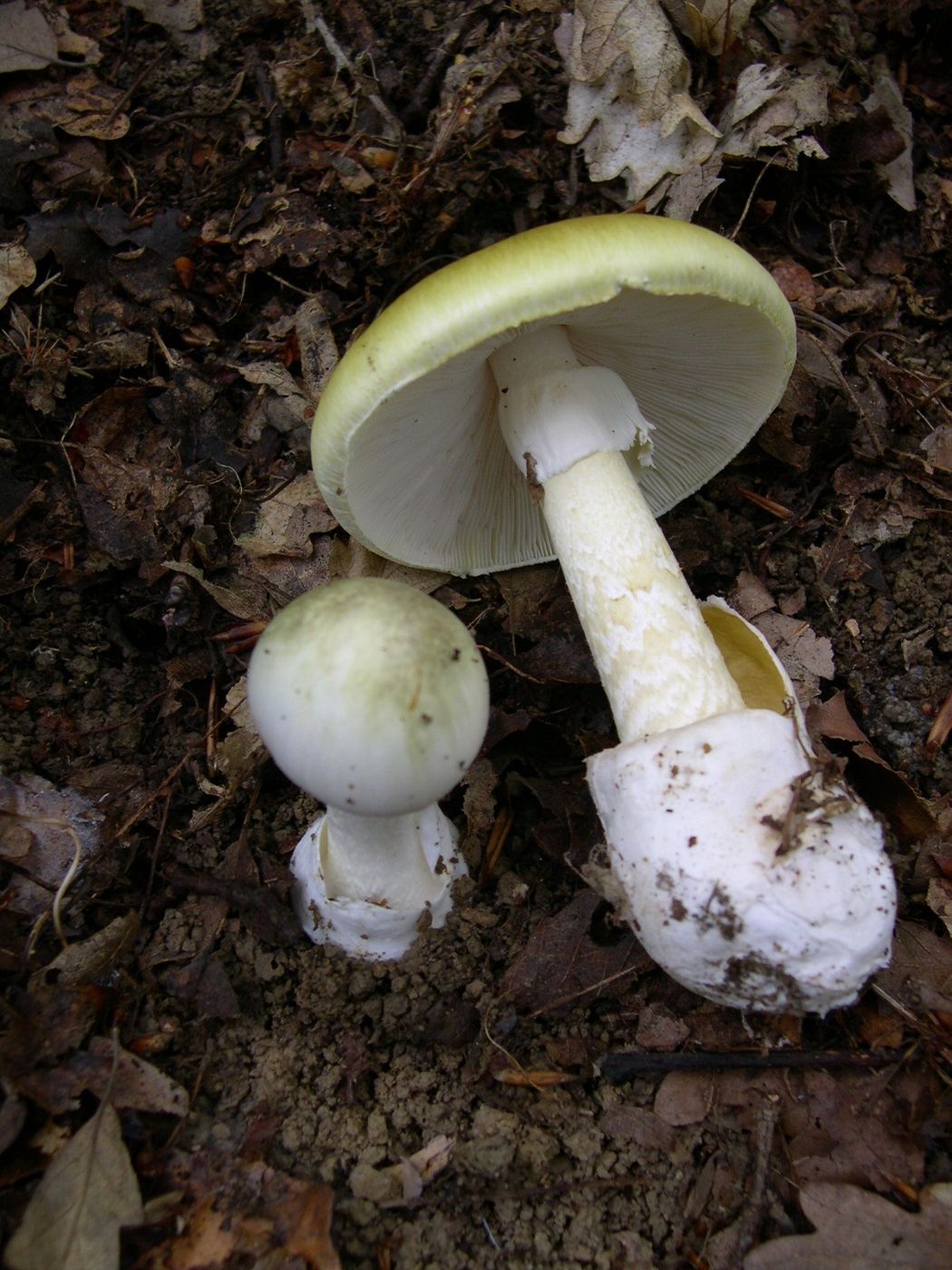
Almost every well-known wild edible mushroom has at least one look-alike that can make you seriously ill, and several have look-alikes that can kill. Poisonous species do not advertise themselves with bright warning colours or bad smells. Some of the deadliest fungi in the world are pale, plain, pleasant-smelling and easy to confuse with something sold in a supermarket. Most fatal mushroom poisonings follow a confident misidentification by someone who believed they knew what they had picked, not a reckless gamble. This guide covers the mix-ups that experts and poison centres see again and again, so you understand why edibility can never be judged from a single feature, a photograph or a hunch.
The most dangerous group by far is the genus Amanita, especially the death cap (Amanita phalloides) and the white destroying angels such as Amanita virosa, Amanita bisporigera and Amanita ocreata. These contain amatoxins, which damage the liver, and they cause the large majority of mushroom poisoning deaths worldwide. Young specimens still enclosed in their universal veil can look like puffballs when they are a smooth white egg, which is why any puffball-like fungus must be sliced top to bottom to check for the outline of a developing cap and gills inside. Mature death caps and destroying angels have been mistaken for field mushrooms (Agaricus campestris), horse mushrooms and other Agaricus species, and for the paddy straw mushroom (Volvariella volvacea), a common edible in parts of Asia. Poisoning clusters have been reported among people who picked a familiar-looking mushroom in a new country. The key warning features are white gills that never turn pink or brown, a ring on the stem, and a sac-like volva at the base, which is often hidden underground and lost when the mushroom is snapped off rather than dug out whole.
Small brown mushrooms on wood cause a second major group of tragedies. The funeral bell (Galerina marginata) contains the same amatoxins as the death cap and grows in clusters on stumps and logs, exactly where foragers look for honey fungus (Armillaria species), velvet shank (Flammulina velutipes) and sheathed woodtuft (Kuehneromyces mutabilis). Galerina has also been picked by people looking for psychoactive Psilocybe species, since both are small, brown and nondescript. A single funeral bell mixed into a basket of a similar species can be enough to cause serious harm. Spore print colour, stem texture and ring characteristics help experts separate these genera, but the differences are subtle, and they are easy to misjudge in poor light or on older, weathered specimens.
Other popular edibles have their own dangerous doubles. The parasol (Macrolepiota procera) resembles the green-spored parasol (Chlorophyllum molybdites), a frequent cause of severe gastrointestinal poisoning in lawns. Small parasol-like dapperlings in the genus Lepiota, some of which contain amatoxins, are also a risk. Chanterelles (Cantharellus species) are confused with the jack-o'-lantern (Omphalotus species), the false chanterelle (Hygrophoropsis aurantiaca) and, most seriously, with orange-brown webcaps such as the deadly webcap (Cortinarius rubellus). Its toxin, orellanine, can cause kidney failure with symptoms that may not appear for days or even weeks. True morels (Morchella species) are mistaken for false morels (Gyromitra species), which contain gyromitrin. The fairy ring champignon (Marasmius oreades) can grow alongside small white Clitocybe species such as the ivory funnel (Clitocybe dealbata), which contain muscarine.
These mix-ups are so dangerous partly because many of the deadliest toxins act slowly. Amatoxin poisoning typically begins with severe vomiting and diarrhoea several hours after the meal, often followed by a temporary improvement while liver damage continues. Orellanine can take far longer to produce symptoms. By the time someone realises the mushroom was not what they thought, serious organ damage may already be under way. Folk tests offer no protection. A silver spoon does not change colour in the presence of these toxins. Death caps are said to taste pleasant. Many poisonous caps peel easily. Slugs, squirrels and other animals eat deadly species without apparent harm. Smell is unreliable. Cooking, drying and freezing do not destroy amatoxins or orellanine either.
If you or anyone else, including a child or pet, may have eaten a wild mushroom that has not been confirmed by an expert, call poison control or emergency services immediately, even if there are no symptoms yet. Keep a sample of the mushroom, or any leftovers, to help identification. Do not try home remedies and do not wait to see whether symptoms develop. Fast professional assessment matters most with the slow-acting toxins described above.
Identifying mushrooms carefully is still worthwhile, as long as you treat identification as a starting point rather than a verdict on edibility. Photograph the whole mushroom from several angles, including the top of the cap, the gills or pores underneath, and the very base of the stem after gently digging it out. Shroomly can then suggest likely species and flag known toxic look-alikes so you know which features to check more closely. Then take the actual specimen to a local mycological society or an experienced expert for confirmation. Only someone who has examined the mushroom in hand can judge whether it is edible, and when it comes to the species in this article, even experienced foragers leave any doubt on the forest floor.