


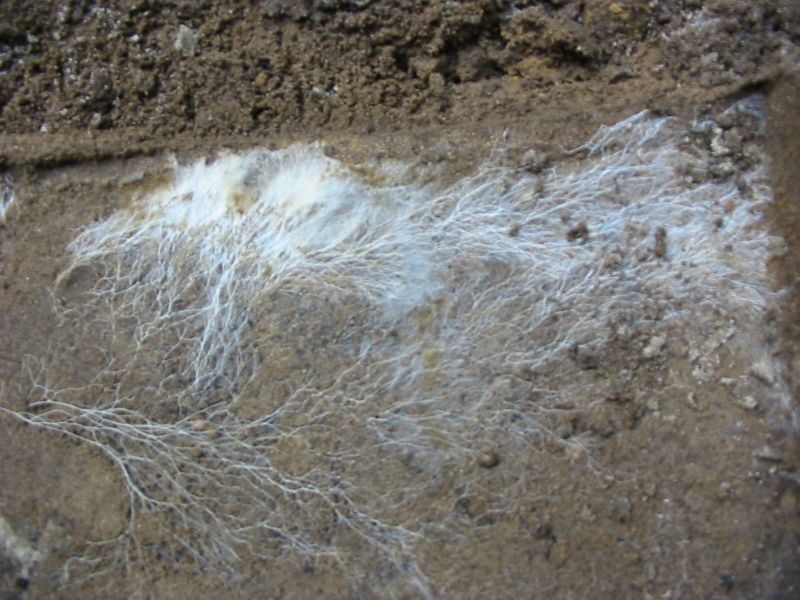
When you pluck a mushroom from the lawn or forest floor, you will often notice pale, stringy threads clinging to the base of its stem. It is easy to assume that these pale fibers are roots anchoring the fungus into the ground, much like the root system of a dandelion or an oak tree. However, mushrooms do not possess true roots. Roots are specialized organs found exclusively in vascular plants, equipped with distinct vascular tissues known as xylem and phloem that transport water and dissolved nutrients upward to photosynthetic leaves. Because fungi belong to their own biological kingdom—entirely separate from plants—their anatomy and method of gathering nutrients operate on a completely different evolutionary blueprint.
The underground structure that people mistake for roots is called mycelium, an expansive web made up of countless microscopic filaments known as hyphae. While plant roots serve primarily to anchor the plant and draw moisture and dissolved minerals up into photosynthetic foliage, fungal hyphae represent the actual living body of the organism. Fungi cannot photosynthesize, so they do not produce energy from sunlight. Instead, hyphae grow directly through their food source—whether that is forest soil, rotting leaf litter, or fallen logs—and release powerful digestive enzymes into the surrounding environment. These enzymes break down complex organic compounds like cellulose and lignin externally, allowing the hyphae to absorb the simplified nutrients directly across their cell walls.
In some species, these hyphae bundle together into visible cords called rhizomorphs, which look remarkably like dark tree roots or coarse black shoestrings. Fungi such as the honey fungus, Armillaria mellea, produce extensive networks of rhizomorphs that travel through the soil and beneath tree bark. These specialized strands act as subterranean pipelines, transporting oxygen, water, and nourishment over significant distances so the fungus can explore new territory and colonize nearby dead or stressed trees. To an untrained observer, a peeled piece of rotting bark lined with dark rhizomorphs looks indistinguishable from a root-bound garden bed, but every strand is composed entirely of densely aggregated fungal cells.
The relationship between fungi and true plant roots becomes even more fascinating in mycorrhizal associations. Many forest mushrooms, including species of Russula, Lactarius, and Cortinarius, form intimate underground partnerships with living trees like pines, birches, and oaks. In these partnerships, the fungal hyphae envelop or penetrate the fine tips of the tree's actual roots. The tree shares surplus sugars generated through photosynthesis in its leaves, while the fungal network expands the tree's reach by delivering water, nitrogen, and phosphorus scavenged from the soil. Rather than having their own roots, these fungi become an extended, highly efficient underground root-support network for the surrounding woodland.
Misunderstanding how mushrooms grow underground often fuels dangerous assumptions about wild foraging. A persistent folk myth claims that mushrooms with clean, sweet-smelling bases or white, root-like mycelial strands are inherently safe to harvest and eat. Folk rules like this—along with testing mushrooms with silver spoons, checking if wildlife nibbled them, or peeling the cap cuticle—are entirely false and potentially lethal. Deadly species such as the death cap (Amanita phalloides) and destroying angel (Amanita bisporigera) have robust subterranean mycelia and produce spotless, pristine fruiting bodies that can easily deceive the untrained eye. Only a qualified expert who has physically examined the intact specimen can ever determine whether a wild mushroom is safe to eat. If you or someone you know ever ingests an unknown wild mushroom, contact poison control or emergency medical services immediately and preserve the remaining specimen for expert identification.
To identify any mushroom accurately, observing how the stem connects to the ground and what lies at its base is just as important as examining the cap above. Crucial diagnostic features—including subterranean volva cups, bulbous stem bases, and rhizomorph strands—often disappear if a mushroom is simply snapped off at ground level. When documenting a specimen, carefully expose the base, keep it intact, and capture clear, well-lit photographs of the cap surface, the fertile layer of gills or pores underneath, and the full stem down to the ground. Submitting these detailed angles to Shroomly helps the app surface probable species matches and highlight dangerous look-alikes, providing an excellent educational starting point before you consult with a local mycological society or experienced expert to confirm the identity of your find.