


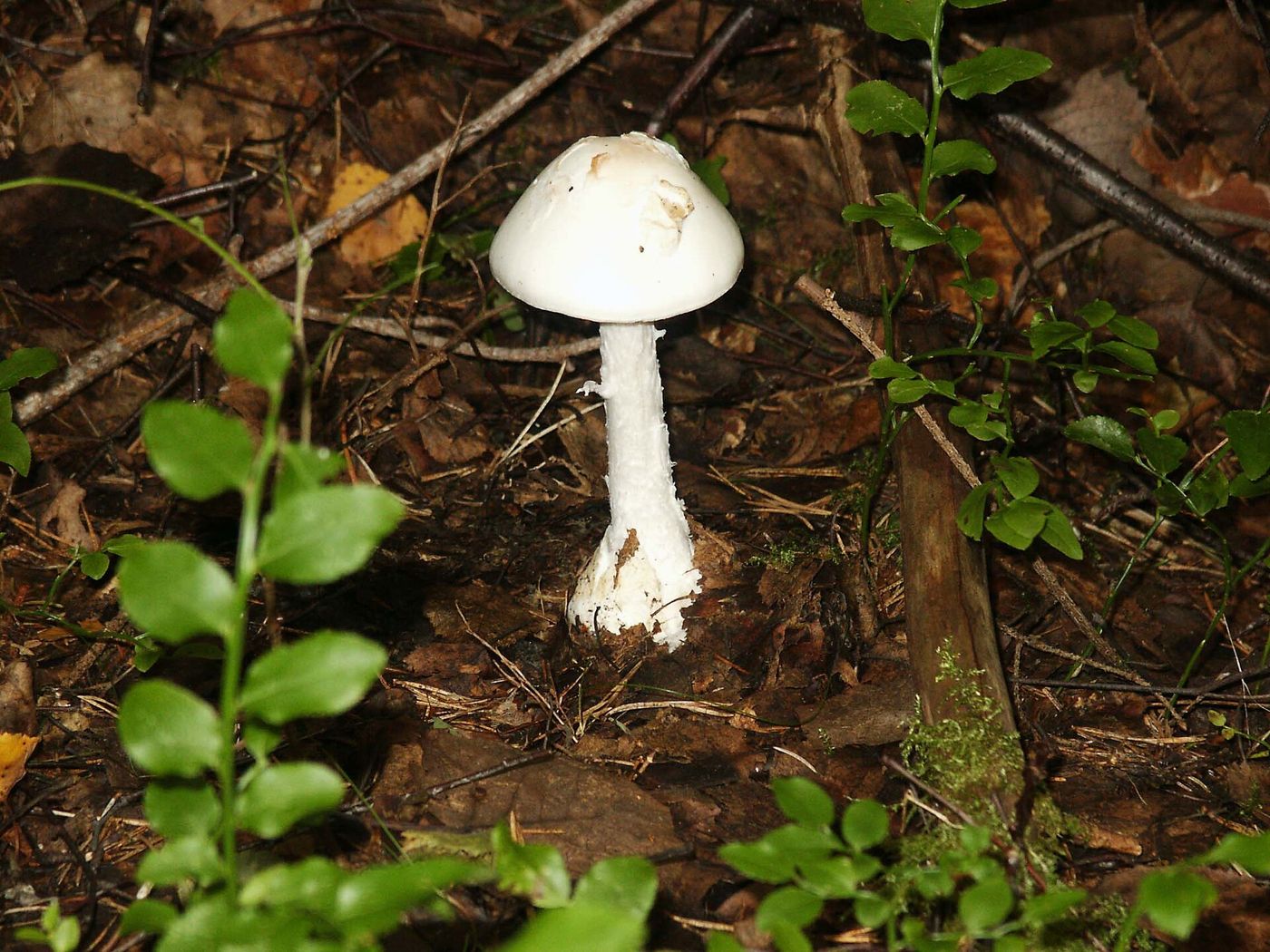
The name destroying angel belongs to a notorious group of pure white, elegant fungi in the genus Amanita, primarily Amanita bisporigera and Amanita magnivelaris in eastern North America, Amanita ocreata on the Pacific coast, and Amanita virosa across parts of Europe and Asia. Despite their clean, innocent appearance, these mushrooms are among the most lethal living organisms on Earth. They contain amatoxins, the exact same class of cellular poisons found in the death cap (Amanita phalloides). Amatoxins do not degrade when boiled, baked, frozen, or dried, and ingesting even a fraction of a single cap can cause irreversible liver and kidney destruction within days.
A typical destroying angel begins fruiting in midsummer and continues through autumn, appearing on the ground near hardwood and conifer trees with which it forms essential mycorrhizal partnerships. When mature, the mushroom features a smooth, satiny white cap that can span anywhere from two to five inches across, occasionally developing a faint ivory or yellowish tint at the center. Beneath the cap, the gills are stark white, crowded closely together, and completely free from the stem. The stem itself is tall, slender, and white, frequently decorated with a delicate, skirt-like membranous ring hanging near the upper portion, though harsh rain or age can sometimes tear this fragile ring away.
The most critical identification feature of a destroying angel lies beneath the surface of the soil. Like other members of the Amanita family, the mushroom emerges from a universal veil that leaves behind a distinct, cuplike sac called a volva at the very base of the stem. Foragers who casually pluck or cut mushrooms at ground level often leave this volva buried under moss and leaf litter, missing the single most diagnostic clue of a deadly species. Recognizing a destroying angel requires gently unearthing the entire stem base intact to inspect for this telltale membranous cup, which distinguishes it from harmless ground-dwelling species.
Tragic poisonings frequently happen because immature destroying angels bear an alarming resemblance to edible white mushrooms. When young and unexpanded, the rounded white caps closely mimic common field mushrooms (Agaricus campestris) and cultivated button mushrooms (Agaricus bisporus). However, true field mushrooms have pink gills that turn chocolate-brown as their spores mature, and they never possess a sac-like volva at the base. Novice foragers also confuse destroying angels with white puffballs when the young mushroom is still enclosed in its egg-like universal veil. While slicing an egg-shaped mushroom open reveals the nascent outline of a cap and stem in an Amanita, dangerous misconceptions persist, and relying on casual visual similarities in the field is extraordinarily perilous.
Widespread folk tests regarding mushroom safety are dangerously false and must never be trusted. Common myths claim that poisonous mushrooms will tarnish a silver spoon, peel easily like an onion, taste bitter, or be avoided by insects and slugs. In reality, destroying angels peel smoothly, have a mild and pleasant taste, and are regularly nibbled by woodland rodents and invertebrates that possess entirely different digestive biochemistry from humans. There is no shortcut, folk rule, or single visual trick that replaces rigorous botanical identification. If anyone suspects that a person or pet has swallowed any portion of a wild white mushroom, call your national poison control center or emergency medical services immediately, and always collect any remaining fragments in a paper bag for toxicological analysis rather than waiting for gastrointestinal symptoms to appear.
Because several deadly wild species closely resemble edible white mushrooms, only an experienced professional mycologist who has physically handled and examined the complete specimen can ever verify whether a wild find is safe. Whenever you come across an unfamiliar fungus in the forest or your yard, take clear, well-lit photographs showing the top of the cap, the underside of the gills, the stem ring, and the fully excavated stem base. Submitting these detailed angles to Shroomly: Mushroom Identifier can help you quickly flag dangerous species and toxic look-alikes, providing an invaluable learning tool to pair with the guidance of your local mycological society before you ever handle wild mushrooms.