


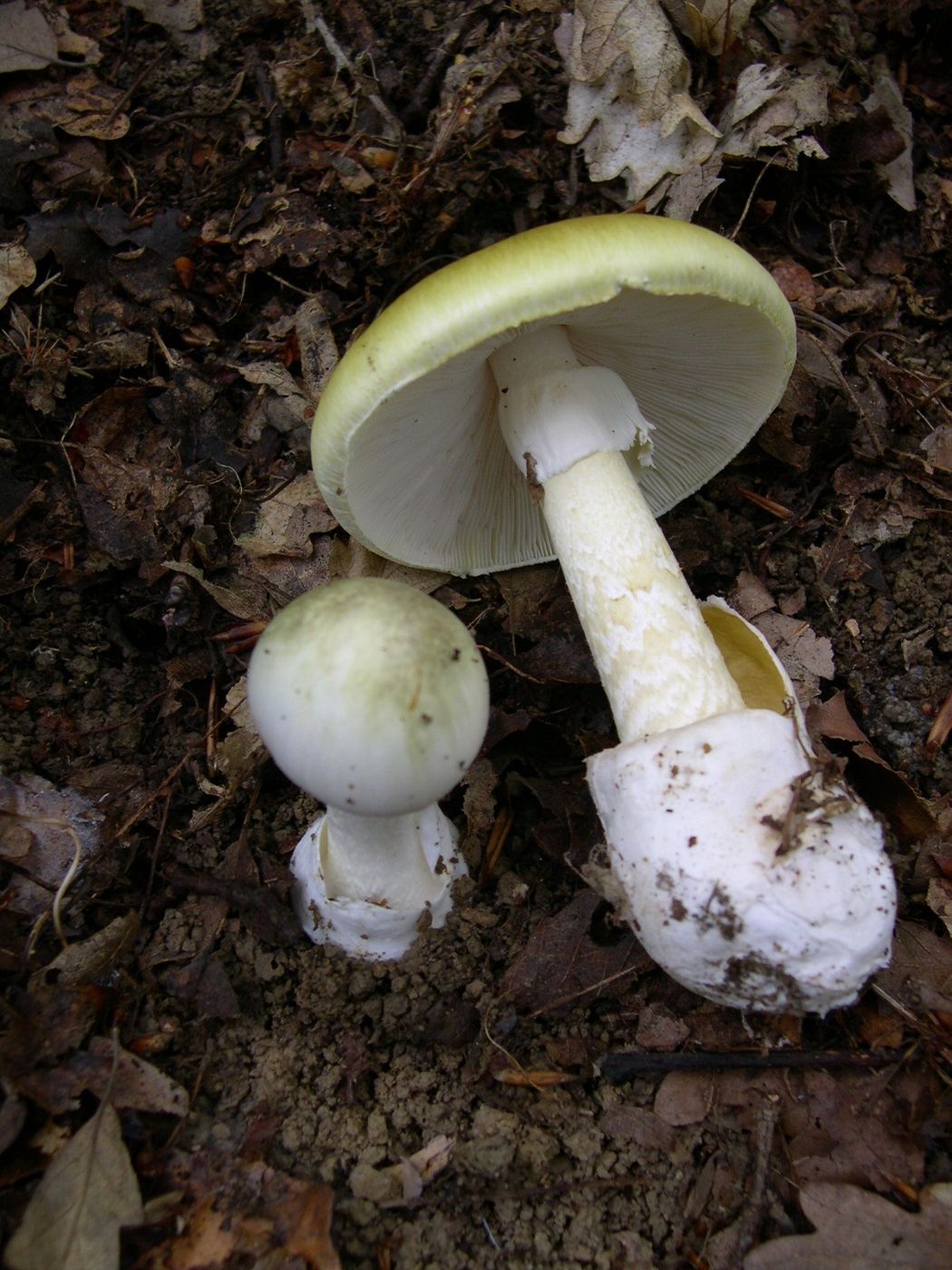
The paddy straw mushroom, Volvariella volvacea, is one of the most widely eaten mushrooms in East and Southeast Asia, sold fresh, canned and dried in markets around the world. The death cap, Amanita phalloides, is responsible for a large share of fatal mushroom poisonings globally. These two species belong to different families, yet they share one feature that makes them dangerous to confuse: both begin life wrapped inside a universal veil, and both leave a cup-shaped volva at the base of the stem. Poison centres in North America and Australia have repeatedly recorded serious and sometimes fatal poisonings among people who picked young death caps believing they had found wild straw mushrooms like the ones they knew from home or from the shop.
The confusion is easiest to understand at the egg stage. A young straw mushroom is an oval, greyish to brownish egg, often sold in this unopened form. A young death cap is also an egg-like button, white to pale with a hint of greenish or yellowish colour at the top as the cap begins to push through. At this stage, the gills, ring and spore colour that normally separate the two are hidden or undeveloped. Cutting an egg lengthways can reveal the outline of a cap and stem inside, but that only tells you it is a gilled mushroom developing inside a veil, not which one. This is exactly why experts treat any wild egg-stage mushroom with a volva as potentially deadly.
Once the mushrooms open, several features help separate them, though none should be relied on alone. The death cap typically has a smooth cap ranging from olive-green and yellowish-green to bronze or almost white, often with faint radiating fibres. Its gills are free from the stem and stay white, and it leaves a white spore print. Most specimens have a skirt-like ring (annulus) high on the stem, although rain or handling can remove it. The paddy straw mushroom has a grey to dark brown, often streaky cap, free gills that start whitish but turn pink as the spores mature, a pinkish spore print, and no ring at all. A spore print, made by leaving a mature cap gills-down on paper and glass for several hours, is one of the clearest separating characters, but it cannot be done on unopened eggs and it does not by itself make any mushroom safe.
Habitat is another major difference. The death cap is a mycorrhizal species, meaning it lives in partnership with tree roots, so it grows on the ground near trees, especially oaks, but also beech, chestnut, hornbeam and other hosts. It is native to Europe, including the United Kingdom, and has been introduced to parts of North America, notably California and the Pacific Northwest, and to south-eastern Australia, including Canberra and Melbourne, often near planted European trees in parks, streets and gardens. It fruits mainly in autumn, and in mild climates such as coastal California it can appear through late autumn and winter after rain. The paddy straw mushroom, by contrast, is a decomposer that grows on rotting rice straw, compost and plant debris in hot, humid conditions. It is largely a cultivated species and is uncommon to rare as a wild find in temperate parts of the UK, Canada, the northern United States and southern Australia.
That habitat clue is useful, but it is not a safety rule. A mushroom with a volva growing in a lawn or park can still be a death cap, because the tree roots it depends on may extend well beyond the canopy. There are also wild relatives of the straw mushroom in temperate regions, such as the stubble rosegill, Volvopluteus gloiocephalus, which grows in grassland, compost and disturbed ground and also has a volva and pink spores. Their existence means that finding a pink-spored mushroom with a volva does not confirm anything about edibility, and it is easy to misjudge spore colour on immature specimens.
Folk tests offer no protection here. The death cap is reported to have a mild, unremarkable smell and taste, its cap can be peeled, it does not blacken silver, and animals such as slugs may eat it without obvious harm. Its toxins, amatoxins, are not destroyed by cooking, drying or freezing. Symptoms usually start hours after eating, often 6 to 24 hours, by which time the toxins may already be damaging the liver, and a brief apparent recovery can follow. If anyone may have eaten a death cap or any wild mushroom mistaken for a straw mushroom, call poison control or emergency services immediately, even if they feel well, and keep a sample of the mushroom for identification.
If you find an egg-shaped or cup-based mushroom and want to know what it is, photograph the cap from above, the gills underneath, and especially the very base of the stem after gently digging it out, since the volva is often buried. Note nearby trees and the date. Shroomly can suggest likely species from your photos and flag dangerous look-alikes such as the death cap, but a photo or app result can never confirm that a mushroom is safe to eat. Only an expert who has examined the actual specimen can do that, so take your find to a local mycological society or experienced identifier, and buy straw mushrooms from a shop rather than picking ones that look similar in the wild.