


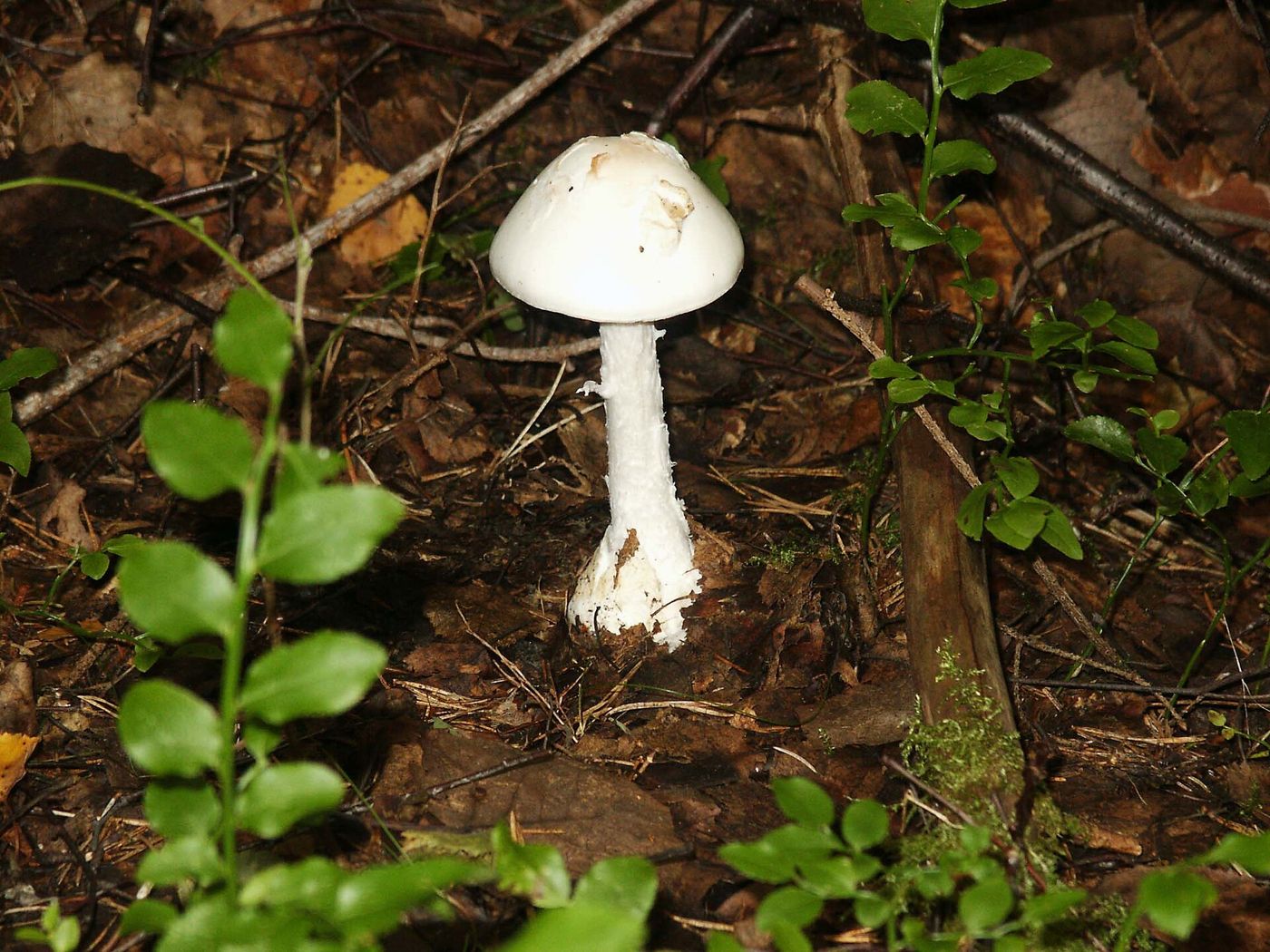
The death cap (Amanita phalloides) and the destroying angel group are responsible for the large majority of fatal mushroom poisonings in Europe and North America, so it is no surprise that people search for how to tell them apart. They are close relatives in the genus Amanita, they share the same body plan, and they carry the same group of toxins. The differences between them are mostly about color, cap shape and habitat, and those differences are worth knowing because they help you recognize both species in places and seasons where you might not expect them. What they should never do is give anyone confidence that a pale mushroom is safe simply because it does not match one of the two.
The death cap typically has a smooth cap that ranges from olive-green and bronze-green to yellowish-green, often darker toward the center and with faint radiating fibers. Young caps are rounded, flattening with age to roughly 5 to 15 centimeters across. The gills are white and free from the stem, the stem is white or faintly tinged with the cap color, and there is a thin, skirt-like ring near the top. At the base sits a swollen bulb wrapped in a white, cup-like volva, which is often buried in soil or leaf litter. Crucially, cap color varies a great deal: faded, rain-washed or pale forms can look almost white, and a pure white variety has been described, so the green tint is a clue rather than a reliable rule.
Destroying angels are white all over. In Europe the classic species is Amanita virosa, which tends to have a slightly conical or lopsided cap when young, a ragged or shaggy stem surface below the ring, and a fragile ring that can tear away or disappear. In North America the name destroying angel covers several closely related white species, including Amanita bisporigera in the east and Amanita ocreata in the west. All of them share the white gills, the ring or its remnants, and the sac-like volva at the base. Many white mushrooms that people consider edible, such as young Agaricus species, puffballs and some white dapperlings, overlap with destroying angels in size and color, which is why these species cause so many tragic mistakes.
Where and when they grow also differs. The death cap is mycorrhizal, forming partnerships mainly with oaks, and also with beech, chestnut and other broadleaf trees. It is native to Europe and has been introduced elsewhere along with imported trees: it is now established in parts of the United States, especially coastal California under oaks, as well as in parts of Canada and in Australia, notably around Canberra and Melbourne under planted oaks. It fruits mostly from late summer through autumn, though in mild climates it can appear for much longer. Amanita virosa in Britain and Europe is associated with birch, pine and spruce, often on acidic soils, and it is more frequent in northern and upland woodland. In North America, Amanita bisporigera appears in summer and early autumn in eastern forests, while Amanita ocreata fruits from winter into spring along the Pacific coast.
The toxicology is the reason none of these differences should be treated as a safety check. Both the death cap and the destroying angels contain amatoxins, which damage the liver and kidneys and are not destroyed by cooking, drying or freezing. Symptoms typically begin many hours after eating, often 6 to 24 hours, with severe vomiting and diarrhea followed by a deceptive period when the person may feel better while organ damage continues. A small amount of mushroom can be enough to cause serious harm. If anyone may have eaten either species, or any unidentified wild mushroom, call poison control or emergency services immediately and keep a sample of the mushroom, ideally with the stem base, for identification. Do not wait for symptoms to appear.
Folk rules do not help here and have contributed to fatalities. Survivors of death cap poisoning have reported that the mushroom tasted good. Peeling caps, silver spoons darkening, pleasant smell, and the observation that slugs, squirrels or other animals have nibbled a mushroom tell you nothing about amatoxins. The most common fatal error is picking a mushroom without digging up the base, which hides the volva that is the key warning sign. Only an expert who has examined the actual specimen, including the full stem base and a spore print, can confirm an identification, and even then some deadly species look very like popular edible ones, so beginners should treat any white-gilled mushroom with a ring and a bulbous or cupped base as off-limits.
If you find a mushroom that might be a death cap or a destroying angel, the safest approach is to document it rather than handle it casually. Carefully lift the whole mushroom so the base comes out intact, then photograph the top of the cap, the gills underneath, the ring on the stem and the bulb or volva at the base, along with the trees growing nearby. Shroomly can use those photos to suggest likely species and flag dangerous look-alikes such as Amanita phalloides and Amanita virosa, giving you a clear starting point. Treat that result as a guide, not a verdict on edibility, and confirm any identification with a local mycological society or an experienced expert who can examine the specimen in person.