

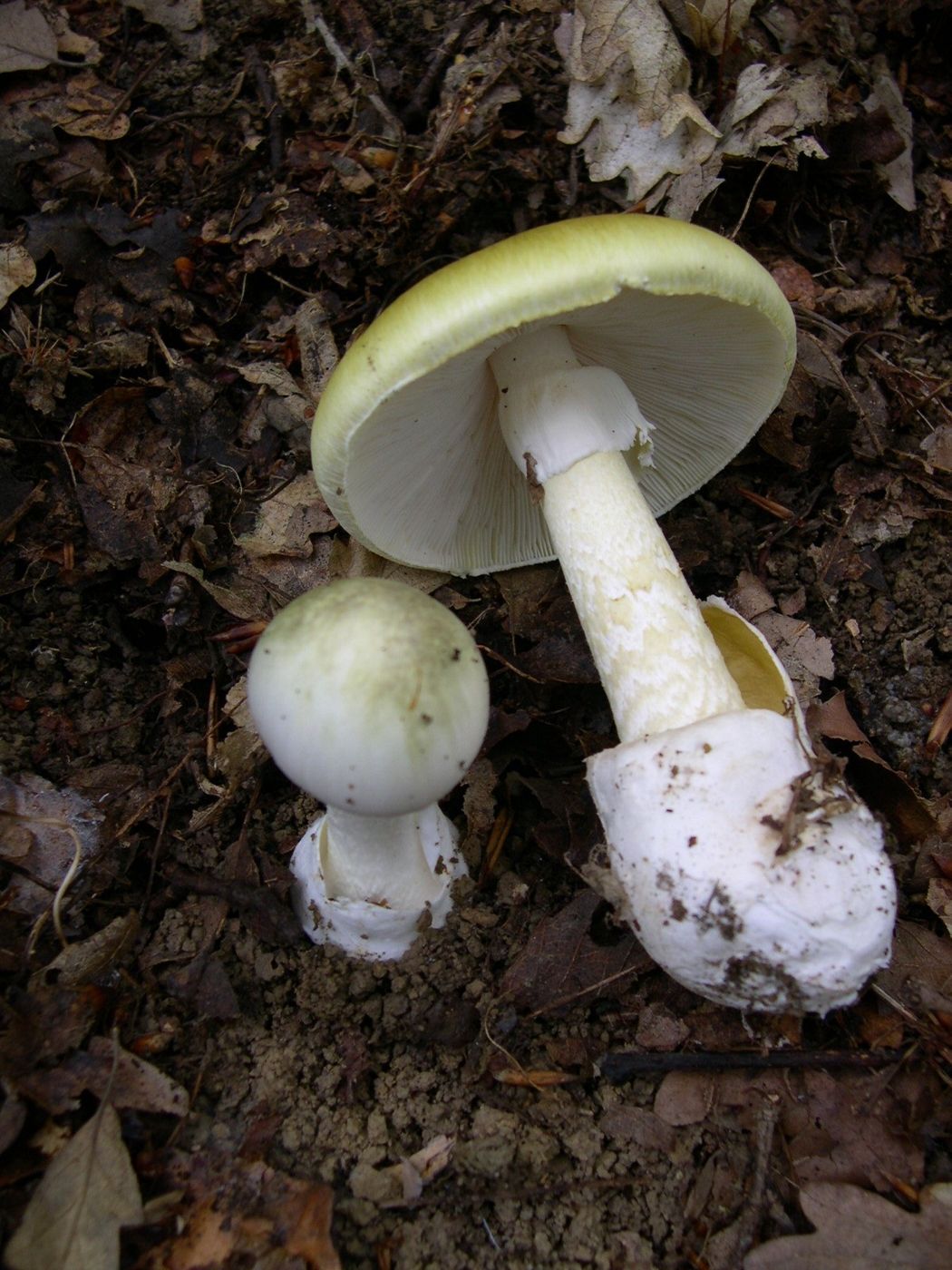
Death cap mushroom identification matters because Amanita phalloides is the species behind the majority of fatal mushroom poisonings in the world. It looks ordinary. There are no bright warning colours, no unpleasant smell, and survivors often say it tasted good. The danger is entirely in the chemistry: it contains amatoxins, which shut down protein production in liver cells. Cooking, drying, and freezing do not destroy them.
A typical death cap has a smooth cap from olive green to yellowish green, sometimes fading to bronze or almost white, often with a faint darker streaking from the centre. The gills underneath are white and stay white, and they are not attached to the stem. Higher up the stem sits a thin, skirt-like ring, and at the base is a white sac-like cup called a volva. The volva is the most important feature and the easiest to miss, because it is usually below ground or buried in leaf litter. A mushroom cut off at ground level has lost its best clue.
Death caps grow in association with trees, most often oaks but also beech, chestnut, and others. Native to Europe, they have spread with imported trees to parts of North America, including California and the Pacific Northwest, as well as to Australia and other regions. They fruit mostly from late summer through autumn, and in mild climates well into winter, often in parks, gardens, and streets lined with oaks rather than only in wild forest.
Poisoning follows a deceptive timeline. Symptoms usually start six to twenty-four hours after eating, with severe vomiting, abdominal pain, and diarrhoea. Then there is often a period when the person seems to improve, while liver damage continues silently. Without urgent hospital treatment, liver and kidney failure can follow over the next days. Anyone who may have eaten a death cap needs emergency care immediately, before any symptoms appear.
Most death cap poisonings are cases of mistaken identity. Immigrants have confused it with the paddy straw mushroom they picked at home, foragers have mistaken pale specimens for field mushrooms or young buttons for puffballs, and some people trust a 'rule' like peeling caps or a silver spoon test. None of those rules work. The young 'egg' stage, when the mushroom is still enclosed in its universal veil, is especially easy to misread, which is why any puffball-like find should be sliced from top to bottom and checked for the outline of a cap and gills.
Knowing these features is about recognising danger, not about getting clever with edible Amanitas, which beginners should leave alone entirely. If you find a mushroom under oaks with white gills and a ring, photograph the cap, the gills, and the base after gently uncovering it, and let Shroomly compare it with the death cap and its look-alikes. If a death cap is even possible, keep it away from your kitchen, and if anyone has eaten an unidentified mushroom, call emergency services at once.