


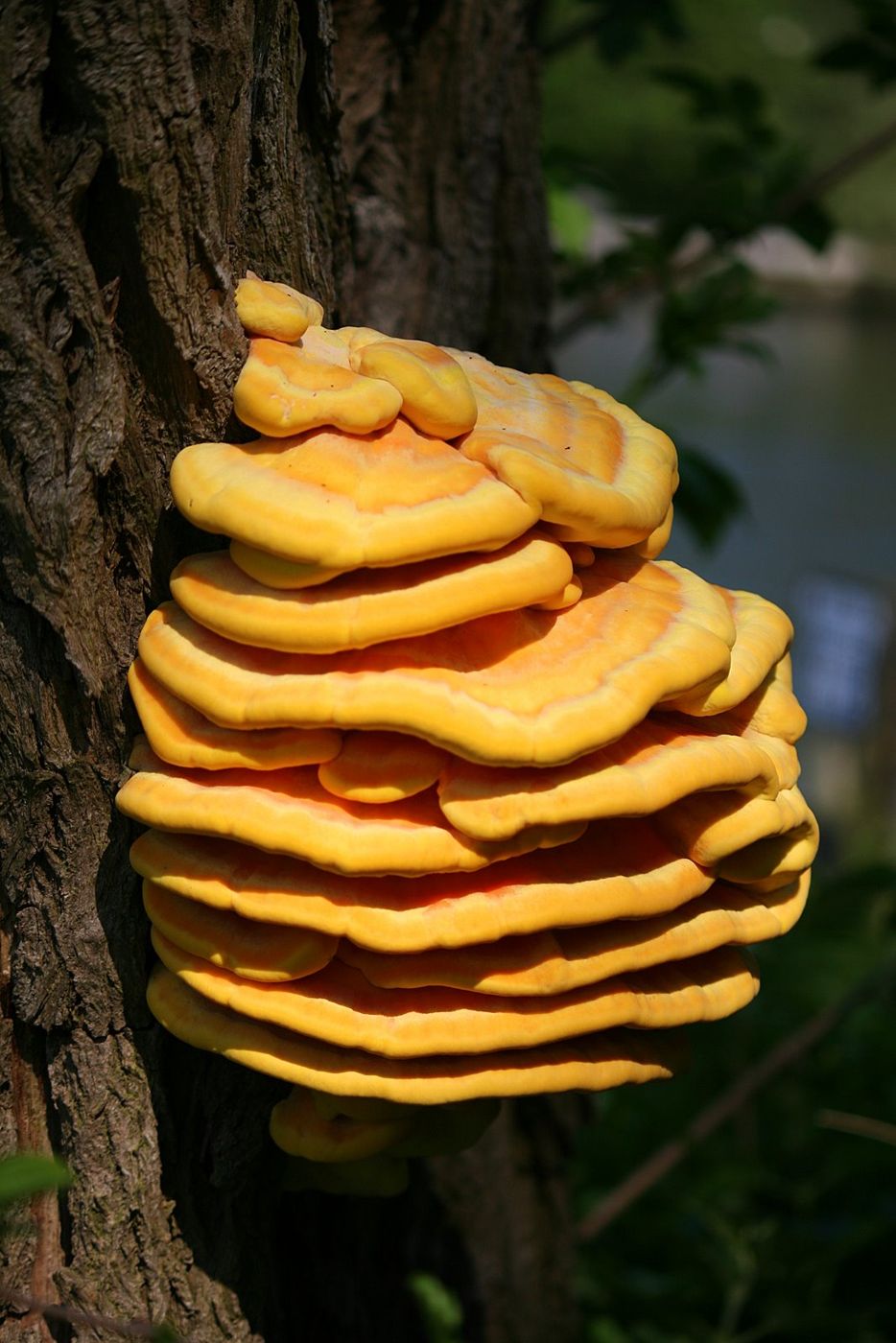
Few sights in a summer or autumn wood are as eye-catching as a burst of bright orange fungus on a tree. Two very different organisms produce that effect. Chicken of the woods is the common name for several Laetiporus species, including Laetiporus sulphureus in Europe and eastern North America, Laetiporus cincinnatus in eastern North America and Laetiporus gilbertsonii in western North America. Jack-o'-lantern is the name for several Omphalotus species: Omphalotus illudens in eastern North America, Omphalotus olivascens in California and Omphalotus olearius in Europe, especially around the Mediterranean. Because both are orange, appear around the same months and are associated with trees, people searching for one sometimes find the other. Understanding how their basic structure differs is the most useful starting point.
The biggest difference is body plan. Chicken of the woods is a polypore, a type of bracket fungus. It grows as overlapping fan- or shelf-shaped lobes that emerge directly from wood, usually with no real stem at all. The upper surface is typically bright orange to salmon, often with a sulphur-yellow margin when fresh, and the texture is soft and fleshy when young, becoming chalky and crumbly with age. Laetiporus cincinnatus is a partial exception: it often forms rosettes at the base of trees or from buried roots and has a whitish rather than yellow underside. The jack-o'-lantern, by contrast, looks like a classic mushroom. Each fruiting body has a cap and a distinct stem, and they usually grow in dense clusters with the stems fused together at the base.
Turn the specimen over and the difference becomes clear. The underside of chicken of the woods is covered in tiny pores, so small that the surface can look smooth until you look closely, and it is usually yellow in Laetiporus sulphureus. There are no blade-like gills. The jack-o'-lantern has true, knife-edged gills that run down the stem, a feature called decurrent gills, and they are orange like the rest of the mushroom. The flesh of the jack-o'-lantern is also orange inside, whereas chicken of the woods has pale yellowish to whitish flesh. Some jack-o'-lantern species have gills that give off a faint green glow in complete darkness, but this bioluminescence is weak, not always visible and not something to rely on in the field.
Where and how they grow adds further clues. Chicken of the woods is a wood-rotting fungus that causes brown rot in living and dead trees, most often hardwoods such as oak, cherry, willow, beech and sweet chestnut, though related species grow on conifers and, in Australia and elsewhere, on eucalypts. It tends to appear from late spring through autumn, often high on a trunk or on a stump, and may return to the same tree year after year. Jack-o'-lanterns typically fruit in summer and autumn at the base of hardwood trees, especially oaks, or from stumps and buried roots, so a cluster that seems to be growing from the soil may actually be attached to wood below the surface. A jack-o'-lantern clump rising from the ground near a tree is a very different picture from orange shelves stacked on the trunk itself.
The reason this distinction matters is toxicity. Jack-o'-lantern mushrooms contain compounds called illudins, and eating them commonly causes severe vomiting, cramps and diarrhoea, typically starting within a few hours. They are not generally considered deadly to healthy adults, but the illness can be intense and dehydrating, and it is a well-documented result of mistaking them for edible orange mushrooms, including chanterelles. Chicken of the woods is not risk-free either: some people experience digestive upsets or allergic-type reactions after eating it, and there have been reports of problems linked to specimens growing on certain trees. Other orange or yellow bracket fungi, such as the dyer's polypore (Phaeolus schweinitzii), can also be confused with it. None of this can be resolved by a single trait, and folk tests such as checking whether animals have nibbled the fungus, whether it smells pleasant or whether it tastes mild tell you nothing about safety.
So treat any orange tree fungus with caution. Pores versus gills, shelves versus stems and trunk versus base are genuinely useful features for telling these two groups apart, but they are identification clues, not an edibility verdict. Only an experienced expert who has examined the actual specimen in person can confirm whether a wild mushroom is edible, and many deadly species look remarkably like popular edible ones. If anyone has eaten a wild mushroom and you are unsure what it was, call poison control or emergency services immediately and keep a sample of the mushroom, including any leftovers, to help with identification. Do not wait to see whether symptoms develop.
If you find a bright orange fungus and want to know what it is, a few careful photos make all the difference. Photograph the top of the cap or shelf, the underside so the gills or pores are visible, the stem or point of attachment, and the base where it meets the wood or soil, along with a wider shot showing the tree. Shroomly can use those images to suggest likely species, such as Laetiporus or Omphalotus, and flag toxic look-alikes you should rule out. Treat that result as a starting point, then confirm it with your local mycological society or an experienced expert who can examine the specimen in hand.