


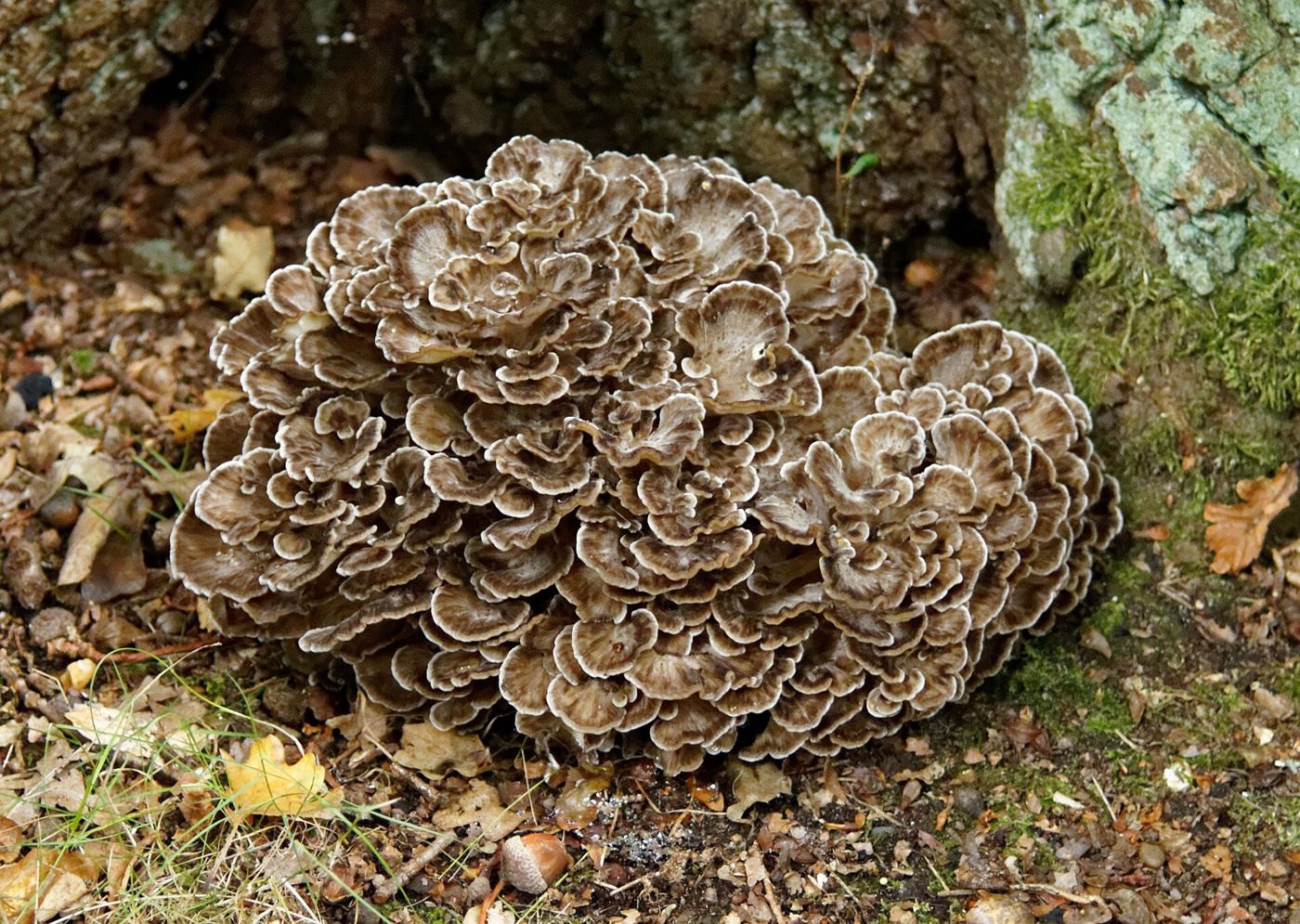
Few mushroom names cause as much confusion as chicken of the woods and hen of the woods. People hear them mentioned together, assume they are the same fungus or close relatives, and then search for a way to tell them apart. In reality they are quite different polypores, meaning both release spores from tiny pores rather than gills, but they differ in color, shape, texture, host and season. Chicken of the woods is Laetiporus sulphureus and its close relatives, often called sulphur shelf. Hen of the woods is Grifola frondosa, also known as maitake or, in parts of North America, sheep's head. Learning the differences is a good exercise in looking at the whole mushroom rather than relying on a name or a single feature.
Color is the most obvious starting point. Fresh chicken of the woods is hard to miss: the upper surface is a vivid orange to salmon, often with a bright sulphur-yellow margin, and the pore surface underneath is sulphur yellow. Older specimens fade to pale cream or chalky white and become brittle. Hen of the woods, by contrast, is muted. Its caps range from grey to grey-brown or tan, sometimes darker toward the edges, and the pore surface underneath is white to cream. If you are looking at something neon orange, it is not a hen of the woods; if it is drab grey-brown, it is not a typical chicken of the woods. Color alone is never enough for identification, though, because both fungi have look-alikes that share their palette.
Growth form is the next key difference. Chicken of the woods usually grows as overlapping fan-shaped or semicircular shelves attached directly to wood, often stacked up a trunk, along a log or emerging from a wound in a living tree. The individual brackets are fairly thick and fleshy when young, with a texture often described as soft and slightly rubbery before turning crumbly with age. Hen of the woods grows as a single compact rosette, sometimes very large, made up of dozens of small, spoon- or tongue-shaped caps branching from a shared, thick base. It typically sits on the ground at the foot of a tree, arising from roots or buried wood, and can look a little like a ruffled hen settling on a nest, which is where the name comes from.
Host tree and season add useful context. Hen of the woods is most strongly associated with oaks and tends to appear in late summer and autumn, often returning to the same tree in successive years. It is widespread in eastern North America and occurs in Europe, though it is less frequently encountered in much of the United Kingdom. Chicken of the woods grows on a wider range of hosts, including oak, cherry, willow, yew and other trees, and fruits from late spring through autumn. In North America several Laetiporus species are recognized, such as Laetiporus conifericola on conifers in the west and Laetiporus gilbertsonii on oak and eucalyptus. Some people report stomach upsets from chicken of the woods, and reactions have been linked anecdotally to particular hosts, which is one more reason the exact species and substrate matter and why no one should treat a quick visual match as a green light.
Both mushrooms have look-alikes that are more important than the confusion between the two of them. Hen of the woods is commonly mistaken for the giant polypore, Meripilus giganteus in Europe and Meripilus sumstinei in North America, which forms large rosettes at the base of trees but has broader, flatter fronds and a white pore surface that slowly bruises black when handled. Berkeley's polypore (Bondarzewia berkeleyi) also grows at oak bases but is cream to tan with much larger, tougher caps. A white-pored relative of chicken of the woods, Laetiporus cincinnatus, grows as a rosette at the base of trees and can superficially resemble hen of the woods. On the chicken side, orange jack-o'-lantern mushrooms (Omphalotus species) clustered on wood are sometimes misjudged at a distance, but they have true gills rather than pores, and they are toxic. Dyer's polypore (Phaeolus schweinitzii), found at conifer bases, can be orange-yellow with a brown center and is not considered edible.
Because of these overlaps, it is worth checking several features together rather than leaning on any shortcut. Look underneath to confirm pores versus gills, note the pore color, gently press the pore surface and watch for darkening over several minutes, record what the fungus is growing on and identify the tree if you can, and note whether it is a stacked shelf or a ground-level rosette. Folk tests such as whether animals have nibbled it, whether it smells pleasant or whether a silver spoon darkens tell you nothing about safety. And even when every feature lines up, edibility can only be confirmed by an expert who has examined the actual specimen in hand, since mistakes with wild fungi can cause serious illness. If anyone becomes unwell after eating a wild mushroom, call poison control or emergency services immediately and keep a sample of the mushroom.
If you come across a big orange shelf or a grey frilly rosette and want to know what it is, Shroomly can help you narrow it down. Photograph the top of the caps, the pore surface underneath, the point of attachment or base, and the tree or wood it is growing from, and include a shot after pressing the pores if you can. Shroomly will suggest likely species along with known look-alikes, including toxic ones, so you know which features to double-check. Treat that result as a starting point, not a verdict on edibility, and confirm your find with a local mycological society or an experienced expert who can examine the specimen in person.