


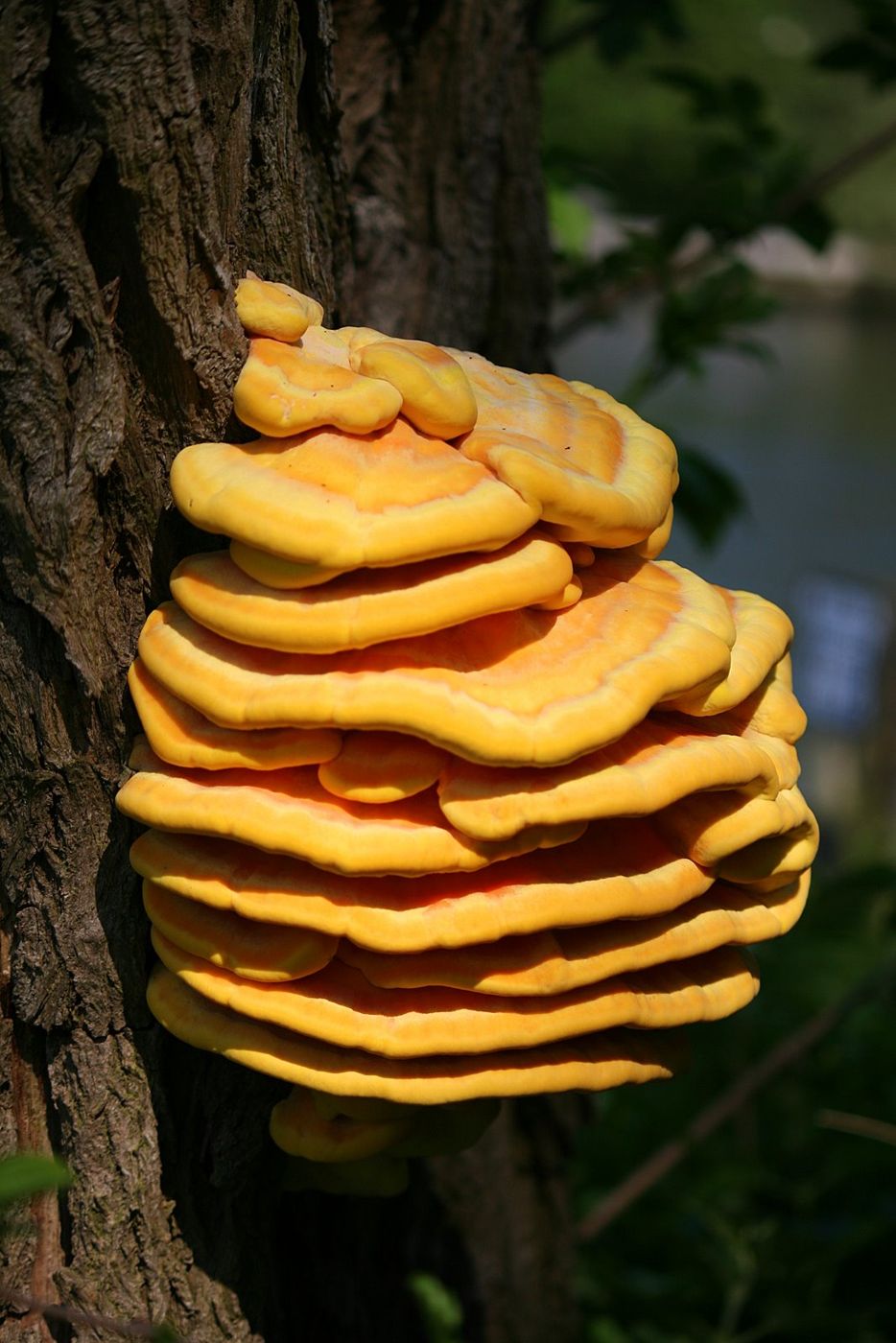
Chicken of the woods is one of the most recognizable bracket fungi in the world, but the common name does not belong to a single species. It covers several members of the genus Laetiporus, a group of brown rot fungi that grow on living and dead trees. In the UK and most of Europe the name generally refers to Laetiporus sulphureus, while in North America at least four or five species go by the same name. Learning which one you are looking at is a useful exercise in careful observation, because the differences come down to details that are easy to overlook: the color of the underside, the way the fruiting body is arranged, and exactly what it is growing from.
Laetiporus sulphureus is the classic form. It produces fan-shaped or semicircular shelves, often in overlapping tiers, directly on the trunks, stumps and large branches of hardwoods. Oak, cherry, willow, beech and sweet chestnut are frequent hosts in Europe and eastern North America, and it is also recorded on yew in Britain. The upper surface is bright orange to salmon, usually with a vivid yellow margin when young, and the underside is a sulphur-yellow pore surface with no gills. Fresh shelves are soft and moist, oozing a little yellowish juice when squeezed, while older ones fade toward pale cream or white, turn chalky and crumble. It typically fruits from late spring through early autumn, and because the fungus lives inside the wood for years, it often reappears on the same tree season after season.
Laetiporus cincinnatus, sometimes called the white-pored chicken of the woods, is found in eastern North America and is especially associated with oaks. The most reliable clue is that its pore surface is white to pale cream rather than yellow, even when the fruiting body is fresh. The upper surface is pink-orange to salmon, often a little paler and more pastel than its sulphur cousin. Instead of stacking up the trunk, it usually forms a rosette or broad cluster at or near the base of the tree, or appears to rise from the ground where it is growing from buried roots. Its season overlaps with L. sulphureus, running mainly through summer and autumn, and the two species can sometimes be found in the same woodland.
Western North America has its own species. Laetiporus gilbertsonii grows on hardwoods, notably oaks and planted eucalyptus, and tends to have a pale pore surface, while Laetiporus conifericola grows on conifers such as fir, spruce and hemlock and has a yellow pore surface much like L. sulphureus. In the Great Lakes region, Laetiporus huroniensis has been described on conifers as well. These species are hard to separate by eye alone, and host tree and geography are often more helpful than color. Some people report gastrointestinal upset or other reactions after eating chicken of the woods, and reports linked to particular hosts such as eucalyptus, conifers and yew are often repeated by foragers, but the evidence is largely anecdotal. That uncertainty is a good reason to treat every specimen as unconfirmed until someone qualified has looked at it.
Chicken of the woods is often promoted as a beginner-friendly mushroom, but it does have look-alikes. The jack-o'-lantern (Omphalotus illudens in North America, Omphalotus olearius in Europe) can appear as an orange cluster at the base of a tree or stump, which is exactly where L. cincinnatus grows; the key difference is that jack-o'-lanterns have true gills under the cap, whereas Laetiporus has pores. Other polypores can also cause confusion, including the dyer's polypore (Phaeolus schweinitzii), which grows at the base of conifers and is rustier brown with greenish-yellow tones, Berkeley's polypore (Bondarzewia berkeleyi), which is a large cream rosette at oak bases, and the black-staining polypore (Meripilus giganteus), which darkens when handled. Old, faded Laetiporus shelves can also look surprisingly different from the bright fresh ones shown in photographs.
Whatever species you find, remember that no single trait, color, host tree or rule of thumb can tell you a wild mushroom is safe to eat. Folk tests such as watching whether animals nibble it, checking the smell or rubbing it on silver are unreliable and have no basis in science. Edibility can only be confirmed by an expert who has examined the actual specimen, and some deadly species elsewhere in the fungal kingdom closely resemble popular edible ones. If anyone becomes unwell after eating a wild mushroom, call poison control or emergency services immediately and keep a sample of the mushroom for identification.
If you come across a bright orange bracket and want to know which Laetiporus it might be, a few good photos make a big difference. Photograph the upper surface, the underside so the pore color is clearly visible, the point where it attaches to the wood or emerges from the ground, and the tree it is growing on, ideally including its bark or leaves. Shroomly can use those photos to suggest likely species and flag toxic look-alikes such as the jack-o'-lantern, giving you a strong starting point. Then take your notes and photos to a local mycological society or an experienced expert, who can examine the specimen in person and confirm what you have found.