

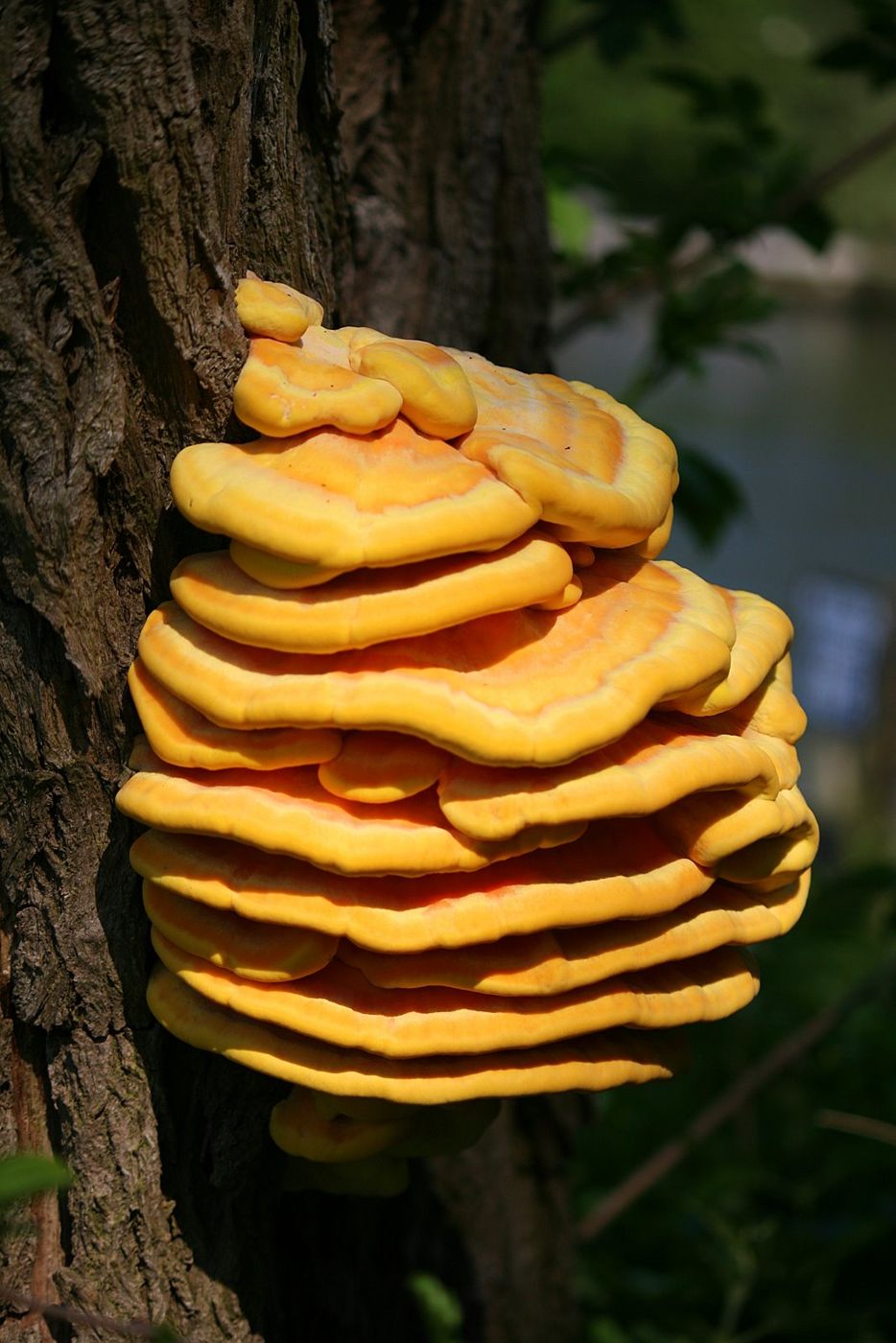
Chicken of the woods refers to a group of related shelf fungi in the genus Laetiporus, best known for their bright orange and yellow overlapping brackets. They commonly grow on living or dead hardwoods, especially oaks, and appear as conspicuous shelf-like clusters from late spring through autumn in many temperate regions. Because of their color, texture and the way older specimens can separate into meaty layers, they are a popular target for mushroom foragers, but they are not universally safe to eat—some people experience gastrointestinal upset or allergic reactions after consuming them, and reactions can vary by species and by what tree the fungus was growing on.
Key field features to recognize Laetiporus include vivid orange to salmon-colored upper surfaces when young, a soft porous underside rather than gills, and a tendency to form large overlapping shelves or rosettes attached to the wood. The flesh is often thick and sometimes fibrous; younger, fresh brackets are usually more tender and have the strongest color. Several closely related Laetiporus species exist (for example Laetiporus sulphureus on hardwoods and Laetiporus conifericola on conifers), and they can differ slightly in color, pore size and preferred host tree. Knowing the host tree is an important identification clue because some Laetiporus that grow on conifers are reported to cause more adverse reactions in people than those on hardwoods.
Despite the genus’ distinctive appearance, there are look‑alikes and potential identification pitfalls. Young specimens of some other bracket fungi can be superficially similar at a glance, and older, weathered Laetiporus may lose their bright color and become harder to tell apart. Rarely, other polypores or decaying wood growths might be confused with Laetiporus by inexperienced collectors. Importantly, even correct identification of the fungus does not guarantee it will be edible for everyone; individual sensitivity, how recently the mushroom fruited, and the specific Laetiporus species and substrate all influence how a person will react after eating it.
Reports of poisoning from chicken of the woods are most commonly gastrointestinal—nausea, vomiting, cramps and diarrhea—occurring within hours of eating, and most cases resolve, but severe reactions are documented. Some people collect and eat Laetiporus without problems, while others become ill from the same species; this inconsistency suggests allergic or idiosyncratic responses, and possibly variable chemical compounds depending on tree host and local strains. Because of that unpredictability, the responsible approach is caution: never assume an individual will tolerate a wild mushroom, and never rely on folk tests (such as tasting a small amount, watching animals eat it, or using silverware tests), which are unreliable and dangerous.
If you believe you or someone else has been poisoned after eating chicken of the woods or any wild mushroom, call your local poison control center or emergency services immediately and keep a sample of the mushroom for identification. If you plan to forage Laetiporus for eating, get confirmation from a local expert who can examine fresh specimens and advise about which local species are known to cause problems. Commercially available or cultivated mushroom varieties are subject to different standards than wild foraged fungi, so treat wild finds with greater caution.
To identify chicken of the woods safely and reduce risk, photograph and document the specimen before harvesting: wide shots showing the cluster on its host tree, close-ups of the upper surface and the porous underside, and a photo showing the tree or wood type it’s growing from. Use those images with Shroomly to get suggested species and known toxic lookalikes, then confirm any edibility decision with a local mycological society or qualified expert who can examine the actual specimen. Remember that no app, photo or single trait can legally or safely declare a wild mushroom edible—only an expert inspection of the specimen can provide that confirmation.