

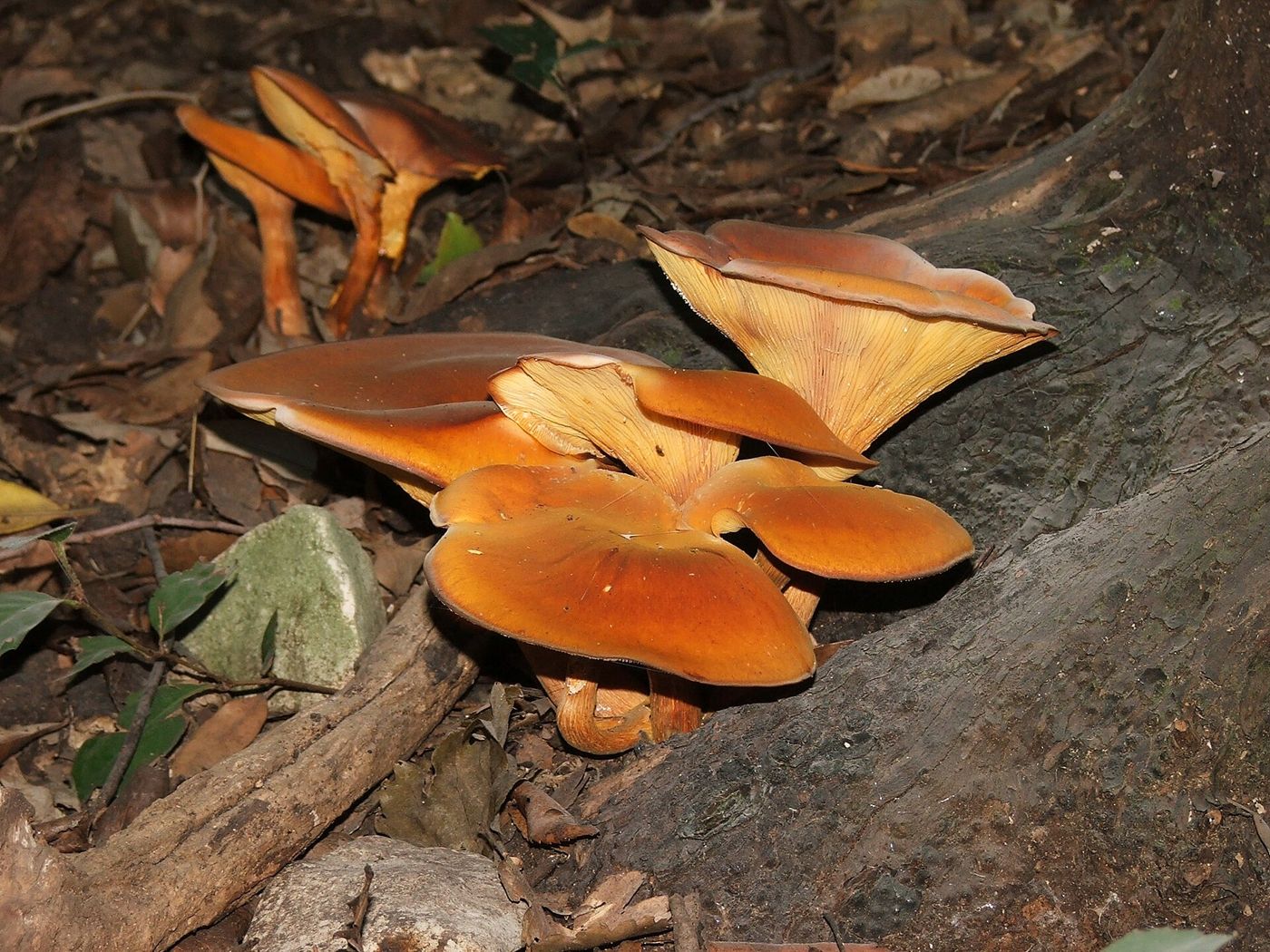
Chanterelle vs jack-o'-lantern is one of the most searched mushroom comparisons for a good reason. Both are bright orange, both appear in late summer and autumn, and both can turn up in the same woods. Chanterelles (Cantharellus species) are among the most prized wild mushrooms, while jack-o'-lanterns (Omphalotus olearius in Europe, Omphalotus illudens in eastern North America) contain illudins, which cause hours of severe vomiting, cramps, and diarrhoea.
Look at how they grow. Jack-o'-lanterns grow in dense clusters, often dozens of mushrooms fused at the base, coming out of a stump, the base of a tree, or buried roots. Chanterelles grow from soil, usually singly or scattered, sometimes in loose groups but rarely joined at the stem. A tight bouquet of orange mushrooms growing out of wood is a strong signal to walk away.
Then turn them over. A jack-o'-lantern has true gills: thin, sharp-edged blades running down the stem, crowded and regular like the pages of a book. A chanterelle has false gills: blunt, shallow ridges that fork and cross-connect, looking more like veins or wrinkles than blades. You should be able to see the difference clearly in a close-up photo of the underside.
Inside, the colour differs as well. If you slice a jack-o'-lantern lengthwise, the flesh is orange throughout. A chanterelle's flesh is pale, whitish to light yellow, and often pulls apart in strings like string cheese. Chanterelles also tend to have a fruity, apricot-like smell. A third orange mushroom, the false chanterelle Hygrophoropsis aurantiaca, has thin, true, forking gills and a softer texture, which adds another reason not to rely on colour.
Jack-o'-lanterns have one more trick: their gills can glow a faint green in total darkness, a phenomenon called bioluminescence. It is too faint to use as a field test, but it explains the name. Poisonings rarely kill healthy adults, yet they are miserable and can be dangerous for children, older people, and pets, and they happen every year to people who were sure they had chanterelles.
If you find a patch of orange mushrooms, take a photo of the cluster, a close-up of the underside, and a cut stem, and let Shroomly compare them against chanterelles, jack-o'-lanterns, and false chanterelles. Use the result to learn the differences, and never eat a wild mushroom unless someone experienced has checked the actual specimen in person.