


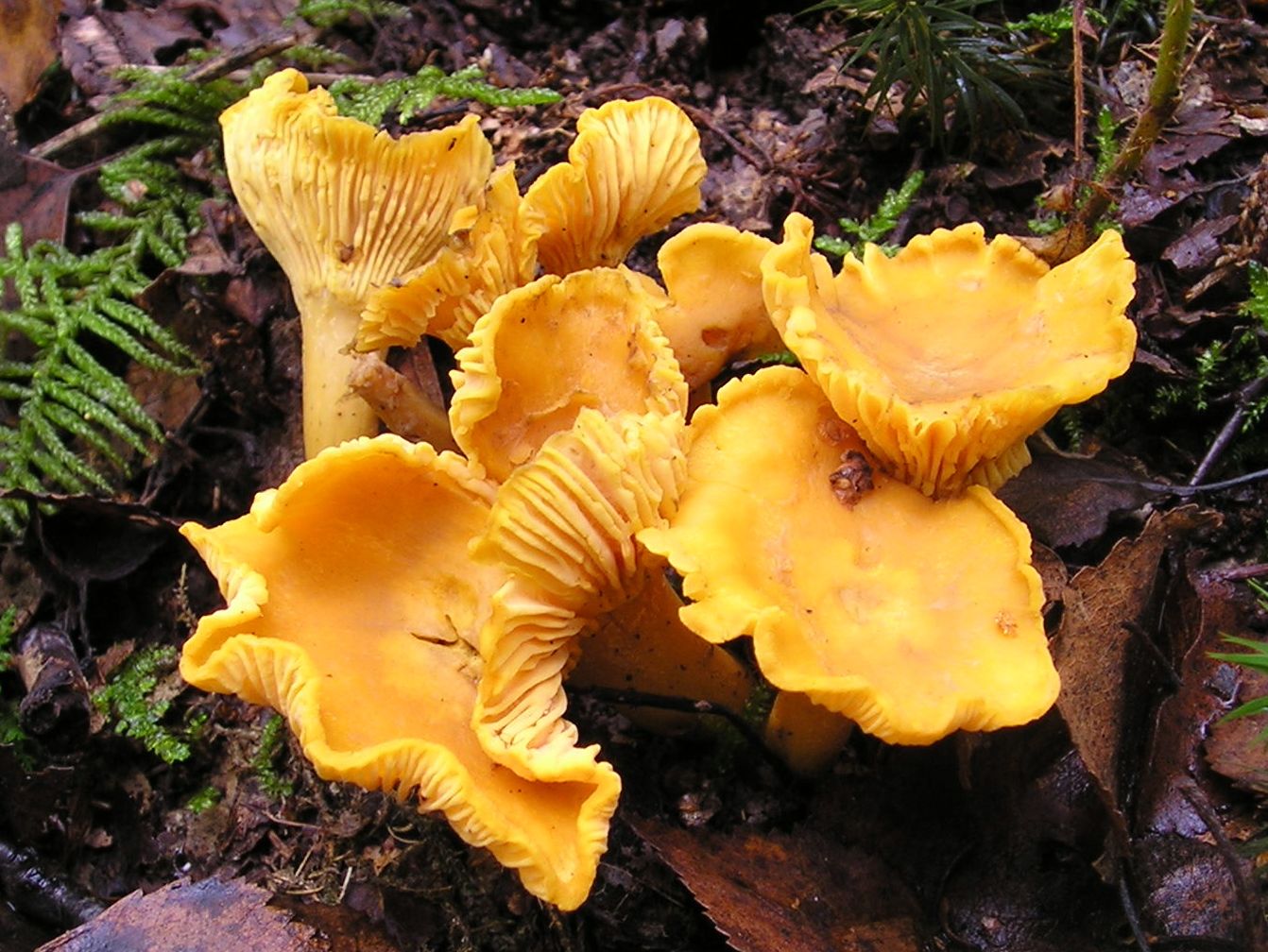
Late summer and autumn bring an explosion of color to temperate woodlands, and few sights capture attention quite like a cluster of bright golden mushrooms emerging through moss and damp leaf litter. Woodland walkers and naturalists frequently search for the golden chanterelle, represented primarily by species in the genus Cantharellus, such as Cantharellus cibarius. However, another common woodland fungus often shares the same seasonal window and broad silhouette: the false chanterelle, known scientifically as Hygrophoropsis aurantiaca. Because both species display warm yellow to orange shades and generally funnel-shaped caps, beginners often confuse them at first glance. Telling them apart requires looking past initial color and carefully examining the precise structural features beneath the cap.
The most reliable anatomical difference between the two fungi lies in the structure of their spore-bearing surfaces. True chanterelles do not have true gills at all. Instead, their undersides feature blunt, wrinkled folds or ridges that appear as though they were sculpted directly out of the mushroom cap tissue. These ridges run smoothly down the upper stem, a feature known botanically as decurrent attachment, and they frequently connect with one another through delicate cross-veins. In contrast, the false chanterelle possesses true gills that are thin, blade-like, and crowded closely together. These gills are distinct from the cap tissue, sharply defined, and fork symmetrically in repeating pairs as they radiate outward toward the cap margin. If the underside reveals paper-thin, sharp-edged blades rather than blunt, wavy ridges, you are looking at a false chanterelle or another gilled mushroom rather than a true Cantharellus.
Examining the interior flesh provides another critical point of comparison. Slicing a specimen cleanly in half from the center of the cap down through the stem base reveals stark differences in tissue density and coloration. A true golden chanterelle is firm, meaty, and uniformly solid inside, with interior flesh that is pale cream or stark white, contrasting sharply with the yellow or golden skin of the cap. The false chanterelle, by comparison, has much thinner, softer flesh that shares the pale orange or yellowish tone of the exterior. Its stem is often bendable, fibrous, or slightly hollow at maturity rather than dense and solid throughout. While some guidebooks mention that true chanterelles possess a faint, fruity aroma reminiscent of apricots, naturalists should never rely on scent alone for identification. Scent perception varies considerably from person to person, and older, rain-soaked, or sun-baked specimens frequently lose their signature fragrance entirely.
Habitat and growing substrate also provide valuable clues to an observant field naturalist. True chanterelles are mycorrhizal fungi, meaning they form mutually beneficial partnerships with the root systems of living trees, particularly oaks, beeches, pines, and firs. Because of this subterranean partnership, chanterelles emerge exclusively from soil, leaf litter, or moss-covered earth under compatible tree canopies; they do not consume dead wood directly. The false chanterelle, on the other hand, is primarily saprotrophic, obtaining its nutrients by decomposing decaying organic material. While it can appear to grow out of the forest floor, a closer look often reveals that it is fruiting from buried woody debris, decaying pine needles, wood chips, or heavily rotted tree stumps. Observing what a mushroom is actually growing on can immediately narrow down the possibilities.
Understanding these distinctions is vital because consuming misidentified wild fungi carries genuine health risks. The false chanterelle has historically caused significant gastrointestinal upset, nausea, and cramping in many individuals, and it is not considered harmless. More critically, overlooking fundamental anatomical traits like gill structure can lead to far more dangerous confusions with toxic species such as the jack-o'-lantern mushroom (Omphalotus species), which causes intense, protracted vomiting and severe abdominal pain. Longstanding folk rules—such as believing that cooking destroys all fungal poisons, that boiling mushrooms with a silver spoon will detect toxins, or that nibbling a tiny piece is safe—are completely false and dangerously misleading. If you suspect that anyone or any pet has ingested a toxic wild mushroom, contact your regional poison control center or emergency medical services immediately, and retain an intact specimen in a paper bag for expert analysis.
Accurate identification demands patience, systematic observation, and a willingness to verify every detail of an unknown fungus rather than relying on surface similarities. Before making any assumptions in the field, photograph the specimen thoroughly from multiple angles, capturing clear views of the cap surface, the gill or ridge structure beneath, the attachment to the stem, and the undisturbed base where the mushroom meets the ground. Using the Shroomly app allows you to compare your photos against known features of Cantharellus and Hygrophoropsis while alerting you to look-alikes. However, never rely entirely on a photo or mobile app when evaluating wild mushrooms; always seek out in-person verification from an experienced mycologist or your local mycological association before drawing definitive conclusions about any species.