


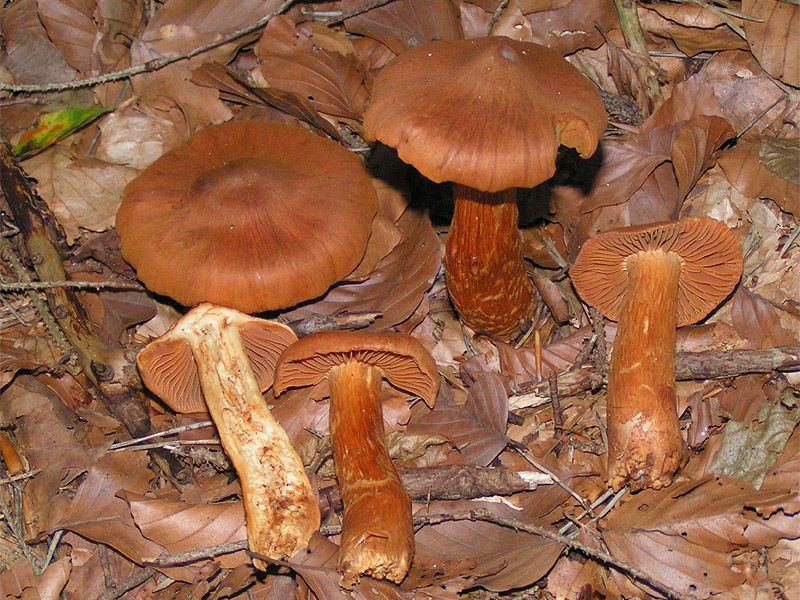
Most chanterelle guides compare it with the jack-o'-lantern or the false chanterelle, but in the mossy conifer and birch woods of northern Europe, including Scotland and Scandinavia, there is a more dangerous mix-up. The deadly webcap, Cortinarius rubellus (also listed as Cortinarius speciosissimus), and its close relative the fool's webcap, Cortinarius orellanus, are orange-brown mushrooms that can grow near chanterelles. From a distance, or in a basket of other orange fungi, they can look similar. People have suffered serious kidney damage after mistaking them for edible species. One widely reported case in Scotland in 2008 left several members of one family needing long-term kidney treatment. Knowing how the two groups differ is valuable, but it is not a substitute for expert confirmation.
Start with the underside of the cap, because this is the most reliable difference. The golden chanterelle, Cantharellus cibarius, and its relatives do not have true gills. They have false gills: blunt, rounded ridges that look like folds or wrinkles in the flesh. These ridges often fork and cross-connect, and they run smoothly down the stem without a clean edge where gill meets stem. The deadly webcap has true gills. These are thin, separate, knife-like plates that can be lifted with a fingernail and are attached to the stem rather than running far down it. In young webcaps the gills are a cinnamon or yellowish-tawny colour. As the spores mature they turn a distinctly rusty brown. If what you see under the cap looks like a neat stack of blades, you are not looking at a chanterelle.
The overall shape and colour add supporting evidence, though they overlap too much to rely on alone. Chanterelles are usually egg-yolk yellow to apricot. Their caps start flattish and often become wavy-edged and funnel-shaped, so the cap merges gradually into a stem that is the same colour. The deadly webcap tends to be a darker, more fox-red or tawny orange-brown. Its cap is often conical to bell-shaped with a pointed or broad bump (umbo) in the centre, and the surface is finely fibrous or slightly scaly rather than smooth. Its slender stem is usually paler or yellowish and often carries faint bands or zigzags of yellowish veil remnants. Young webcaps have a cortina, a delicate cobweb-like veil that stretches from cap edge to stem and protects the gills. It leaves wispy fibres on the stem that soon catch falling rust-brown spores and become stained.
Inside the mushroom and in a spore print, the differences become clearer. Chanterelle flesh is firm, solid and whitish to pale yellow, and it tears in a stringy way, almost like string cheese. A chanterelle spore print is pale, from whitish to cream or faintly pinkish-yellow. A deadly webcap leaves a rusty brown spore print, which is typical of the whole Cortinarius genus and one of the most useful clues you can collect at home. Leave the cap gill-side down on white and dark paper for several hours. Many people mention the chanterelle's fruity, apricot-like smell, but smell is subjective, easily confused and never a safety test. The same applies to folk tests such as peeling the cap, a silver spoon turning dark, or slugs and animals having nibbled the mushroom. None of these tells you whether a mushroom is poisonous, and the webcap will pass most of them.
What makes this look-alike especially dangerous is how its toxin behaves. Orellanine attacks the kidneys, and symptoms usually do not begin for several days and sometimes as long as two to three weeks after the meal. By then people may not connect their illness with the mushrooms they ate, and the kidney damage may already be serious or permanent. Some victims have needed long-term dialysis or a kidney transplant. Cooking, drying and freezing do not destroy orellanine. There are also many other Cortinarius species, several of them brown or orange and some poorly studied, so the safest approach is to treat any rusty-spored mushroom with true gills as potentially dangerous. Chanterelles themselves have other look-alikes, including the false chanterelle (Hygrophoropsis aurantiaca) and the jack-o'-lantern (Omphalotus species). That is why no mushroom should ever be judged edible from colour, habitat or a single trait. Only an expert who has examined the actual specimen can confirm edibility. If anyone may have eaten a webcap or any unidentified wild mushroom, call poison control or emergency services immediately, even if they feel fine, and keep a sample of the mushroom to show the medical team.
If you find an orange mushroom in mossy woodland and want to know what it is, good photographs make a big difference. Take a clear shot of the cap from above, a close-up of the underside showing whether you see blunt forked ridges or true blade-like gills, and a full side view of the stem, including any cobwebby fibres or rusty staining. Dig gently so you can photograph the stem base too, and note nearby trees and the date. Shroomly can use these photos to suggest likely species and point out toxic look-alikes such as Cortinarius rubellus. Add a spore print to narrow things down further. Then take the specimen itself to a local mycological society or an experienced identifier for confirmation. An app result or a photo is a starting point for learning, never a green light to eat a wild mushroom.