


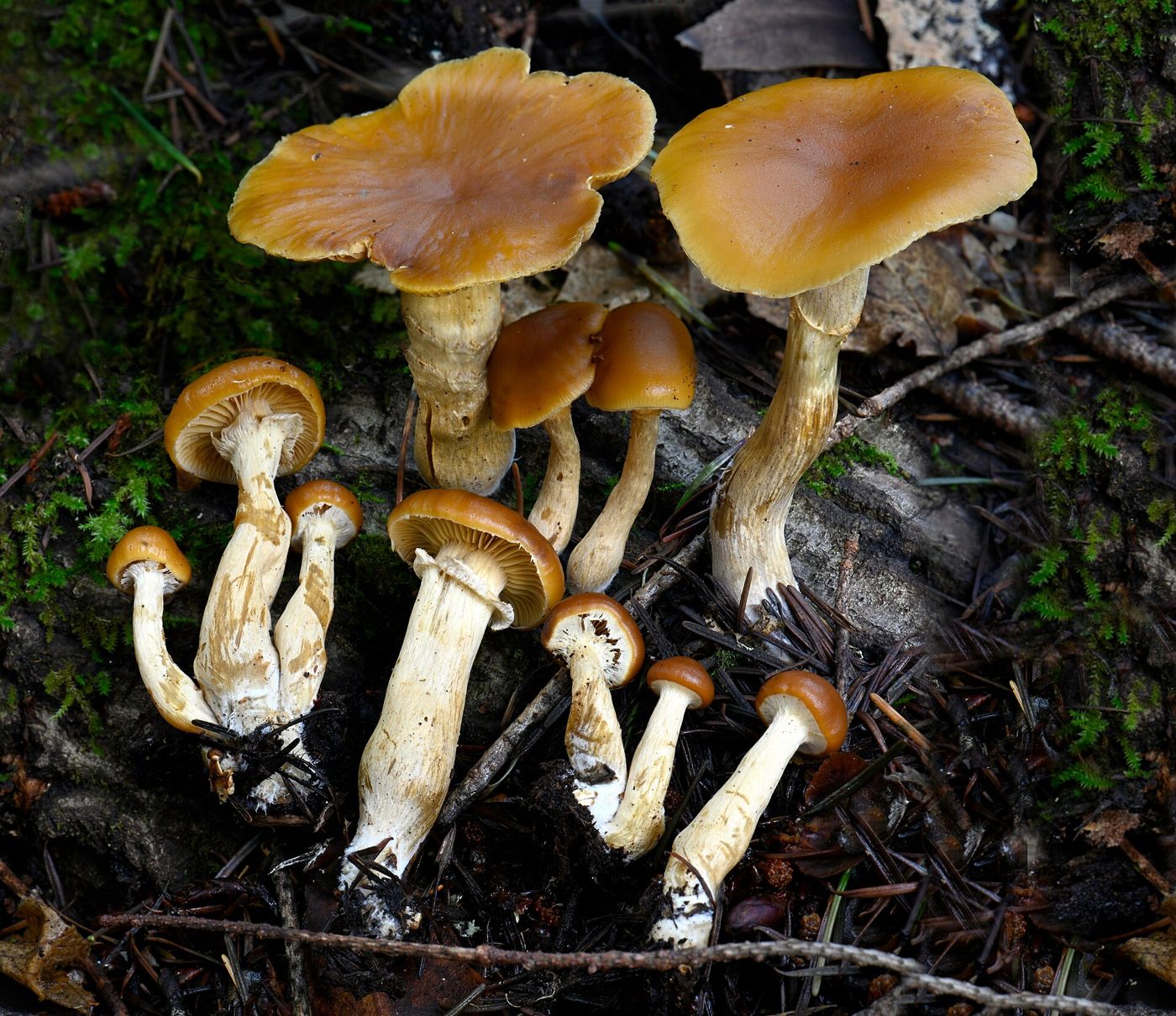
If you have spotted mushrooms sprouting from a tree trunk, a stump or a fallen log, you may have heard that fungi growing on wood are safe to eat. It is one of the more persistent pieces of foraging folklore, and it is wrong. Many wood-growing mushrooms are harmless to touch and play an important role in breaking down dead timber, but the habitat itself is not a safety test. Several wood-loving species cause severe stomach upset, and at least one common group can cause fatal liver failure. Where a mushroom grows is a useful clue for identification, never a guarantee of edibility.
The clearest counterexample is the funeral bell, Galerina marginata. It is a small, unremarkable brown mushroom with a honey-coloured to tan cap, rusty brown spores and often a thin ring on the stem, and it grows on rotting conifer and hardwood logs, stumps and buried woody debris across North America, Europe and Australia. It contains amatoxins, the same class of toxins found in the death cap (Amanita phalloides). Amatoxin poisoning is notorious because the first symptoms are often delayed by many hours, and a person can seem to recover before serious liver damage becomes apparent. The funeral bell has been mistaken for honey fungus (Armillaria species) and for other small brown wood mushrooms collected for the table, which is exactly why the 'wood is safe' rule is so dangerous.
Other wood-growing species are less deadly but still poisonous. Sulphur tuft (Hypholoma fasciculare) forms dense yellow clusters on stumps and is known to cause gastrointestinal poisoning. Jack-o'-lantern mushrooms (Omphalotus species) grow in orange clusters at the base of trees or from buried roots and cause vomiting and diarrhoea, and they are regularly confused with chanterelles. Even species that some people collect deliberately can cause trouble: honey fungus and chicken of the woods (Laetiporus species) are both reported to cause digestive upset in some people, and angel wings (Pleurocybella porrigens), which grows on conifer wood, was linked in Japan to a serious and sometimes fatal brain illness, particularly in people with kidney disease. None of these risks is visible in the fact that the mushroom is growing on a tree.
It also helps to know that 'growing on wood' is not always obvious. Mushrooms that appear to rise from soil or grass near a tree may actually be fruiting from buried roots, old stumps or wood chips beneath the surface. Mulched garden beds and playgrounds are a common place for wood-rotting fungi to appear suddenly after rain. This means a mushroom on the lawn could be a wood species, and a mushroom on a log could be a species you would normally associate with the ground. Using habitat as a shortcut can mislead you in both directions.
Hard, woody bracket fungi, such as turkey tail (Trametes versicolor) or artist's conk (Ganoderma applanatum), are a slightly different case. They are tough and leathery or corky, and young children and pets rarely eat much of them. That does not make them a safe snack, and you should still discourage children and dogs from chewing any fungus. Softer, fleshy mushrooms growing from trees and stumps are more tempting and deserve more caution. If you share a garden with small children or animals, check stumps, log piles and mulch after wet weather and remove fruiting bodies while wearing gloves, bagging them so they are not left lying around.
Other folk tests are no better than the wood myth. A silver spoon will not tarnish in the presence of toxins, the ability to peel a cap means nothing, a pleasant smell does not indicate safety, and seeing a squirrel, slug or deer eat a mushroom does not mean it is safe for people or pets. Cooking does not reliably destroy the toxins in the most dangerous species either. Some deadly mushrooms look strikingly similar to popular edible ones, and only an expert who has examined the actual specimen can confirm edibility. If anyone, child or adult, or a pet may have eaten a wild mushroom, call poison control or emergency services immediately and keep a sample of the mushroom, or a photo if no sample is available. Do not wait for symptoms to appear.
If you want to know what is growing on the trees and stumps around you, start by photographing it carefully. Take clear pictures of the top of the cap, the gills or pores underneath, the stem and how it attaches to the wood, and note whether it grows singly or in clusters and on which type of tree. Shroomly can use those photos to suggest likely species and flag toxic look-alikes such as the funeral bell, sulphur tuft and jack-o'-lantern, which helps you learn and stay alert. Treat any app result as a starting point rather than a verdict, and confirm identification with a local mycological society or an experienced expert who can examine the specimen in person.