


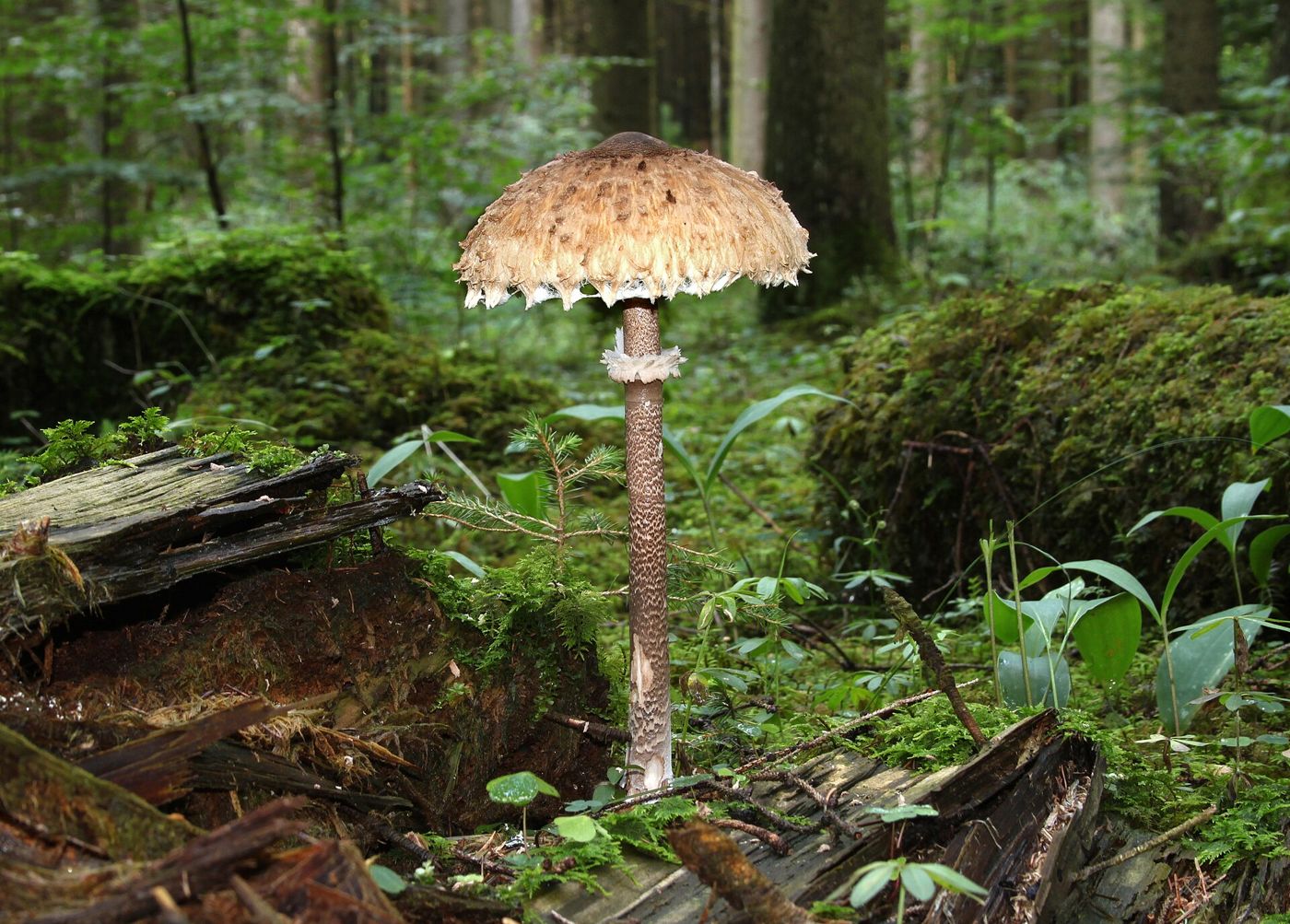
Dapperlings are small, rather elegant mushrooms in the genus Lepiota. Most have a pale cap decorated with darker scales that are often concentrated toward the center, white gills that do not touch the stem, a white spore print and a slender stem that may carry a fragile ring or ragged ring zone. They look like miniature versions of the parasol mushroom, Macrolepiota procera, and that resemblance is exactly what makes them dangerous. A number of Lepiota species contain amatoxins, the heat-stable toxins responsible for most fatal mushroom poisonings worldwide, and they have been involved in serious and sometimes fatal poisonings in Europe, North America and elsewhere.
The species of greatest concern include Lepiota brunneoincarnata, sometimes called the deadly dapperling, Lepiota subincarnata (often listed under the older name Lepiota josserandii) and Lepiota castanea, the chestnut dapperling, along with several close relatives. These typically have caps only a few centimetres across, with pinkish-brown, reddish-brown or chestnut scales on a whitish background, and some develop pinkish or brownish bands on the lower stem. Their toxicology is not fully worked out for every member of the genus, and new species are still being described, so mycologists generally treat all small Lepiota species as potentially deadly rather than trying to sort the safe from the dangerous. Even the very common stinking dapperling, Lepiota cristata, recognizable by its unpleasant rubbery or gassy smell, is regarded as poisonous.
Part of the risk comes from where dapperlings grow. Many favour disturbed, nutrient-rich ground: garden beds, compost heaps, mulched borders, park lawns, roadside verges and the edges of woodland paths. That puts them close to homes, playgrounds and places where dogs are walked, and it means they can appear in the same lawns as fairy ring champignons, field mushrooms and young parasols. Poisonings have occurred when people collected what they believed were immature parasols, or picked a mixed handful of small pale mushrooms from grass. Because amatoxin symptoms usually take many hours to appear and can be followed by a deceptive period of apparent recovery while liver damage progresses, there is often no early warning that anything is wrong.
The true parasol differs in several ways, but none of them should be treated as a shortcut to safety. A mature Macrolepiota procera is large, with a cap that can open wider than a dinner plate, a tall stem patterned with snakeskin-like bands, and a thick, double-edged ring that can usually be slid up and down the stem. Dapperlings are much smaller and more delicate, and their ring, if present, tends to be thin, cottony or fragmented. The difficulty is that young parasols are also small, and there are other parasol-like mushrooms to consider, including the green-spored parasol, Chlorophyllum molybdites, a common lawn species that causes severe gastrointestinal poisoning. Size, scale colour and ring texture overlap enough between species and growth stages that experienced foragers often follow a simple caution: they will not consider any small parasol-like mushroom at all.
It is also important to be clear about what does not work. Popular folk tests are useless for dapperlings, just as they are for death caps. A mushroom that tastes mild, smells pleasant or has been nibbled by slugs, squirrels or rabbits can still contain lethal amounts of amatoxin. Peeling the cap, testing with a silver spoon or watching whether it darkens when cooked tells you nothing about toxicity, and cooking, drying or freezing does not destroy amatoxins. Only an expert who has examined the actual specimen, ideally with a spore print and microscopic features, can confirm what a mushroom is, and even then many dapperlings are hard to name to species. Some deadly species closely resemble popular edible ones, which is why a guess is never good enough.
If you have small, scaly, parasol-like mushrooms in your garden, the practical steps are straightforward. Pick them while wearing gloves or using a bag over your hand if young children or pets use the area, put them in the household waste rather than the compost, and check again after wet spells, since new flushes appear quickly from mycelium in the soil. Teach children never to put wild mushrooms in their mouths. If anyone, person or animal, may have eaten one, do not wait for symptoms and do not try any home treatment: call poison control or emergency services immediately, or your veterinarian or an animal poison helpline for a pet, and keep a sample of the mushroom, or a photo and any remaining pieces, to help professionals assess the risk.
When you want to know what is growing in your lawn or along a woodland path, careful observation is the best place to start. Photograph the cap from above, the gills and stem underneath, and the very base of the stem after gently digging it out, along with a note of what it was growing near. Shroomly can use those photos to suggest likely species and flag toxic look-alikes such as deadly Lepiota species, green-spored parasols and death caps, helping you understand what you might be dealing with. Treat that result as a starting point for learning, never as permission to eat, and confirm any identification with a local mycological society or an experienced expert who can examine the specimen in person.